
Retatrutide is the next-generation compound in the incretin-agonist research space. Where semaglutide hits one receptor (GLP-1) and tirzepatide hits two (GLP-1 + GIP), retatrutide hits three — GLP-1, GIP, and glucagon. The triple-agonist mechanism is what’s driving the published phase 2 trial results that are pulling researcher attention: the highest-tested dose in Eli Lilly’s TRIUMPH-1 trial produced 24.2% body-weight reduction at 48 weeks, the largest weight effect ever recorded in a peptide-based clinical trial.
This guide covers what retatrutide is, the triple-agonist mechanism that separates it from tirzepatide and semaglutide, the dosing math for the standard research vials, the side-effect profile, and the reconstitution workflow. For research-use context only — retatrutide is an investigational compound in human clinical trials but is not yet an approved prescription drug.
What Is Retatrutide?
Retatrutide is a synthetic peptide that activates three incretin receptors simultaneously: GLP-1 (glucagon-like peptide-1), GIP (glucose-dependent insulinotropic polypeptide), and the glucagon receptor. The glucagon agonism is the new piece — it adds energy-expenditure effects on top of the appetite-and-glucose effects that GLP-1 and GIP agonism produce.
Research and clinical interest centers on three areas:
- Body weight reduction at magnitudes substantially greater than tirzepatide or semaglutide.
- Metabolic-syndrome research — glucagon-receptor agonism is the leg that distinguishes retatrutide from the dual-agonist class.
- NAFLD / metabolic dysfunction-associated steatotic liver disease research — early data on liver-fat reduction.
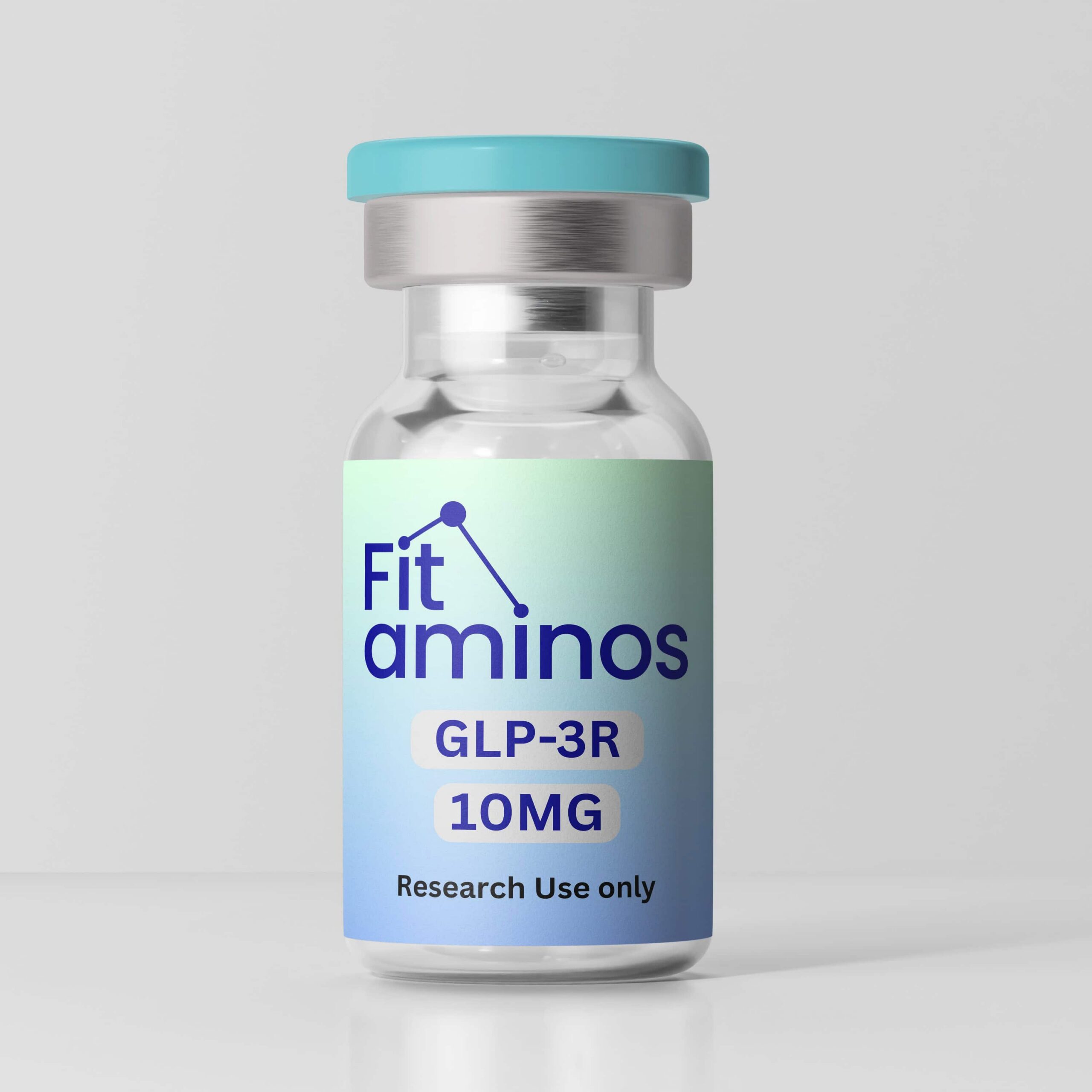
In the FitAminos research catalog, retatrutide ships as GLP-3R — a 10 mg lyophilized research vial. The “3R” naming reflects the triple-receptor mechanism.
How Retatrutide Works — Triple Agonist Mechanism
Each receptor contributes a distinct piece of the metabolic profile:
- GLP-1 receptor — appetite suppression, glucose-dependent insulin release, delayed gastric emptying. Shared with semaglutide and tirzepatide.
- GIP receptor — additional insulin-secretion enhancement and adipose-tissue signaling. Shared with tirzepatide.
- Glucagon receptor — increased energy expenditure (raises metabolic rate), and a documented signal toward hepatic-fat reduction. This is the leg that’s new in retatrutide vs the dual-agonist class.
The glucagon leg seems counter-intuitive at first — glucagon raises blood sugar, and you don’t want a diabetes drug doing that. The trick is that retatrutide’s glucagon agonism is dose-balanced against its GLP-1 insulin-secretion effect, so net blood-sugar control is preserved while the energy-expenditure benefit accrues.
Retatrutide Trial Results — What the Phase 2 Data Showed
The TRIUMPH-1 phase 2 trial (published 2023 in The New England Journal of Medicine) tested retatrutide across weekly dose groups (1, 4, 8, and 12 mg) against placebo over 48 weeks in adults with obesity. The headline result at the 12 mg dose:
| Dose Group | Body Weight Change (48 weeks) | Body Weight Reduction (%) |
|---|---|---|
| Placebo | −2.1 kg | ~2% |
| Retatrutide 1 mg | −8.7 kg | ~8.7% |
| Retatrutide 4 mg | −17.1 kg | ~17% |
| Retatrutide 8 mg | −22.8 kg | ~22.8% |
| Retatrutide 12 mg | −24.2 kg | ~24.2% |
The 24.2% weight reduction at the 12 mg dose is the largest pharmacotherapy weight-loss effect recorded in a clinical trial — exceeding the highest-dose tirzepatide result (~22.5% in SURMOUNT-3) and semaglutide (~14.9% in STEP-1). The phase 3 trial program is ongoing.
Retatrutide Dosage Chart for Research-Protocol Math
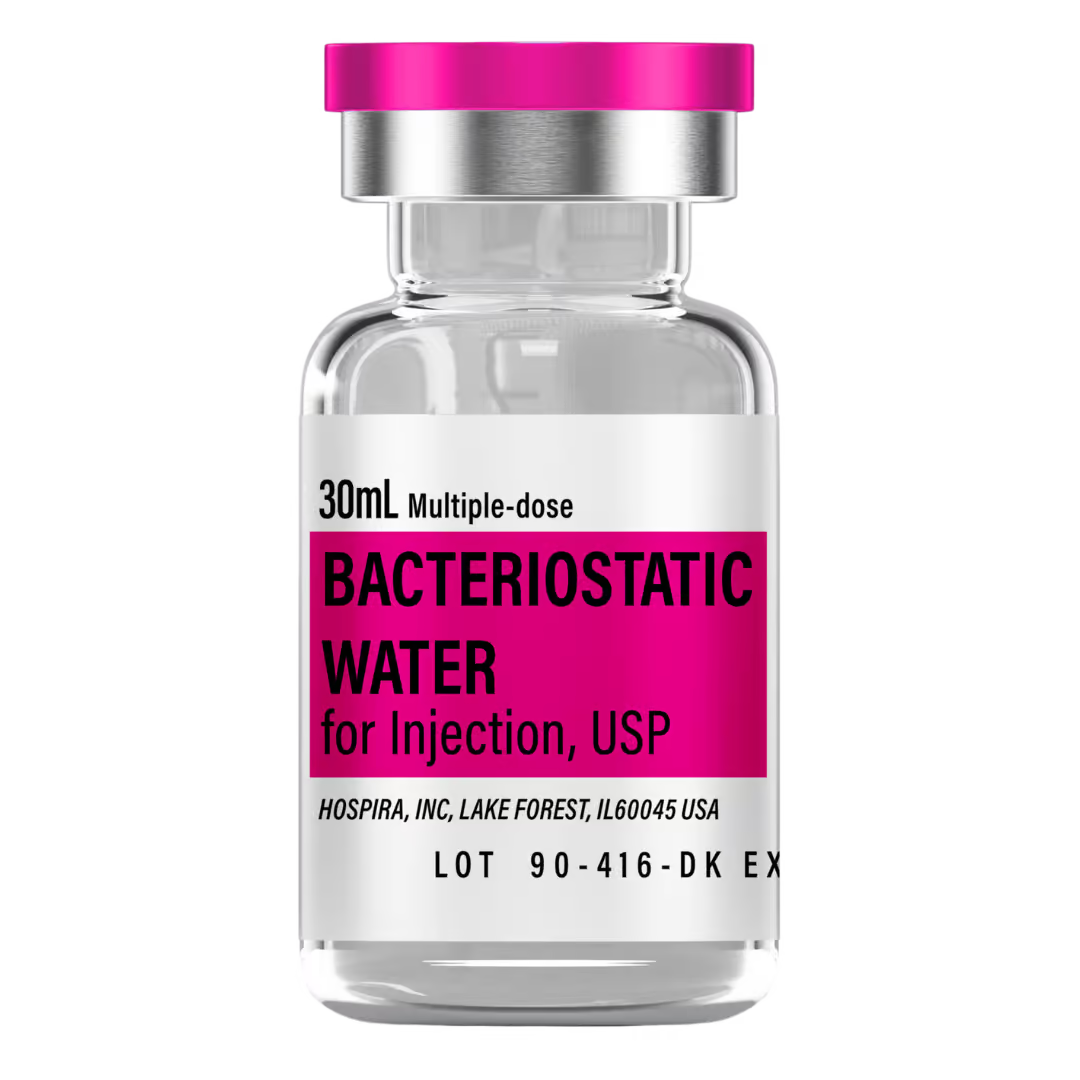
The dosing math for retatrutide follows the same pattern as any research peptide — vial size, BAC water volume, target dose. The chart below assumes the standard FitAminos GLP-3R 10 mg vial reconstituted with 2 mL of bacteriostatic water, producing a 5 mg/mL solution.
| Weekly Research Dose | mcg | mL on Syringe | U-100 Units |
|---|---|---|---|
| 1 mg (starting dose) | 1,000 mcg | 0.20 mL | 20 units |
| 2 mg | 2,000 mcg | 0.40 mL | 40 units |
| 4 mg | 4,000 mcg | 0.80 mL | 80 units |
| 6 mg | 6,000 mcg | 1.20 mL | 120 units |
| 8 mg | 8,000 mcg | 1.60 mL | 160 units |
| 12 mg (max studied) | 12,000 mcg | 2.40 mL | 240 units |
Note that the 12 mg dose at this concentration takes more than one vial per injection — you’d either reconstitute at a higher concentration (10 mg/mL by using 1 mL BAC water instead of 2 mL) or use two vials per high-dose injection. The PeptidesUnleashed peptide calculator handles either case.
Like tirzepatide, retatrutide is dosed once weekly subcutaneously in published trial protocols, with a multi-week titration ladder rather than starting at the target dose.
Retatrutide Reconstitution Step-by-Step
The reconstitution workflow is the same as any research peptide — see the full how to reconstitute peptides guide for the universal protocol. Retatrutide-specific notes:
- Gather supplies. Retatrutide vial (10 mg GLP-3R from FitAminos), bacteriostatic water, U-100 insulin syringes, alcohol pads, clean surface.
- Disinfect both stoppers with fresh alcohol pads. Air-dry 30 seconds.
- Pick the reconstitution volume. For a 10 mg vial: 1 mL BAC water = 10 mg/mL (good for higher doses, smaller syringe draw); 2 mL BAC water = 5 mg/mL (good for lower doses, easier to measure precisely).
- Draw the BAC water and inject slowly down the inside wall of the retatrutide vial. Avoid powder-cake impact.
- Swirl, don’t shake for 60–90 seconds.
- Label and refrigerate. Lot, reconstitution date, total volume, concentration. Store at 2–8 °C. Use within 28 days per most published protocols.
Retatrutide Side Effects in Research
Phase 2 trial data documents a side-effect profile in line with the GLP-1 / GIP class plus some glucagon-receptor-specific findings:
- Gastrointestinal effects. Nausea is the most common adverse event, concentrated during dose-escalation weeks. Vomiting, diarrhea, and constipation appear at meaningful rates. Severity scales with dose and titration speed.
- Decreased appetite. Expected pharmacology — large enough effects at higher doses that intentional caloric monitoring becomes important in protocol design.
- Heart rate elevation. A small but consistent average heart-rate increase has been observed across phase 2 trials, attributed partly to the glucagon-receptor leg. Magnitude is typically modest (5–10 bpm) but worth tracking in study endpoints.
- Injection-site reactions. Mild and typically resolved by site rotation.
- Transient liver enzyme elevations. Small alanine-transaminase increases have appeared in trial data; mechanistically interesting given the hepatic-fat reduction effect.
- Hypoglycemia risk in combination protocols. Retatrutide alone is generally low-hypoglycemia; combined with sulfonylureas or insulin, blood-sugar drops become a concern.
- Class warnings. Like other incretin-agonist peptides, rodent thyroid C-cell findings warrant the same class precaution carried by tirzepatide and semaglutide.
Retatrutide is investigational. It has not been approved as a prescription drug yet. The phase 2 dataset is what’s available; phase 3 safety data is the next milestone.
Retatrutide vs Tirzepatide
| Dimension | Retatrutide | Tirzepatide |
|---|---|---|
| Receptor targets | GLP-1 + GIP + glucagon (triple) | GLP-1 + GIP (dual) |
| Approval status | Investigational (phase 3 ongoing) | FDA-approved (Mounjaro, Zepbound) |
| Dosing frequency | Once weekly | Once weekly |
| Typical research dose range | 1–12 mg weekly | 2.5–15 mg weekly |
| Trial weight reduction (top dose) | −24.2% (TRIUMPH-1, 48 weeks) | −22.5% (SURMOUNT-3, 84 weeks) |
| Distinctive mechanism | Glucagon agonism → energy expenditure | GIP agonism → adipose signaling |
| FitAminos research-vial product | GLP-3R 10 mg | GLP-2T 10 mg |
The cleanest read: retatrutide produces greater weight-loss magnitudes than tirzepatide at high doses, but the safety dataset is much smaller because retatrutide is still investigational. Tirzepatide is the mature, approved compound; retatrutide is the bleeding-edge research compound.
For the tirzepatide side of the comparison, see the tirzepatide research peptide guide.
Frequently Asked Questions
What is retatrutide?
Retatrutide is a triple-agonist research peptide that activates GLP-1, GIP, and glucagon receptors simultaneously. It is investigational — currently in phase 3 clinical trials.
What is the typical retatrutide dosage?
Phase 2 trials tested 1, 4, 8, and 12 mg weekly doses with a titration ladder. Standard research protocols start at 1–2 mg weekly and step up over 16+ weeks.
How much weight loss does retatrutide produce?
TRIUMPH-1 phase 2 data showed 24.2% body weight reduction at the 12 mg weekly dose over 48 weeks — the largest pharmacological weight-loss effect recorded in a clinical trial.
How does retatrutide compare to tirzepatide?
Retatrutide adds glucagon-receptor agonism to tirzepatide’s GLP-1 + GIP mechanism. The added glucagon leg drives energy expenditure and hepatic-fat reduction. Phase 2 weight-loss magnitudes exceed tirzepatide’s by ~2 percentage points.
Is retatrutide approved as a prescription drug?
No. It is investigational. Phase 3 trials are ongoing. As of mid-2026, it is not approved by the FDA or other major regulators.
What are the most common retatrutide side effects?
Nausea, vomiting, diarrhea, constipation, decreased appetite, mild heart-rate elevation, and transient liver enzyme increases. GI effects are most concentrated during dose-escalation.
How is retatrutide reconstituted?
A 10 mg GLP-3R vial reconstituted with 2 mL bacteriostatic water = 5 mg/mL. A 4 mg dose = 0.8 mL = 80 units on a U-100 insulin syringe. See the peptide calculator for custom ratios.
Where does retatrutide ship in the FitAminos catalog?
As GLP-3R — a 10 mg lyophilized research vial. See the FitAminos peptide catalog.
Final Notes
Retatrutide is the most active area in metabolic-peptide research right now. The triple-agonist mechanism is producing weight-loss magnitudes well beyond what tirzepatide and semaglutide deliver, and the published trial dataset, while smaller than the older compounds’, is consistent. For research protocols, key levers are: titrate slowly from 1 mg, pick a reconstitution ratio that lands typical doses in a clean syringe-unit range, rotate injection sites, and track heart-rate-and-liver-enzyme endpoints alongside the standard glucose-and-weight endpoints.
For the rest of the metabolic-peptide pillar set, see the tirzepatide research peptide guide (the dual-agonist predecessor compound), the peptides for men’s weight loss and muscle support overview, and the peptide calculator for protocol math.
Disclaimer: Retatrutide is an investigational compound. This guide is for research and educational purposes only and does not constitute medical advice or recommend off-label, personal, or non-clinical administration. Not for human consumption outside a licensed clinical trial protocol.
