
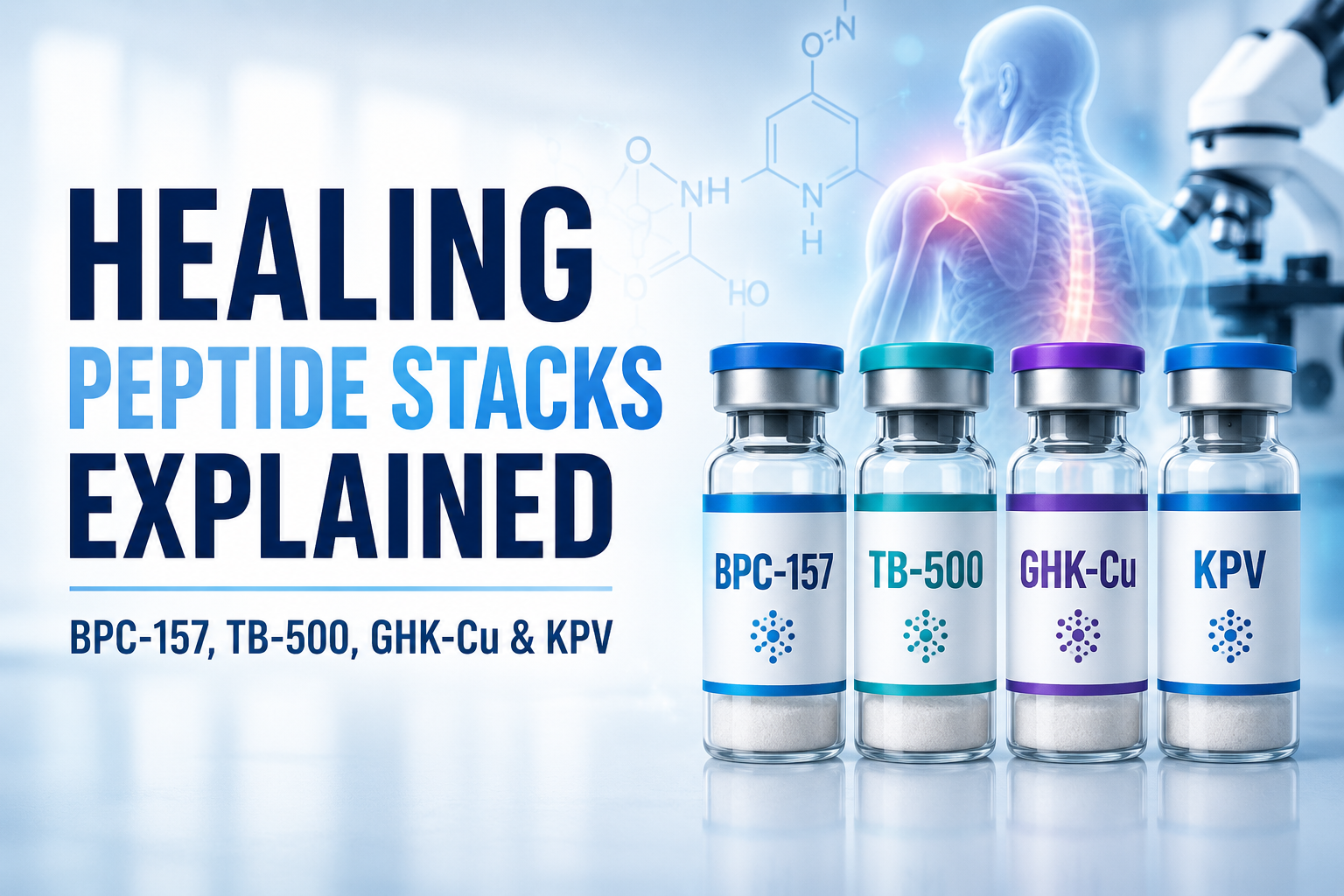
Interest in peptide research has grown rapidly over the past few years. Instead of studying individual compounds alone, many researchers now explore a healing peptide stack—a combination of peptides selected for their different biological mechanisms. The goal is to investigate whether multiple peptides targeting separate healing pathways may produce complementary effects in preclinical research.
Among the most frequently discussed combinations are BPC-157, TB-500, GHK-Cu, and KPV. Each peptide has unique characteristics that make it valuable in laboratory investigations of tissue repair, inflammation, angiogenesis, collagen production, and immune regulation.
It is important to understand that these compounds remain research chemicals in many jurisdictions. Most are not approved by the U.S. Food and Drug Administration (FDA) for treating injuries or diseases, and current evidence comes primarily from laboratory and animal studies rather than large human clinical trials.
This guide explains how a healing peptide stack works, why researchers combine these four peptides, and what current scientific evidence suggests.

What Is a Healing Peptide Stack?
A healing peptide stack refers to using multiple research peptides together instead of individually. Each peptide is selected because it influences different biological pathways involved in recovery.
Rather than performing identical functions, these peptides may complement one another by targeting:
- Tissue regeneration
- Inflammation control
- Blood vessel formation
- Collagen synthesis
- Cellular communication
- Immune regulation
Researchers study these combinations to better understand whether supporting several repair mechanisms simultaneously could improve recovery compared with studying a single peptide alone.
However, combining peptides also makes research more complicated because interactions between compounds have not been extensively studied in humans.
Understanding the Four Peptides
BPC-157
BPC-157 (Body Protection Compound-157) is a synthetic peptide derived from a naturally occurring protective protein found in gastric juice.
Research suggests BPC-157 may influence:
- Tendon healing
- Ligament repair
- Muscle recovery
- Blood vessel formation
- Gastrointestinal tissue protection
Animal studies indicate it may encourage angiogenesis while supporting fibroblast activity involved in connective tissue repair. Researchers are especially interested in its potential effects on soft tissue injuries.
Despite promising laboratory findings, robust human clinical trials remain limited.
TB-500
TB-500 is a synthetic version of a naturally occurring peptide fragment called thymosin beta-4.
Researchers study TB-500 because it appears to influence:
- Cell migration
- Tissue remodeling
- Blood vessel growth
- Muscle regeneration
- Wound healing
Unlike peptides that target one specific tissue, TB-500 may affect several organs and connective tissues by regulating actin, a protein essential for cellular movement.
This broad activity has made TB-500 one of the most widely investigated peptides in regenerative medicine research.
GHK-Cu
GHK-Cu is a naturally occurring copper peptide found in plasma, saliva, and urine.
Unlike BPC-157 and TB-500, GHK-Cu is heavily researched for its effects on:
- Collagen production
- Skin regeneration
- Hair follicle biology
- Antioxidant activity
- Extracellular matrix remodeling
Laboratory studies suggest GHK-Cu may activate genes involved in tissue remodeling while reducing oxidative stress and supporting wound repair.
Its role in collagen synthesis makes it particularly interesting within a healing peptide stack.
KPV
KPV is a short peptide consisting of only three amino acids.
Researchers primarily investigate KPV because of its possible anti-inflammatory properties.
Laboratory studies suggest it may influence:
- Cytokine regulation
- Immune signaling
- Inflammatory bowel research
- Skin inflammation
- Mucosal healing
Unlike BPC-157 or TB-500, KPV focuses less on tissue growth and more on regulating excessive inflammatory responses that can delay healing.
Why Researchers Combine These Peptides
A healing peptide stack attempts to target several biological processes simultaneously.
For example:
| Peptide | Primary Research Focus |
|---|---|
| BPC-157 | Connective tissue repair and angiogenesis |
| TB-500 | Tissue remodeling and cell migration |
| GHK-Cu | Collagen production and skin regeneration |
| KPV | Inflammation regulation |
The idea is that one peptide may support tissue rebuilding while another helps reduce inflammation and another improves collagen formation.
Whether these combined effects provide meaningful advantages remains an active area of research.
Potential Research Applications
Scientists continue investigating healing peptide stacks across several research areas.
Soft Tissue Recovery
Many studies focus on muscles, tendons, ligaments, and fascia because these tissues often heal slowly.
Researchers are exploring whether combining peptides could improve biological processes involved in tissue regeneration.
Wound Healing
GHK-Cu, TB-500, and BPC-157 have all demonstrated encouraging findings in experimental wound-healing models.
Scientists continue studying whether different mechanisms may work together during various stages of wound repair.
Inflammation Research
KPV receives significant attention because excessive inflammation may interfere with healing.
Researchers investigate whether reducing inflammatory signaling could create a more favorable environment for tissue regeneration.
Connective Tissue Remodeling
Collagen organization determines the strength of healing tissues.
Because GHK-Cu influences collagen-related genes while BPC-157 and TB-500 affect tissue remodeling, researchers continue evaluating their combined biological effects.
What Does Current Evidence Say?
Although excitement surrounding healing peptide stacks continues growing, evidence remains limited.
Current research includes:
- Cell culture studies
- Animal experiments
- Small observational reports
- Limited early-stage human investigations
Large randomized clinical trials evaluating peptide combinations remain scarce.
Many positive claims circulating online rely on anecdotal experiences rather than controlled scientific evidence.
Researchers therefore recommend interpreting current findings cautiously until more clinical data become available.
Potential Risks and Unknowns
A healing peptide stack also presents several unanswered questions.
Potential concerns include:
- Unknown long-term safety
- Limited human dosing information
- Variable product purity
- Unknown peptide interactions
- Lack of standardized treatment protocols
Because many products marketed online are sold for research purposes only, manufacturing quality may differ significantly between suppliers.
Researchers also recognize that combining several biologically active peptides may create interactions that have not yet been fully evaluated.
Research Limitations
Current peptide research has important limitations.
Many published studies involve rodents rather than humans.
Animal models often produce encouraging results that later fail to translate into clinical medicine.
Other limitations include:
- Small sample sizes
- Short follow-up periods
- Different dosing methods
- Inconsistent study designs
- Limited replication
For these reasons, scientists continue calling for larger, placebo-controlled human trials.
Future Directions
Interest in regenerative medicine continues expanding.
Future studies may explore:
- Standardized peptide combinations
- Optimal dosing strategies
- Long-term safety monitoring
- Biomarker-guided therapy
- Tissue-specific peptide protocols
Advances in molecular biology and precision medicine may also improve understanding of how different peptides interact during healing.
Conclusion
A healing peptide stack combining BPC-157, TB-500, GHK-Cu, and KPV represents one of the most actively discussed areas of regenerative medicine research. Each peptide targets different biological pathways, including tissue remodeling, collagen production, inflammation regulation, and angiogenesis.
While laboratory findings appear promising, current evidence remains preliminary. Most data come from animal studies and experimental models rather than large human clinical trials. As a result, researchers cannot yet conclude that combining these peptides produces superior outcomes in clinical settings.
Future research will determine whether healing peptide stacks can safely and effectively support tissue repair. Until stronger evidence becomes available, these compounds should be viewed as investigational research tools rather than established medical treatments.
Frequently Asked Questions
What is a healing peptide stack?
A healing peptide stack is a research combination of multiple peptides intended to investigate different biological pathways involved in tissue repair, inflammation, collagen production, and recovery.
Why are BPC-157 and TB-500 commonly paired?
Researchers believe they may target complementary mechanisms. BPC-157 is studied for connective tissue repair, while TB-500 is investigated for cell migration and tissue remodeling.
What role does GHK-Cu play?
GHK-Cu is primarily studied for stimulating collagen production, supporting wound healing, and influencing genes involved in tissue regeneration.
Why is KPV included in some peptide stacks?
KPV is investigated for its anti-inflammatory properties and its potential role in regulating immune signaling during tissue repair.
Are healing peptide stacks FDA approved?
No. These peptide combinations are generally considered investigational. They are not FDA-approved treatments for injury recovery, and more high-quality human research is needed.
References
- Goldstein, A. L., & Kleinman, H. K. (2015). Advances in the basic and clinical applications of thymosin β4. Expert Opinion on Biological Therapy, 15(S1), S139–S145.
- Pickart, L., & Margolina, A. (2018). Regenerative and protective actions of the GHK-Cu peptide in the light of the new gene data. International Journal of Molecular Sciences, 19(7), 1987.
- Sikiric, P., Seiwerth, S., Rucman, R., et al. (2018). Stable gastric pentadecapeptide BPC-157 and wound healing. Current Pharmaceutical Design, 24(18), 1992–2001.
- Catania, A., Lonati, C., Sordi, A., et al. (2010). The peptide KPV and melanocortin pathways in inflammation. Peptides, 31(4), 736–743.
- U.S. Food and Drug Administration. (2025). Human drug compounding and peptide-related guidance.
