
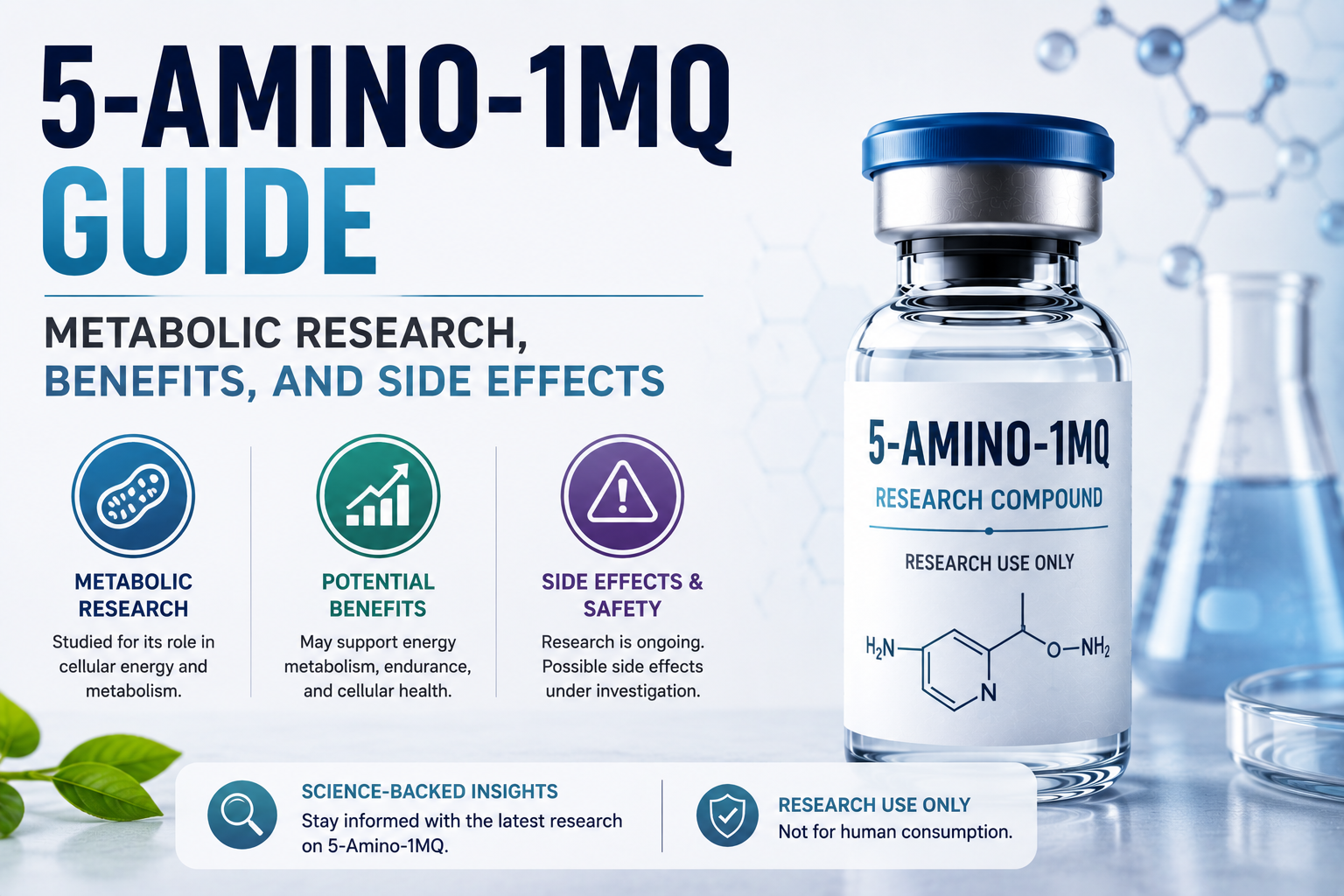
5-Amino-1MQ has attracted attention because researchers use it to inhibit an enzyme involved in nicotinamide and methyl-donor metabolism. The compound has produced metabolic findings in cells and rodents, but the evidence is predominantly preclinical. It is not a proven human weight-loss treatment, and its long-term human safety is unknown.
What Is 5-Amino-1MQ?
5-Amino-1MQ, or 5-amino-1-methylquinolinium, is an experimental small-molecule inhibitor of nicotinamide N-methyltransferase (NNMT). It belongs to a quinolinium chemical scaffold and is studied mainly in laboratory and animal metabolic research. It is not a peptide, approved medication, or clinically proven weight-loss compound.
What Does 5-Amino-1MQ Do?
5-Amino-1MQ inhibits NNMT in biochemical and cell models. Researchers have reported changes in NNMT’s product, 1-methylnicotinamide, and in metabolites linked to NAD+ and methyl-donor pathways. Rodent studies have also measured body-composition and metabolic effects, but these experiments do not establish benefits, effective exposure, or safety in humans.
What Is NNMT?
Nicotinamide N-methyltransferase is a cytosolic enzyme: it operates inside cells and transfers a methyl group from S-adenosyl-L-methionine (SAM) to nicotinamide, producing 1-methylnicotinamide and S-adenosyl-L-homocysteine. Because nicotinamide contributes to NAD+ salvage and SAM supplies methyl groups for many reactions, NNMT can influence interconnected metabolic and methylation pathways.
Established biochemical role: the reaction catalyzed by NNMT is well characterized. What is not established is that reducing this enzyme’s activity will improve health in people. NNMT expression differs among tissues and disease contexts, and an enzyme associated with a condition is not automatically a safe therapeutic target.
Interest in NNMT and adipose tissue increased after a 2014 mouse study found that genetic knockdown of Nnmt in fat and liver altered SAM and NAD+ measures, increased energy expenditure, and protected mice against several effects of a high-fat diet. This was target-validation research, not a study of 5-Amino-1MQ and not a human trial.
Human data about the target are observational. In cohorts that included people undergoing surgery, exercise, or bariatric procedures, adipose NNMT expression and plasma 1-methylnicotinamide were associated with insulin resistance and changed with interventions that improved insulin sensitivity. These associations do not show that 5-Amino-1MQ treats insulin resistance.
How Does 5-Amino-1MQ Work?
Established biochemical mechanism: medicinal-chemistry experiments identified methylquinolinium compounds as low-micromolar NNMT inhibitors. Computational docking in the original structure-activity study predicted that quinolinium analogues interact with residues in NNMT’s nicotinamide-binding site. That supports a plausible enzyme-level mechanism, but a docking model is not clinical proof.
Cell-model finding: in differentiated mouse 3T3-L1 adipocytes, 5-Amino-1MQ lowered intracellular 1-methylnicotinamide and changed NAD+, SAM, and related metabolite measures. Investigators also reported suppressed lipogenesis under their experimental conditions. These results show target engagement in a controlled model; cultured cells cannot reproduce whole-body absorption, organ distribution, metabolism, adverse effects, or disease complexity.
The proposed metabolic chain is therefore best understood as a research hypothesis: NNMT inhibition may change access to nicotinamide and methyl donors, which may affect downstream cellular pathways. Describing this as “switching off fat storage” or “boosting metabolism” would erase important steps and overstate what has been demonstrated. Readers interested in other cellular-energy research can compare this small molecule with the very different mechanisms discussed in our NAD+ research overview.
What Does 5-Amino-1MQ Research Suggest?
Cell and Biochemical Research
The 2017 structure-activity study compared multiple related compounds and established 5-Amino-1MQ as part of a selective small-molecule NNMT-inhibitor series. The 2018 follow-up tested membrane permeability, selectivity, adipocyte metabolites, lipogenesis, and cell viability. Together, these experiments support its use as a laboratory tool for probing NNMT. They do not identify a clinical indication.
Animal Body-Weight and Adiposity Findings
Animal-model finding: in a short 11-day study of diet-induced obese mice, researchers reported lower body weight relative to baseline, lower epididymal fat-pad weight, smaller adipocytes, and lower total cholesterol after systemic 5-Amino-1MQ treatment. Total food intake did not significantly differ from controls.The small groups, brief duration, obese-mouse model, and absence of human participants sharply limit interpretation.
A 2021 mouse experiment combined 5-amino-1-methylquinolinium with a switch from an obesogenic diet to a lower-calorie diet. The combination accelerated body-weight and fat loss and changed liver, adipose-tissue, and metabolomic outcomes compared with diet change alone. Because the intervention combined a compound with dietary change, not every outcome can be attributed to 5-Amino-1MQ alone.
In a 28-day study published in 2024, diet-induced obese mice receiving 5-Amino-1MQ showed dose-related limits on body-weight and fat-mass gain, improved glucose tolerance and insulin sensitivity measures, and differences in liver pathology and circulating markers. This added animal evidence, but the study still did not test weight loss or metabolic treatment in people. Several authors were current or former employees of, or affiliated with, Ridgeline Therapeutics; that disclosed interest should be considered alongside study design and replication.
Animal Pharmacokinetics
Animal-model finding: a 2021 analytical study measured 5-amino-1-methylquinolinium in rat plasma and urine after intravenous and oral administration and reported measurable systemic exposure and oral bioavailability in rats. Rat pharmacokinetics cannot establish a human dose, route, exposure target, or safety margin and should not be converted into a personal-use protocol.
Human Evidence
Human clinical evidence: not identified. Searches of PubMed and ClinicalTrials.gov for 5-Amino-1MQ and 5-amino-1-methylquinolinium, updated August 23, 2026, found no published or registered intervention trial administering the compound to human participants. Human observational research on NNMT is relevant to the target, but it is not evidence that the compound produces human weight loss or metabolic benefit.
Potential 5-Amino-1MQ Benefits in Research
“Benefits” here means potential research applications or preclinical findings—not consumer health outcomes. Evidence supports investigating:
- NNMT pathway biology: 5-Amino-1MQ can help researchers examine enzyme inhibition and target engagement.
- Adipocyte metabolism: cell experiments reported changes in 1-methylnicotinamide, NAD+, SAM, and lipogenesis-related measures.
- Body composition in rodents: multiple mouse studies reported changes in weight or fat-mass outcomes under specific experimental conditions.
- Metabolic markers in rodents: studies assessed cholesterol, glucose handling, insulin sensitivity, liver measures, and adipose metabolites.
- Experimental comparisons: the compound offers a pharmacological approach that can be compared with genetic NNMT knockdown and other inhibitors.
These areas are scientifically interesting because they connect enzyme activity with cellular-energy regulation. They should not be translated into claims that 5-Amino-1MQ burns fat, treats diabetes, or improves metabolic health in humans. For context on a genuine mitochondrial-derived peptide studied in metabolic models, see our MOTS-C research guide; MOTS-C and 5-Amino-1MQ are chemically and mechanistically distinct.
What Are the Possible 5-Amino-1MQ Side Effects?
Unknown in humans: there is no reliable human adverse-event dataset from which to determine common 5-Amino-1MQ side effects, their frequency, severity, timing, or reversibility. Lists of headaches, nausea, fatigue, or injection reactions found on commercial pages should not be presented as established compound-specific effects without controlled evidence.
Limited preclinical observations: the 2018 study reported no loss of viability in mouse preadipocytes exposed for 24 hours at concentrations up to 100 micromolar under the tested conditions. The investigators also reported no observable adverse effects during their short mouse experiment. Neither observation is a comprehensive toxicology assessment. A viable cell after 24 hours does not answer questions about chronic toxicity, organ injury, reproduction, development, genotoxicity, or effects in humans.
Theoretical pathway concern: chronic NNMT inhibition could have consequences that short experiments do not capture because the enzyme participates in nicotinamide and methyl-donor metabolism and is expressed in multiple tissues. The direction and clinical importance of any such effect remain unknown; this is an evidence gap, not a documented side effect.
What Are the Main Safety Concerns?
- No established human safety profile: controlled trials have not defined tolerated exposure or adverse-event rates.
- Unknown long-term effects: published 5-Amino-1MQ animal experiments are too short to establish chronic human safety.
- Unknown interactions: reliable studies have not established interactions with medicines, supplements, alcohol, or health conditions.
- Species translation: cell concentrations and rodent exposure cannot be converted directly into human use.
- Material uncertainty: online products may differ by salt form, identity, purity, strength, stability, contamination, and labeling accuracy.
- No validated consumer standard: there is no FDA-approved label or evidence-based consumer dosing standard for 5-Amino-1MQ.
These limitations are reasons to avoid personal-use recommendations, not instructions for making experimentation safer.
Has 5-Amino-1MQ Been Studied in Humans?
No human intervention trials were identified in the searches described above. Some research involving human tissues or human-derived cells may mention NNMT or use 5-Amino-1MQ in a dish, but that is still laboratory research. It cannot determine absorption, effectiveness, side effects, or long-term outcomes when the compound is administered to a person.
The human NNMT study cited earlier measured associations between the enzyme pathway and insulin resistance.5 Participants were not treated with 5-Amino-1MQ. This distinction prevents target-level observations from being misrepresented as clinical evidence for the compound.
Is 5-Amino-1MQ FDA-Approved?
No. 5-Amino-1MQ is not an FDA-approved weight-loss medication. An FDA warning letter issued in January 2026 identified 5-amino-1-methylquinolinium iodide as a bulk substance used by an outsourcing facility and stated that products compounded with it were not eligible for section 503B exemptions because the substance was not on the 503B bulks list and was not used for a drug on the shortage list. Online sale does not confer regulatory approval, and “research use” is not equivalent to authorization to treat a disease.
What Researchers Should Consider
Well-designed work should establish the compound’s full identity, including counterion or salt form; independently verify purity and concentration with suitable analytical methods; document storage and stability; select a model that can answer the stated question; and use vehicle, positive, and negative controls where appropriate. Concentrations should be justified experimentally rather than borrowed from consumer claims.
Protocols should define target-engagement, efficacy, and toxicity endpoints separately, report null and adverse findings, and operate under applicable institutional, biosafety, and animal- or human-research oversight. A supplier certificate is useful documentation but is not a substitute for independent identity, purity, sterility, or endotoxin testing where those attributes matter.
Readers comparing research materials may consult 5-Amino-1MQ product information. That commercial page is not scientific evidence and is not used to support any claim in this guide.
Frequently Asked Questions
What is 5-Amino-1MQ?
5-Amino-1MQ is an experimental small molecule also called 5-amino-1-methylquinolinium. Researchers study it as an inhibitor of NNMT, an enzyme involved in nicotinamide and methyl-donor metabolism. Its published metabolic evidence comes mainly from biochemical, cell, mouse, and rat research—not controlled human treatment trials.
Is 5-Amino-1MQ a peptide?
No. 5-Amino-1MQ is a quinolinium small molecule, not a chain of amino acids and therefore not a peptide. Its presence on websites that also discuss peptides does not change its chemical classification.
How does 5-Amino-1MQ inhibit NNMT?
It inhibits NNMT at the enzyme level, and medicinal-chemistry modeling predicts interactions within the enzyme’s nicotinamide-binding region. Cell studies also found lower levels of NNMT’s product, 1-methylnicotinamide, after exposure. The clinical relevance of this mechanism remains unknown.
Does 5-Amino-1MQ cause weight loss?
It has affected body weight or fat-mass measures in diet-induced obese mice under controlled experimental conditions. That does not prove weight loss in humans. No controlled human intervention trial was identified to establish efficacy.
What are the possible side effects of 5-Amino-1MQ?
They are not reliably known in humans. Short cell and animal studies did not provide the type, duration, or scale of evidence needed to identify common adverse effects. Long-term toxicity, interactions, reproductive effects, organ-specific risks, and consequences of sustained NNMT inhibition remain insufficiently studied.
Is 5-Amino-1MQ FDA-approved?
No. 5-Amino-1MQ is not FDA-approved as a weight-loss drug or metabolic treatment. The FDA has also addressed 5-amino-1-methylquinolinium iodide in a compounding warning letter, explaining that it was not eligible for the cited section 503B exemptions.
Conclusion
5-Amino-1MQ is a small-molecule NNMT inhibitor, not a peptide. Biochemical and cell work supports its use as a research tool, and rodent studies suggest that NNMT inhibition can affect adiposity, body composition, glucose-related measures, liver findings, and metabolic pathways under specific experimental conditions.
Those preclinical findings do not establish human benefits. No human intervention trials were identified, the compound is not an FDA-approved weight-loss medication, and a dependable human side-effect profile does not exist. Controlled, independently replicated research is needed to determine whether the mechanism translates to people and whether any exposure can be both effective and acceptably safe.
References
- National Center for Biotechnology Information. “5-Amino-1-methylquinolinium.” PubChem Compound Summary for CID 950107. Updated database record. Direct record.
- Neelakantan H, Wang H-Y, Vance V, Hommel JD, McHardy SF, Watowich SJ. “Structure-Activity Relationship for Small Molecule Inhibitors of Nicotinamide N-Methyltransferase.” Journal of Medicinal Chemistry. 2017;60(12):5015–5028. doi:10.1021/acs.jmedchem.7b00389. PMID: 28548833.
- Kraus D, Yang Q, Kong D, et al. “Nicotinamide N-methyltransferase knockdown protects against diet-induced obesity.” Nature. 2014;508(7495):258–262. doi:10.1038/nature13198. PMCID: PMC4107212.
- Neelakantan H, Vance V, Wetzel MD, et al. “Selective and membrane-permeable small molecule inhibitors of nicotinamide N-methyltransferase reverse high fat diet-induced obesity in mice.” Biochemical Pharmacology. 2018;147:141–152. doi:10.1016/j.bcp.2017.11.007. PMID: 29155147.
- Kannt A, Pfenninger A, Teichert L, et al. “Association of nicotinamide-N-methyltransferase mRNA expression in human adipose tissue and the plasma concentration of its product, 1-methylnicotinamide, with insulin resistance.” Diabetologia. 2015;58(4):799–808. doi:10.1007/s00125-014-3490-7. PMID: 25596852.
- Sampson CM, Dimet AL, Neelakantan H, et al. “Combined nicotinamide N-methyltransferase inhibition and reduced-calorie diet normalizes body composition and enhances metabolic benefits in obese mice.” Scientific Reports. 2021;11(1):5637. doi:10.1038/s41598-021-85051-6. PMID: 33707534.
- Awosemo O, Neelakantan H, Watowich S, et al. “Development & validation of LC-MS/MS assay for 5-amino-1-methyl quinolinium in rat plasma: Application to pharmacokinetic and oral bioavailability studies.” Journal of Pharmaceutical and Biomedical Analysis. 2021;204:114255. doi:10.1016/j.jpba.2021.114255. PMID: 34304009.
