
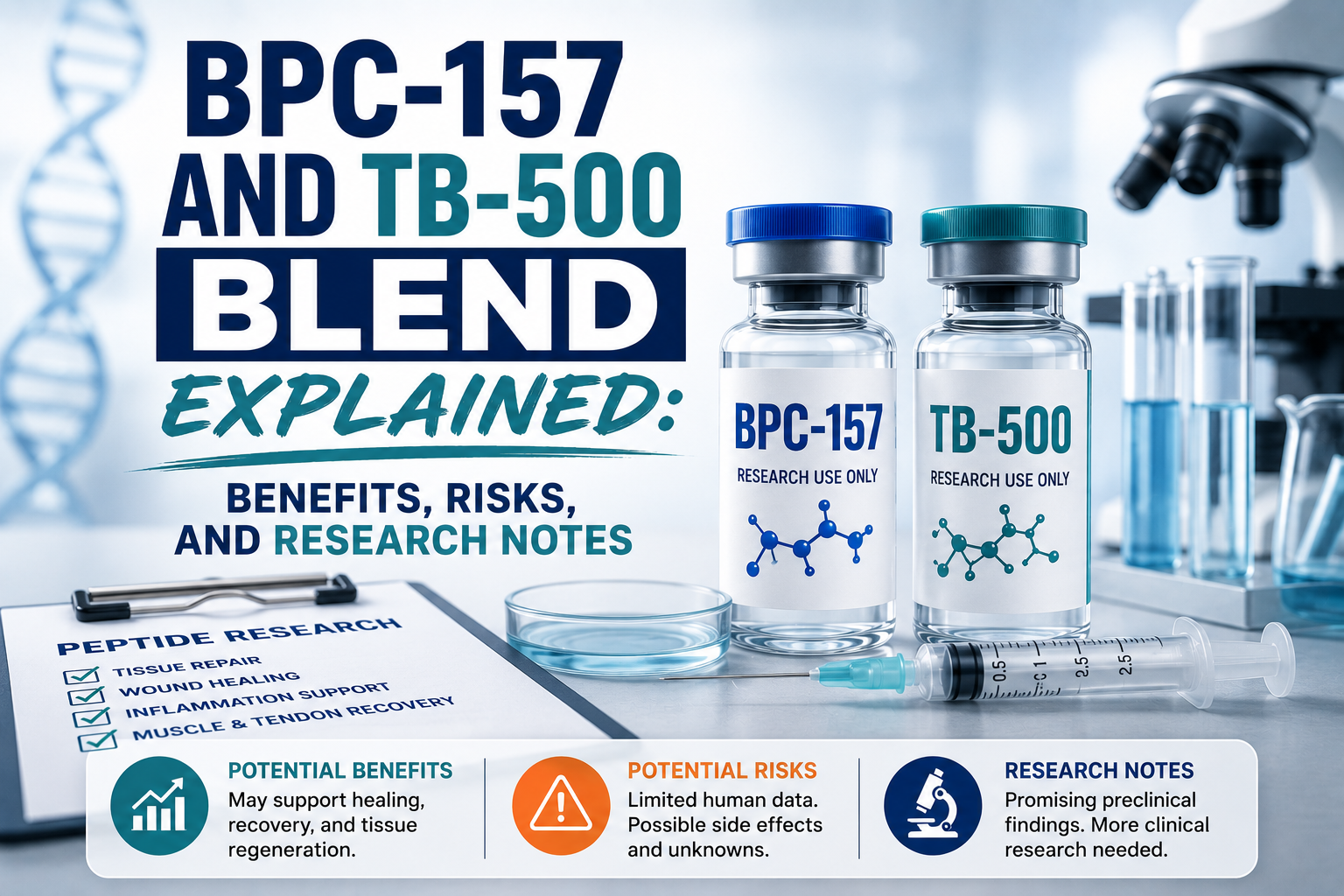
The BPC-157 TB-500 blend has become one of the most discussed peptide combinations in regenerative medicine research. Many researchers study these peptides together because they may support different biological pathways involved in tissue repair and recovery. However, it is important to understand that neither peptide is approved by the U.S. Food and Drug Administration (FDA) for treating injuries in humans, and evidence from high-quality clinical trials remains limited.
This guide explains what the BPC-157 TB-500 blend is, how researchers believe it works, the current evidence, potential risks, and important considerations for anyone following peptide research.
What Is the BPC-157 TB-500 Blend?
- BPC-157 (Body Protection Compound-157): A synthetic peptide derived from a protein naturally found in gastric juice. It has primarily been studied in animal models for tendon, ligament, muscle, nerve, and gastrointestinal healing.
- TB-500: A synthetic peptide fragment based on thymosin beta-4, a naturally occurring protein involved in cell migration, tissue repair, and blood vessel formation.
Researchers often investigate these peptides together because they may influence different aspects of the healing process rather than performing identical functions.

Why Are BPC-157 and TB-500 Studied Together?
Although research is still developing, scientists have proposed that combining these peptides could produce complementary effects.
BPC-157 Research Focus
Most published studies investigate BPC-157 for:
- Tendon healing
- Ligament repair
- Muscle injuries
- Nerve regeneration
- Gastrointestinal protection
- Reduced inflammation in animal models
BPC-157 appears to influence growth factor signaling, collagen formation, and blood vessel development during tissue repair.
TB-500 Research Focus
TB-500 research has examined its possible role in:
- Cell migration
- Angiogenesis (new blood vessel formation)
- Muscle recovery
- Wound healing
- Reduced scar formation
- Tissue remodeling
Because these mechanisms differ somewhat from BPC-157, researchers sometimes explore whether using both peptides together may support multiple stages of healing.
How the BPC-157 TB-500 Blend May Work
Although no definitive mechanism has been confirmed in humans, laboratory research suggests several possible biological actions.
H3: Supporting Angiogenesis
Healthy tissue repair depends on an adequate blood supply. Both peptides have been associated with increased angiogenesis in experimental studies, potentially helping deliver oxygen and nutrients to injured tissues.
H3: Encouraging Cell Migration
TB-500 may help cells involved in wound repair move efficiently to damaged areas. This process is important during early healing.
H3: Promoting Collagen Organization
Animal studies suggest BPC-157 may improve collagen formation, which is essential for tendon and ligament strength.
H3: Modulating Inflammation
Both peptides have shown anti-inflammatory effects in laboratory and animal research. Controlled inflammation is necessary for healing, while excessive inflammation may delay recovery.
Potential Research Benefits of the BPC-157 TB-500 Blend
Current evidence is largely preclinical. Reported research findings include:
Faster Soft Tissue Recovery
Animal studies have demonstrated accelerated healing of:
- Tendons
- Ligaments
- Muscles
- Skin wounds
Researchers continue investigating whether combining both peptides offers additional benefits compared with either peptide alone.
Improved Tendon and Ligament Healing
One reason the BPC-157 TB-500 blend attracts attention is its potential application in tendon injuries.
Experimental research has shown:
| Research Area | BPC-157 | TB-500 |
|---|---|---|
| Tendon healing | Strong animal evidence | Moderate evidence |
| Ligament repair | Positive animal studies | Limited research |
| Muscle recovery | Moderate evidence | Strong experimental interest |
| Angiogenesis | Yes | Yes |
| Human clinical trials | Very limited | Very limited |
Muscle Recovery
Several laboratory studies suggest TB-500 may improve muscle regeneration after injury, while BPC-157 may reduce inflammation surrounding damaged tissue.
Wound Healing
Researchers have observed improved wound closure and tissue remodeling in animal studies involving both peptides.
Gastrointestinal Protection
Unlike TB-500, BPC-157 has been extensively studied for gastrointestinal protection in experimental models, including ulcers and inflammatory bowel conditions.
What Does the Human Research Show?
This is where expectations should remain realistic.
Despite widespread discussion online, high-quality human clinical trials are limited.
Most available evidence comes from:
- Animal research
- Laboratory studies
- Case reports
- Mechanistic research
Currently, there is insufficient clinical evidence to conclude that the BPC-157 TB-500 blend safely or effectively treats sports injuries, chronic pain, arthritis, or other medical conditions in humans.
More randomized controlled trials are needed before clinical recommendations can be made.
Potential Risks of the BPC-157 TB-500 Blend
Because these peptides remain experimental, their long-term safety profile is unknown.
Potential concerns include:
Unknown Long-Term Effects
No long-term human safety studies currently exist.
Product Quality
Many peptide products sold online are marketed for “research use only.” Independent testing has found that some products may contain:
- Incorrect peptide concentrations
- Impurities
- Contaminants
- Different compounds than listed
Limited Regulatory Oversight
Neither BPC-157 nor TB-500 is FDA-approved for treating injuries or enhancing athletic recovery.
Possible Side Effects
Limited human reports have described:
- Injection site irritation
- Headache
- Fatigue
- Nausea
- Dizziness
However, reliable safety data remain scarce.
Are Athletes Allowed to Use the BPC-157 TB-500 Blend?
Competitive athletes should exercise caution.
BPC-157 is listed on the World Anti-Doping Agency (WADA) Prohibited List under the S0 category (non-approved substances). Athletes subject to anti-doping regulations could face sanctions if these substances are detected.
Current Research Limitations
Several important limitations affect the current evidence.
Most Studies Are Animal-Based
Rodent studies cannot always predict human outcomes.
Small Sample Sizes
Human evidence is limited and often lacks rigorous study design.
Lack of Standardized Dosing
Research protocols vary significantly, making comparisons difficult.
Few Combination Studies
Although the BPC-157 TB-500 blend is popular within research communities, relatively few published studies specifically investigate both peptides together.
Who Should Avoid Experimental Peptides?
Because safety has not been established, experimental peptides should generally be avoided by:
- Pregnant individuals
- Breastfeeding individuals
- Children
- Individuals with active cancers
- People with serious chronic illnesses unless participating in approved clinical research
Always consult a qualified healthcare professional regarding any medical condition or treatment decisions.
Frequently Asked Questions
Is the BPC-157 TB-500 blend FDA approved?
No. Neither BPC-157 nor TB-500 is FDA-approved for treating injuries or medical conditions.
Does the blend work better than using one peptide?
Current research has not established that combining both peptides produces superior outcomes in humans.
Is there evidence in humans?
Only limited human data are available. Most published evidence comes from laboratory and animal research.
Can these peptides improve sports injuries?
Some animal studies show promising findings, but clinical evidence in humans remains insufficient to recommend their use for injury treatment.
Is the BPC-157 TB-500 blend legal?
Legality varies by country and intended use. Researchers should always review local regulations before purchasing or studying experimental peptides.
Final Thoughts
The BPC-157 TB-500 blend continues to generate significant interest because laboratory and animal research suggests it may influence several biological pathways involved in tissue repair, inflammation, angiogenesis, and regeneration. However, enthusiasm should be balanced with scientific caution.
At present, the strongest evidence comes from preclinical studies rather than well-designed human clinical trials. While early findings are promising, important questions remain regarding effectiveness, optimal dosing, long-term safety, and potential adverse effects.
Researchers and readers should interpret current findings carefully and rely on peer-reviewed scientific evidence rather than anecdotal reports or marketing claims.
References
- Goldstein, A. L., & Kleinman, H. K. (2015). Advances in the basic and clinical applications of thymosin β4. Expert Opinion on Biological Therapy, 15(S1), S139–S145. https://doi.org/10.1517/14712598.2015.1014792
- Sikiric, P., Seiwerth, S., Rucman, R., et al. (2018). Stable gastric pentadecapeptide BPC 157 and wound healing. Current Pharmaceutical Design, 24(18), 1998–2010. https://doi.org/10.2174/1381612824666180608072736
- World Anti-Doping Agency. (2026). Prohibited List. https://www.wada-ama.org/en/prohibited-list
- U.S. Food and Drug Administration. Human Drug Compounding Resources. https://www.fda.gov/drugs/human-drug-compounding
- National Center for Biotechnology Information (NCBI). https://www.ncbi.nlm.nih.gov/
- PubMed Database. https://pubmed.ncbi.nlm.nih.gov/
