
A lyophilized peptide is one that has been freeze-dried into a solid so that it will keep. The water is removed under vacuum at low temperature, leaving the peptide behind as a powder, a thin film or a small solid puck. Before relying on any supplier document, it is worth knowing what a certificate of analysis actually shows.
The most common question about them is not really about the process. It is why the vial looks empty, and that has an answer you can check with arithmetic.
What Is a Lyophilized Peptide, Exactly?
It is a peptide with the water taken out, stored as a solid until you put the water back.
Lyophilization is freeze-drying. The peptide is frozen, then held under vacuum so the ice turns directly to vapour without passing through a liquid stage, and the vapour is drawn off. What is left is the peptide and whatever else was in the solution, minus the water.
The reason to do this is stability. Water is what drives the chemical breakdown of a peptide, so removing it is the single most effective way to make the material keep.
- Before: solid, dry, stable for years frozen
- After you add water: in solution, stable for days to weeks refrigerated
Why Does My Peptide Vial Look Almost Empty?
Because it very nearly is, and that is normal. Ten milligrams of freeze-dried peptide is a smaller physical quantity than most people expect.
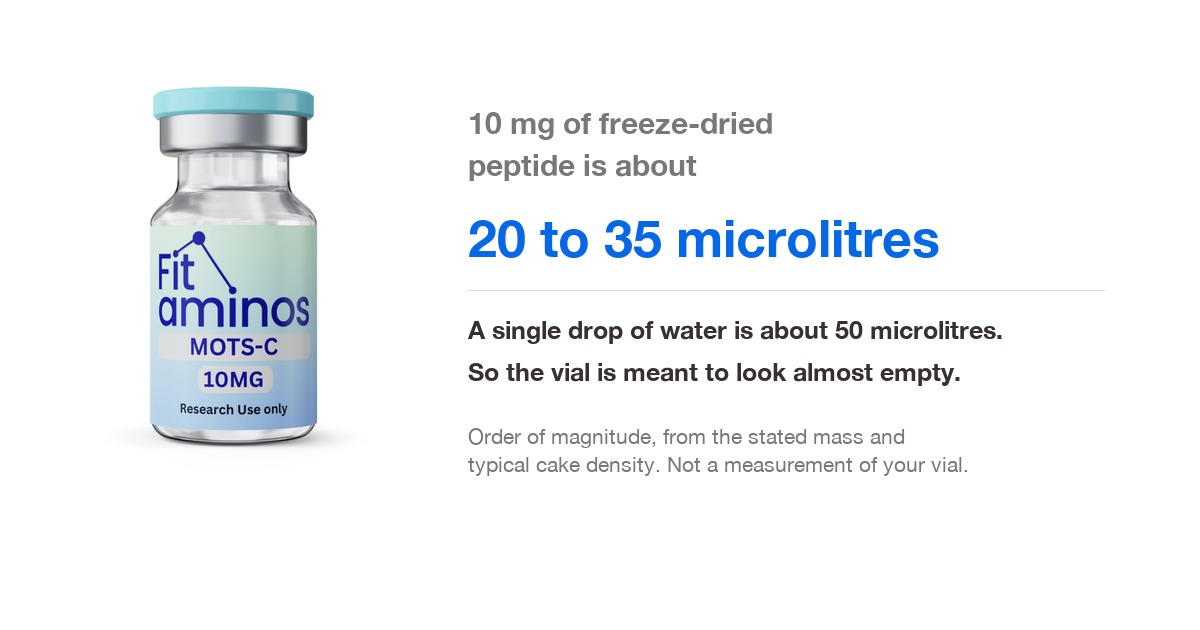
Here is the arithmetic. Ten milligrams is one hundredth of a gram. A lyophilized cake is not dense, so depending on how it formed, that ten milligrams occupies somewhere in the region of twenty to thirty-five microlitres of space.
A single drop of water is about fifty microlitres. So a 10 mg vial contains less solid material than one drop, spread across the bottom of a glass vial that holds several millilitres.
At that scale it will not look like a meaningful amount of anything. It commonly looks like a faint dusting, a translucent film on the glass, a few flakes, or nothing at all until you tilt the vial against the light.
This is worth stating plainly because the alternative explanation people reach for is that they have been sold an empty vial. The physical appearance of a correctly filled 10 mg vial and an actually empty one are genuinely hard to tell apart by eye, which is an uncomfortable fact rather than a reassuring one, and it is why the weight is printed on the label rather than left to inspection.
A 5 mg vial is half that again. The smaller the quantity, the more likely the vial looks untouched.
There is a related surprise waiting at the other end of the process. Because the solid takes up so little room, adding two millilitres of water to a 10 mg vial gives you very close to two millilitres of solution.
Why Are Peptides Freeze-Dried in the First Place?
Because water is what breaks them, and freeze-drying is the most effective way to take it away without cooking the molecule.
A peptide is a chain of amino acids joined by peptide bonds, and those bonds are vulnerable to hydrolysis, which is the reaction where water splits them. In solution that process runs continuously. Remove the water and it effectively stops.
Ordinary drying with heat would work for some materials and not for this one, because heat causes its own damage. Freeze-drying gets the water out at low temperature by going around the liquid phase entirely, which is why it is the standard method for peptides, proteins, vaccines and similar fragile materials.
It also explains why the material arrives dry rather than pre-mixed. Shipping a solution would mean shipping the clock along with it, and the product would be partway through its useful life before it reached anyone.
GenScript’s handling guidance puts the practical difference plainly: lyophilized peptides stored at -20°C are “stable for several years”, while peptide solutions have a shelf life the company describes as very limited by comparison.
How Does Freeze-Drying Actually Work?
Three stages, and the middle one is where the name comes from.
Freezing. The peptide solution is frozen solid. Primary drying. Under vacuum, the ice sublimes, turning straight from solid to vapour without melting, and the vapour is pumped away. Secondary drying. Residual water still bound to the material is driven off, leaving a very low final moisture content.
What remains is the solid you find in the vial, along with any excipients that were in the original solution to help the cake form and hold its shape.
The vacuum is the part that makes it work. At low enough pressure ice can pass straight to vapour, so the material never has to be liquid and never has to be warmed.
What the Powder Can Look Like in the Vial
It varies more than people expect, and the appearance depends on how the freeze-drying cycle ran rather than on the amount you were sold.
Common appearances include an intact cake sitting at the bottom, a cake that has pulled away from the glass at the edges, a thin translucent film coating the base, loose flakes, or a small amount of material that has slid to one side. Any of those can come out of a normal process.
We are going to be careful here rather than reassuring. We are not in a position to tell you that a particular appearance is fine, because assessing whether lyophilized material is intact is a laboratory question and not something that can be settled by looking at it through glass. Cake appearance is a recognised quality attribute in pharmaceutical manufacturing, and it is assessed against specifications with instruments rather than by eye.
What we can say usefully is which observations are worth acting on.
Worth querying with the supplier: discolouration compared with what the product should look like, material that has visibly gone sticky or wet, or a vial where the seal or stopper looks compromised. Those are observations about the container and the material’s condition rather than about the shape of the cake.
Not by itself a problem: a film rather than a puck, a cake that has shrunk from the sides, or a quantity that looks smaller than you expected. The arithmetic in the section above covers the last one.
Once water is in, you cannot go back and you cannot return it.
That asymmetry is the reason to look before you mix rather than after. It costs a minute and it is the only point in the process where a question is still cheap to ask.
Is Lyophilized the Same Thing as Powder?
Not quite, though the words get used interchangeably and it rarely matters in practice.
Lyophilized describes how the solid was produced, which is freeze-drying. Powder describes what it physically is. A lyophilized peptide is usually a powder or a cake, but a powder could in principle have been made another way, such as by precipitation or spray-drying.
Where the distinction does matter is in what you can infer. Lyophilized tells you something about how the material was handled and therefore why it should keep. Powder on its own tells you only that it is dry.
If a listing says only powder and you want to know whether it was freeze-dried, that is a reasonable question to put to the supplier rather than something to assume either way.
Frequently Asked Questions About Lyophilized Peptides
Is my vial empty or is that normal?
Almost certainly normal. Ten milligrams of freeze-dried peptide occupies roughly twenty to thirty-five microlitres, which is less than a single drop of water spread across the base of the vial. A correctly filled small vial often looks like a faint film or nothing at all.
Does lyophilized mean the same as freeze-dried?
Yes. Lyophilization is the technical term for freeze-drying, and the two are used interchangeably on labels and in product descriptions.
How long do lyophilized peptides last?
Years, if kept properly. GenScript’s guidance specifies storage at -20°C away from bright light, under which most lyophilized peptides remain stable for several years. That figure applies to the sealed dry material. Once water is added the picture changes completely, and the useful window drops to days or weeks refrigerated depending on the sequence. The dry form is where the shelf life lives, which is the whole reason the material is supplied this way rather than pre-mixed.
Should I worry if the powder is a film rather than a solid cake?
That variation comes from how the freeze-drying cycle ran and is common. Assessing lyophilized material properly is a laboratory question rather than something to judge through glass, so we will not tell you a given appearance is fine. What is worth querying with the supplier is discolouration, material that looks wet or sticky, or a stopper or seal that looks compromised. Photograph it before opening if you are unsure, because you cannot return a vial once you have added water.
About the author
This article was written by Dr. Bradley Thomas, MD, orthopedic surgeon and sports medicine specialist, for Peptides Unleashed. Dr. Thomas is double board-certified by the American Board of Orthopaedic Surgery in both Orthopaedic Surgery and Orthopaedic Sports Medicine, and specializes in sports medicine, joint preservation and regenerative therapies.
He earned his medical degree at the Keck School of Medicine at the University of Southern California, completed his residency at Montefiore Medical Center and Albert Einstein College of Medicine, and a fellowship at the Southern California Center for Sports Medicine. He has over 24 years of surgical experience and more than 14,000 procedures performed. He is a Master Instructor with the Arthroscopy Association of North America, a Fellow of the American Academy of Orthopaedic Surgeons, the California Orthopaedic Association and the American Orthopaedic Society for Sports Medicine, and a co-founder of Beach Cities Orthopedics.
Peptides Unleashed is not a medical practice and does not prescribe, diagnose or recommend treatment. The volume figures on this page are our own calculation from the stated mass and typical lyophilized cake density, and are given as an order of magnitude rather than a measurement of your vial.
More about Dr. Bradley Thomas and how we source and check our information
