Before the clock starts
Frequently Asked Questions About Peptide Storage
Do lyophilized peptides need to be refrigerated?
They should be frozen rather than refrigerated. GenScript’s guidance specifies -20°C, away from bright light, where most lyophilized peptides stay stable for several years. A fridge is better than a warm cupboard but it is not the reference condition. Before relying on any supplier document, it is worth knowing what a certificate of analysis actually shows.
Should I let a frozen vial warm up before opening it?
Yes. Opening a cold vial lets warm room air condense inside it, and moisture is exactly what freeze-drying removed. Let it reach room temperature first so the condensation forms on the outside of the glass.
Is it bad to freeze and thaw a peptide repeatedly?
Yes. GenScript states that peptides undergoing freeze-thaw cycles are susceptible to degradation, and the recommended practice where freezing is necessary is to divide the solution into single-use aliquots first, which reduces both the cycling and the air exposure.
About the author
This article was written by Dr. Bradley Thomas, MD, orthopedic surgeon and sports medicine specialist, for Peptides Unleashed. Dr. Thomas is double board-certified by the American Board of Orthopaedic Surgery in both Orthopaedic Surgery and Orthopaedic Sports Medicine, and specializes in sports medicine, joint preservation and regenerative therapies.
He earned his medical degree at the Keck School of Medicine at the University of Southern California, completed his residency at Montefiore Medical Center and Albert Einstein College of Medicine, and a fellowship at the Southern California Center for Sports Medicine. He has over 24 years of surgical experience and more than 14,000 procedures performed. He is a Master Instructor with the Arthroscopy Association of North America, a Fellow of the American Academy of Orthopaedic Surgeons, the California Orthopaedic Association and the American Orthopaedic Society for Sports Medicine, and a co-founder of Beach Cities Orthopedics.
Peptides Unleashed is not a medical practice and does not prescribe, diagnose or recommend treatment. The storage and residue-stability statements on this page are quoted from GenScript’s published peptide handling guidance, read on 26 August 2026.
More about Dr. Bradley Thomas and how we source and check our information
Yes, but not all in the same way, and not all in the fridge.
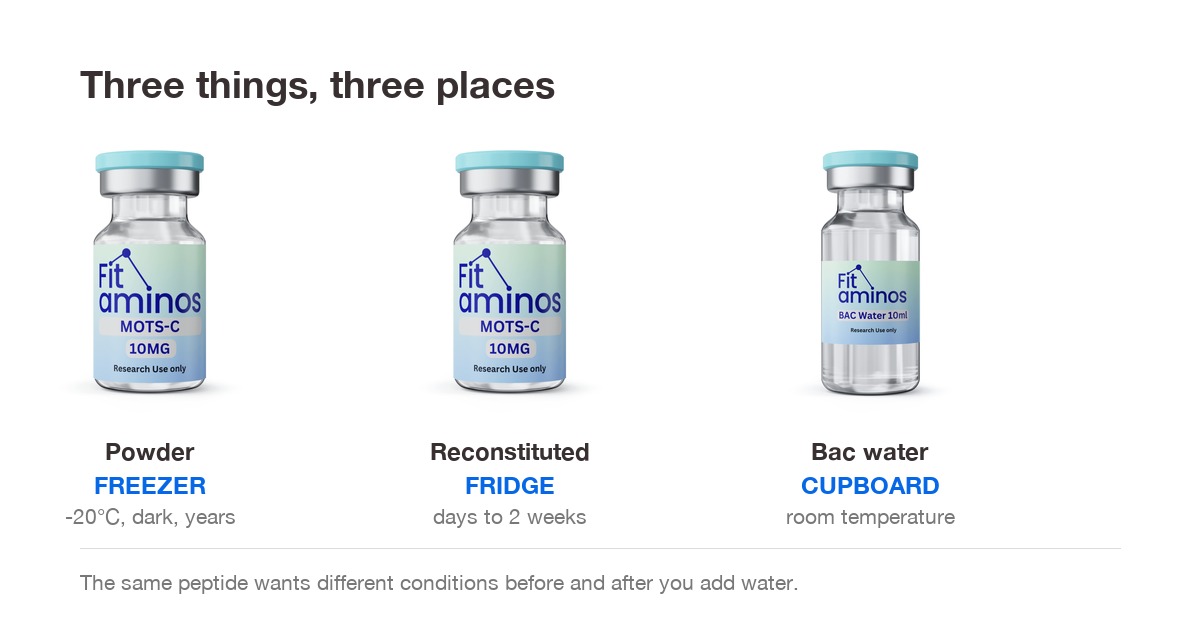
The short version: powder goes in the freezer, solution goes in the fridge, and the diluent stays in the cupboard. This page covers why, how long each one lasts, and which peptides are more fragile than others.
Do Peptides Need to Be Kept in the Fridge?
Lyophilized powder should be frozen rather than refrigerated. Those are two different answers for the same peptide at two different stages.
GenScript’s peptide storage guidance states that “lyophilized peptides should be stored at -20℃, away from bright light” and that “most lyophilized peptides are stable for several years under these conditions.”
Once water goes in, that changes completely. Solutions are far less stable than powder, which is the single most useful thing to know about peptide storage.
- Lyophilized powder: freezer at -20°C, dark, years
How Should You Store Lyophilized Powder?
Cold, dark and dry, in that order of importance.
Cold. The reference condition is -20°C, an ordinary domestic freezer. Colder is better for long storage and some labs use -80°C, but -20°C is the practical target and it is what the manufacturer guidance specifies.
Dark. “Away from bright light” is part of the same instruction. Light drives photodegradation, and a clear glass vial offers no protection. The freezer solves this incidentally by being dark, which is convenient rather than a reason to be careless with a vial left out on a bench.
Dry. This is the one people miss. Several amino acid residues are hygroscopic, meaning they pull moisture out of the air, and moisture is what starts the reaction that freeze-drying was performed to prevent. GenScript lists aspartate, glutamate, lysine, arginine and histidine as the moisture-absorbing residues, and recommends desiccator storage where those are present.
There is a practical consequence that catches people out. Taking a frozen vial straight out and opening it lets warm room air condense inside the cold vial. Let a vial reach room temperature before you open it, and the condensation happens on the outside of the glass instead of on your powder.
Air matters as well as water. Cysteine, methionine and tryptophan are the oxidation-prone residues, and the same guidance recommends anaerobic storage where those are present. In practice that means not leaving a vial open longer than the moment you need it.
A domestic freezer is a reasonable approximation of the reference condition, with two caveats worth knowing. The door shelf is the warmest part and cycles in temperature every time the freezer is opened, so the back of a drawer is better. And a frost-free freezer works by periodically warming slightly to prevent ice building up, which means the contents see small repeated temperature swings rather than a flat -20°C.
Neither of those is a reason to store powder somewhere warmer. They are reasons to put it at the back rather than the front, and to not treat a domestic freezer as identical to a laboratory one.
What Actually Degrades a Peptide
Four mechanisms, and each one maps to a specific storage decision. This is worth understanding because it turns storage from a list of rules into something you can reason about for a vial nobody has written instructions for.
Hydrolysis. Water breaking the peptide bond. This is the reason lyophilization exists and the reason powder outlasts solution by years rather than days. It is also why the mixing date is the date that counts.
Oxidation. Air attacking specific residues. GenScript names cysteine, methionine and tryptophan as the oxidation-prone ones. If your compound contains those, air exposure matters more than it does for something that does not, and the storage answer is minimal open time rather than a lower temperature.
Moisture uptake. Hygroscopic residues pulling water from the air even while the vial looks like dry powder. The listed residues are aspartate, glutamate, lysine, arginine and histidine. This is the mechanism the room-temperature-before-opening habit defends against.
Physical stress. Agitation and freeze-thaw cycling, which drive aggregation rather than chemical breakdown.
Put together, those four explain every storage rule on this page. Cold slows all of them. Dark addresses photodegradation. Dry addresses moisture. Minimal handling addresses the last two.
Notice that only one of the four is about temperature. Cold is the most useful single lever because it slows every mechanism at once, which is why it dominates the advice, but it is not a substitute for the other three.
There is also a residue-level answer to why some peptides are noticeably more fragile in solution than others. GenScript lists cysteine, methionine, tryptophan, aspartate, glutamine and N-terminal glutamate as the sequences with the least solution stability.
Signs a Vial Should Be Discarded
Discard on any visible change, regardless of how many days are left on any count.
Cloudiness or haze in what should be a clear solution. Visible particles or anything floating. Colour change from what it looked like when you mixed it.
None of these are recoverable and none of them can be filtered out. There is also no home test for a solution that has degraded chemically without changing appearance, which is why the dates matter rather than the look alone.
Before the clock starts
Frequently Asked Questions About Peptide Storage
Do lyophilized peptides need to be refrigerated?
They should be frozen rather than refrigerated. GenScript’s guidance specifies -20°C, away from bright light, where most lyophilized peptides stay stable for several years. A fridge is better than a warm cupboard but it is not the reference condition.
Should I let a frozen vial warm up before opening it?
Yes. Opening a cold vial lets warm room air condense inside it, and moisture is exactly what freeze-drying removed. Let it reach room temperature first so the condensation forms on the outside of the glass.
Is it bad to freeze and thaw a peptide repeatedly?
Yes. GenScript states that peptides undergoing freeze-thaw cycles are susceptible to degradation, and the recommended practice where freezing is necessary is to divide the solution into single-use aliquots first, which reduces both the cycling and the air exposure.
About the author
This article was written by Dr. Bradley Thomas, MD, orthopedic surgeon and sports medicine specialist, for Peptides Unleashed. Dr. Thomas is double board-certified by the American Board of Orthopaedic Surgery in both Orthopaedic Surgery and Orthopaedic Sports Medicine, and specializes in sports medicine, joint preservation and regenerative therapies.
He earned his medical degree at the Keck School of Medicine at the University of Southern California, completed his residency at Montefiore Medical Center and Albert Einstein College of Medicine, and a fellowship at the Southern California Center for Sports Medicine. He has over 24 years of surgical experience and more than 14,000 procedures performed. He is a Master Instructor with the Arthroscopy Association of North America, a Fellow of the American Academy of Orthopaedic Surgeons, the California Orthopaedic Association and the American Orthopaedic Society for Sports Medicine, and a co-founder of Beach Cities Orthopedics.
Peptides Unleashed is not a medical practice and does not prescribe, diagnose or recommend treatment. The storage and residue-stability statements on this page are quoted from GenScript’s published peptide handling guidance, read on 26 August 2026.
More about Dr. Bradley Thomas and how we source and check our information