
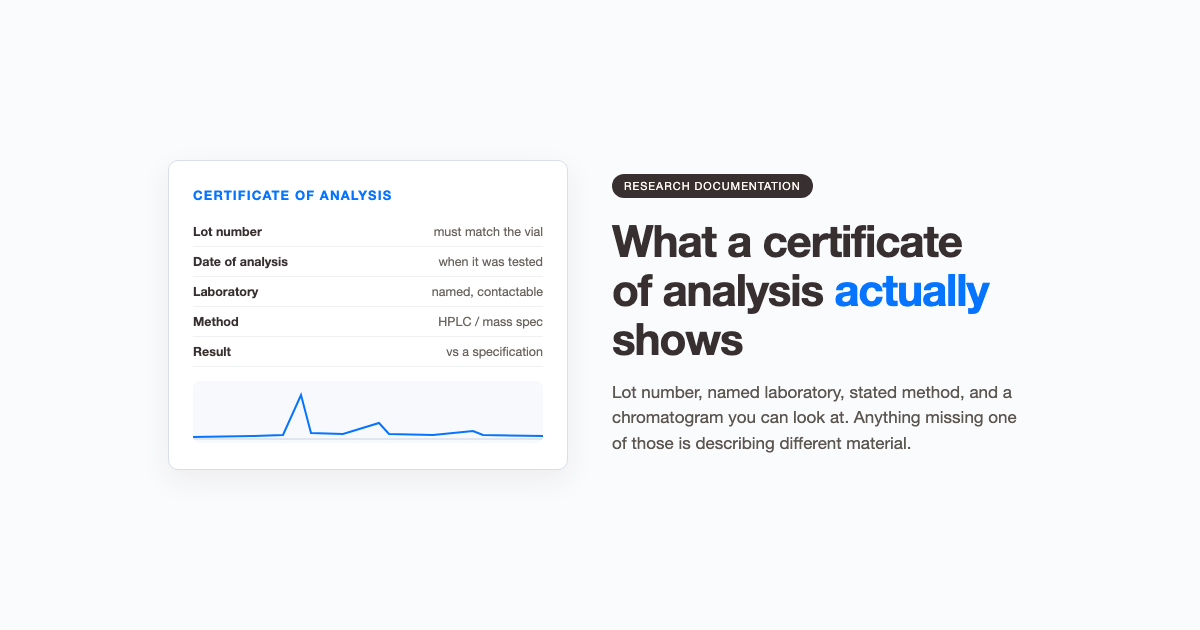
A certificate of analysis is the only document that connects the vial in front of you to a laboratory that actually tested it. It is also the document most often faked, most often misread, and most often missing entirely. This guide covers what a real one contains, how to check it, and what the common substitutes are hiding.
What is a certificate of analysis?
A certificate of analysis, usually shortened to COA, is a laboratory document reporting the measured identity and purity of one specific batch of material. It is tied to a lot number, not to a product line, and it is issued by the laboratory that ran the tests rather than by the seller.
That second point is where most of the confusion starts. A supplier can publish a document with a laboratory logo on it that the laboratory never issued. A real COA names the testing facility, the date of analysis, the lot identifier, the methods used, and the person or system that signed it off.
What a complete certificate of analysis contains
Six elements appear on every legitimate certificate. If any is absent, the document is incomplete rather than merely brief.
- Lot or batch number. This must match the number printed on the vial you received. A certificate that references a different lot describes different material.
- Date of analysis. Not the date the document was downloaded, and not the date the product was listed. The date the laboratory ran the test.
- Testing laboratory name and contact details. A named facility that can be reached independently of the seller.
- Analytical method. Typically high performance liquid chromatography for purity and mass spectrometry for identity. The method should be named, not implied.
- The result itself, expressed as a number against a stated specification.
- Chromatogram or spectrum. The raw output, not just the summary figure.
How to read the purity figure
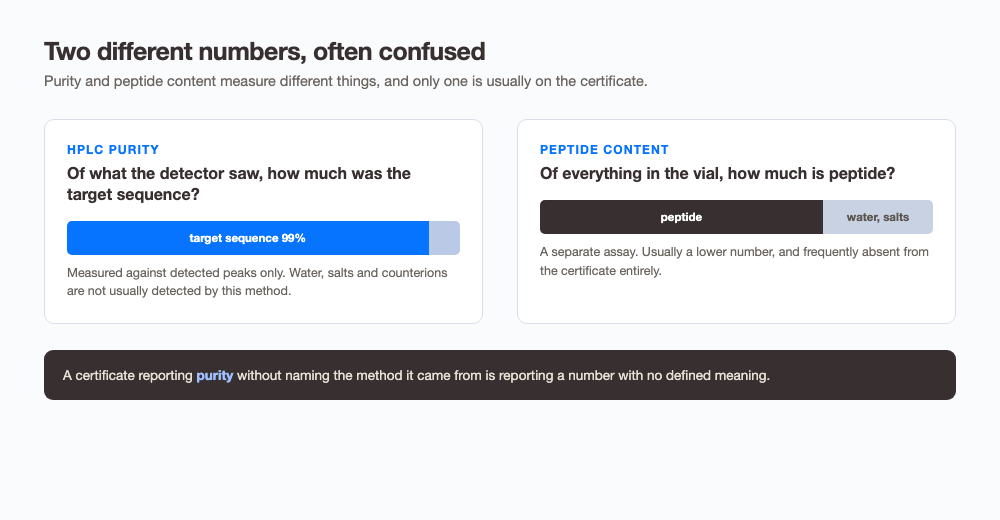
Purity on a peptide certificate is usually reported from high performance liquid chromatography as an area percentage. It describes how much of the detected material corresponds to the target sequence, measured against everything else the detector saw.
That last clause matters more than the number. An area percentage is relative to what the method detects, so a figure of 99 percent means 99 percent of the detected peaks, not 99 percent of the vial contents. Water, residual salts and counterions are not usually captured by the same method. The same distinction matters when reading a lyophilized vial, where most of the volume is not peptide. This is why a peptide content assay, which reports the proportion of the vial that is actually peptide, is a different and often lower number than the purity figure.
A certificate reporting purity without naming the method it came from is reporting a number with no defined meaning.
Identity testing, and why purity alone is not enough
Purity tells you how clean the material is. It does not tell you what the material is. A sample can be extremely pure and still be the wrong compound.
Identity is established separately, usually by mass spectrometry, which measures the molecular weight of the material and compares it against the theoretical weight of the target sequence. A complete certificate reports both. One that reports purity alone has answered half the question.
How to verify a certificate is genuine
Three checks take a few minutes each and catch most fabricated documents.
- Match the lot number to the vial. This is the single most common failure. A certificate for a different batch is not evidence about the batch you hold.
- Contact the testing laboratory directly. Use contact details you find yourself, not the ones printed on the document. A laboratory that has no record of the lot number has not tested it.
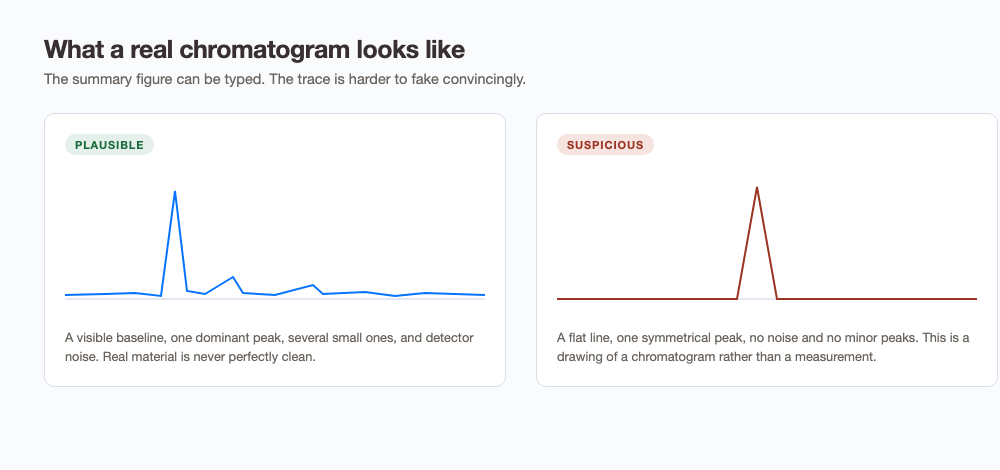
- Look at the chromatogram, not the summary. A genuine chromatogram shows a baseline, a main peak and usually several small ones. A clean image with a single perfect peak and no baseline noise is more likely to be a graphic than a measurement.
What the common substitutes leave out
Several documents are routinely presented as certificates of analysis and are not.
A specification sheet states what the material is supposed to be. It is a target, not a measurement, and it is written before any testing happens.
A certificate of conformance asserts that material meets a specification without reporting the values that were measured. It is a claim, not data.
A supplier summary reproduces a purity figure without the laboratory name, the method or the chromatogram. There is nothing in it that can be independently checked.
None of these are dishonest by definition. They become misleading when they are offered in place of a certificate of analysis and described as one.
Why documentation standards are under scrutiny
The United States Food and Drug Administration issued warning letters to seven online peptide sellers on 31 March 2026, published on 7 April 2026. The letters addressed how products were marketed rather than how they were tested, but they made the regulator’s reading of this market explicit, and documentation practices sit inside that same picture.
For anyone sourcing research material, the practical consequence is straightforward. Verifiable third party testing is now the clearest signal separating suppliers who can evidence what they sell from suppliers who cannot.
Frequently asked questions
Does every batch need its own certificate?
Yes. A certificate describes one lot. Applying a certificate from one batch to another is the most common way a genuine document gets used misleadingly.
What purity figure should a certificate show?
There is no universal threshold, and any supplier quoting one as an industry standard should be asked to name its source. What matters is that the figure is reported against a stated method and accompanied by a chromatogram.
Is third party testing different from in-house testing?
Yes. In-house testing is performed by the supplier. Third party testing is performed by an independent laboratory with no commercial interest in the result. Our review of GMP compliant peptide companies covers how suppliers differ on this. Both can be legitimate, and only one is independent.
What if a supplier will not provide a certificate?
Treat the absence as the answer. A supplier who has commissioned testing has the document and can send it. Storage practice is a related signal, covered in our guide to storing peptides.
The short version
A certificate of analysis is worth exactly as much as its traceability. Lot number matched to the vial, named laboratory, named method, dated analysis, and a chromatogram you can look at. A document missing any of those is describing something other than the material you hold.
