
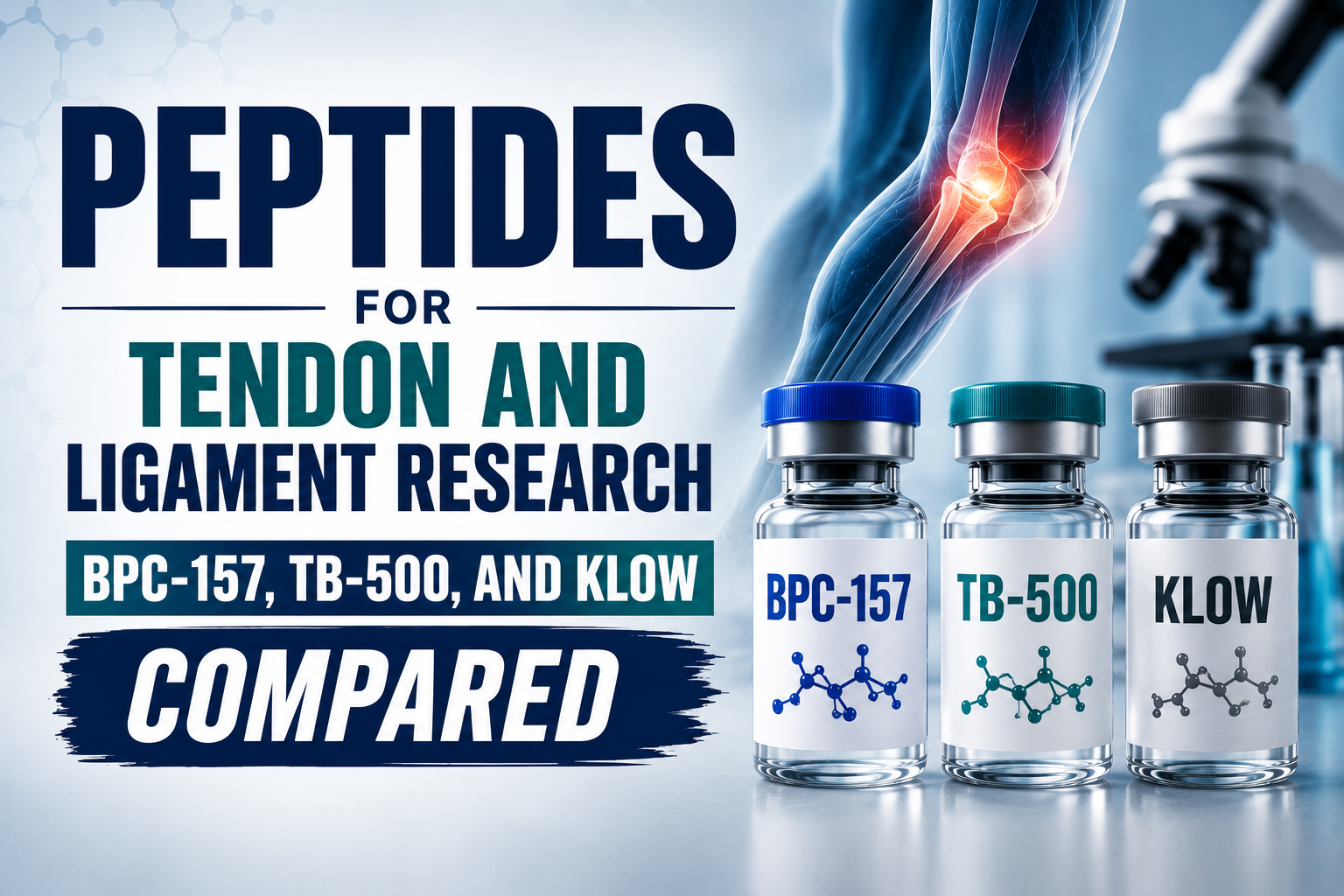
Tendon and ligament injuries are among the most challenging conditions to study because these connective tissues receive a limited blood supply and often heal more slowly than muscles. For this reason, scientists continue to investigate new approaches that may improve tissue regeneration and recovery. One growing area of interest is peptides for tendon repair.
Several research peptides have attracted attention for their potential roles in connective tissue healing. Among the most studied are BPC-157 and TB-500. More recently, multi-peptide formulations such as KLOW have entered the research landscape by combining several peptides into one blend. Researchers are exploring whether these combinations may influence multiple biological pathways involved in tissue repair.
It is important to note that these peptides are experimental research compounds. Most available evidence comes from laboratory and animal studies, and none of these peptides are approved as standard medical treatments for tendon or ligament injuries.
This guide compares peptides for tendon repair, including BPC-157, TB-500, and KLOW, to help explain their ingredients, research goals, and the current scientific evidence.
Why Tendon and Ligament Healing Is Challenging
Tendons connect muscles to bones, while ligaments connect bones to other bones. Both tissues are made primarily of collagen fibers, giving them strength and stability.
However, tendons and ligaments receive less blood flow than many other tissues. As a result, they often recover slowly after injury. Researchers continue to study biological pathways that may improve collagen production, cell migration, blood vessel formation, and tissue remodeling.
This is why peptides for tendon repair have become an important area of regenerative medicine research.
What Is BPC-157?
BPC-157 is a synthetic peptide derived from a protective protein found in the stomach. It has become one of the most widely studied peptides for tendon repair because of its potential role in connective tissue healing.
Laboratory and animal studies suggest that BPC-157 may influence:
- Tendon healing
- Ligament repair
- Muscle recovery
- Blood vessel formation
- Gastrointestinal tissue repair
Researchers believe BPC-157 may support tissue regeneration by influencing growth factors and improving angiogenesis, which is the formation of new blood vessels.
Although these findings are promising, large human clinical trials are still limited.
What Is TB-500?
TB-500 is a synthetic peptide based on thymosin beta-4, a naturally occurring protein involved in tissue repair.
Scientists continue to investigate TB-500 because it may support several biological processes associated with recovery.
Current research has explored its possible effects on:
- Cell migration
- Tissue remodeling
- Muscle recovery
- Connective tissue repair
- Angiogenesis
Unlike BPC-157, which is often associated with localized tissue repair, TB-500 is commonly studied for its broader role in cellular movement and regeneration.
What Is KLOW?
KLOW is a multi-peptide research blend that combines four peptides into one formulation.
A typical KLOW blend contains:
- GHK-Cu
- BPC-157
- TB-500
- KPV
Each ingredient has been investigated for different biological functions.
GHK-Cu has been widely studied for collagen production and skin regeneration.
BPC-157 and TB-500 are commonly researched for tissue repair and connective tissue healing.
KPV has attracted attention because of its potential role in inflammatory regulation.
By combining these peptides, researchers hope to better understand how multiple regenerative pathways work together.
Comparing Peptides for Tendon Repair
When discussing peptides for tendon repair, each option offers a different area of scientific interest.
BPC-157
Researchers often choose BPC-157 when studying tendon, ligament, and muscle healing because much of the available research focuses directly on connective tissue.
TB-500
TB-500 is commonly selected for studies involving cell migration and tissue remodeling. It may complement other peptides by supporting broader regenerative processes.
KLOW
KLOW combines several research peptides into one blend. Researchers interested in collagen production, connective tissue repair, and inflammatory signaling may find this formulation useful for studying multiple biological pathways simultaneously.
Key Differences
| Feature | BPC-157 | TB-500 | KLOW |
|---|---|---|---|
| Peptide Type | Single peptide | Single peptide | Multi-peptide blend |
| Primary Research Focus | Tendon and ligament healing | Cell migration and tissue remodeling | Multi-pathway regenerative research |
| Includes GHK-Cu | ✘ | ✘ | ✔ |
| Includes KPV | ✘ | ✘ | ✔ |
| Collagen Research | Moderate | Moderate | High |
| Inflammation Research | Limited | Limited | Expanded through KPV |
Potential Research Benefits
Researchers continue to investigate peptides for tendon repair because these compounds may influence several important healing processes.
Current areas of research include:
- Collagen production
- Connective tissue regeneration
- Blood vessel formation
- Cellular communication
- Tissue remodeling
- Inflammatory signaling
Although these findings are encouraging, they should be viewed as experimental rather than proven clinical benefits.
Scientific Evidence
Research on peptides for tendon repair has grown rapidly over the last decade. However, most published studies focus on individual peptides rather than multi-peptide blends. Current evidence comes primarily from laboratory experiments and animal models, so more human clinical trials are needed.
BPC-157 Research
Among all peptides for tendon repair, BPC-157 has received significant attention. Animal studies suggest it may support tendon-to-bone healing, improve collagen organization, and promote blood vessel formation during tissue recovery.
Researchers believe BPC-157 may influence growth factors involved in healing. While these findings are promising, they have not yet been confirmed in large, well-controlled human studies.
TB-500 Research
TB-500 is another peptide commonly investigated for tissue regeneration. Studies suggest it may promote cell migration, angiogenesis, and tissue remodeling. These processes are essential for repairing damaged tendons and ligaments.
Unlike BPC-157, TB-500 is often studied for its broader effects on recovery rather than focusing only on connective tissue.
GHK-Cu Research
GHK-Cu is included in the KLOW blend and has been widely researched for its effects on collagen synthesis and wound healing. Laboratory studies indicate that it may activate genes involved in tissue repair while also supporting extracellular matrix remodeling.
Because collagen is the primary structural protein in tendons and ligaments, GHK-Cu is considered an important component in connective tissue research.
KPV Research
KPV is the newest addition to the KLOW peptide blend. Researchers are studying its potential role in regulating inflammatory responses. Since excessive inflammation may delay healing, scientists are interested in whether KPV could complement regenerative peptides by supporting a balanced inflammatory environment.
Current Research Gaps
Although each ingredient has shown encouraging results in preclinical studies, researchers have published very few studies evaluating the complete KLOW blend. At present, there is not enough evidence to conclude that combining these peptides produces better outcomes than studying them individually.
Safety and Research Limitations
Anyone studying peptides for tendon repair should understand the current limitations of the available evidence.
Limited Human Studies
Most published research has been conducted using laboratory models or animals. Human clinical trials remain limited, making it difficult to determine how these peptides perform in real-world medical settings.
Unknown Long-Term Safety
The long-term effects of BPC-157, TB-500, and KLOW have not been fully established. Additional clinical research is necessary before conclusions can be made about long-term safety.
Product Quality
Research peptides are produced by different manufacturers, and purity may vary. For scientific studies, researchers should use products that include independent third-party testing.
Regulatory Status
BPC-157, TB-500, and KLOW are generally sold as research compounds. They are not approved by the U.S. Food and Drug Administration (FDA) for treating tendon or ligament injuries.
Which Peptide Fits Different Research Goals?
Choosing among peptides for tendon repair depends on the specific objectives of the research.
BPC-157
Researchers often select BPC-157 when studying tendon healing, ligament repair, or gastrointestinal tissue recovery. It is one of the most investigated peptides for connective tissue research.
TB-500
TB-500 may be preferred for studies focusing on cell migration, angiogenesis, and tissue remodeling. It is frequently investigated alongside other regenerative peptides because of its broader biological activity.
KLOW
KLOW combines GHK-Cu, BPC-157, TB-500, and KPV into one formulation. Researchers interested in collagen production, tissue repair, and inflammation-related pathways may choose KLOW when studying multiple biological mechanisms at the same time.
Rather than asking which peptide is “best,” researchers typically choose the option that matches the biological process they want to investigate.
Frequently Asked Questions
What are the most studied peptides for tendon repair?
BPC-157 and TB-500 are among the most widely researched peptides for tendon repair. Multi-peptide blends such as KLOW are also gaining attention because they combine several regenerative peptides into one formulation.
Can peptides help ligament healing?
Laboratory and animal studies suggest certain peptides may influence connective tissue repair. However, additional human clinical trials are required before their effectiveness can be confirmed.
What makes KLOW different?
KLOW combines four peptides—GHK-Cu, BPC-157, TB-500, and KPV. The addition of GHK-Cu and KPV expands its research focus to include collagen production and inflammatory regulation.
Are these peptides approved medical treatments?
No. These peptides are generally marketed for research purposes only and are not approved medications for tendon or ligament injuries.
Which peptide blend has the most research?
BPC-157 and TB-500 have more published preclinical studies than the KLOW blend itself. Research on KLOW is newer and remains limited.
Conclusion
Interest in peptides for tendon repair continues to grow as researchers explore new approaches to connective tissue healing. BPC-157, TB-500, and KLOW each represent different strategies for studying regeneration, collagen production, and tissue remodeling.
BPC-157 has become one of the most researched peptides for tendon and ligament healing, while TB-500 is valued for its potential role in cell migration and recovery. KLOW builds on these findings by combining multiple peptides, including GHK-Cu and KPV, to investigate several biological pathways at once.
Although laboratory and animal studies have produced encouraging results, strong clinical evidence in humans remains limited. Future research will be essential to determine whether these experimental peptides can provide measurable advantages in tendon and ligament repair.
For now, BPC-157, TB-500, and KLOW remain valuable research tools that continue to expand our understanding of regenerative medicine.
References
Pickart, L., & Margolina, A. (2018). Regenerative and protective actions of the GHK-Cu peptide in the light of the new gene data. International Journal of Molecular Sciences, 19(7), 1987. https://doi.org/10.3390/ijms19071987
Goldstein, A. L., & Kleinman, H. K. (2015). Advances in the basic and clinical applications of thymosin β4. Expert Opinion on Biological Therapy, 15(Suppl. 1), S139–S145. https://doi.org/10.1517/14712598.2015.1014791
National Library of Medicine. PubMed. https://pubmed.ncbi.nlm.nih.gov/
National Center for Biotechnology Information (NCBI). https://www.ncbi.nlm.nih.gov/
