
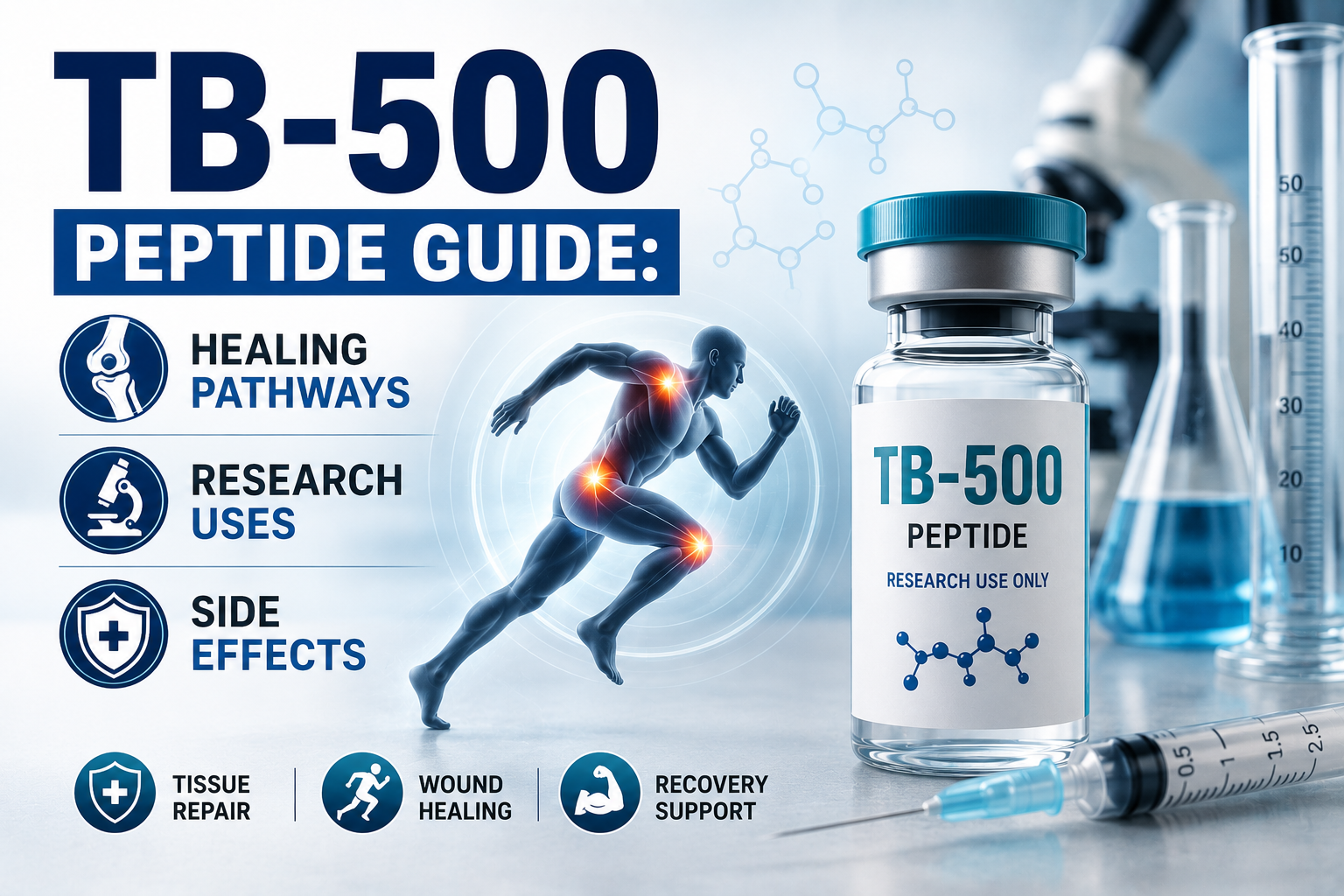
The TB-500 peptide has become one of the most widely discussed peptides in regenerative medicine research. Scientists have investigated its potential role in tissue repair, wound healing, inflammation regulation, and recovery after injury. Although it is commonly mentioned alongside peptides like BPC-157, the research surrounding TB-500 is still developing, and there are no approved therapeutic uses for humans in most countries.
This guide explores what the TB-500 peptide is, how it works, the healing pathways researchers are studying, possible research applications, known side effects, and the current scientific evidence.
What Is TB-500 Peptide
TB-500 peptide is a synthetic peptide derived from a naturally occurring protein called Thymosin Beta-4 (Tβ4). Thymosin Beta-4 is found in nearly every human cell and plays an important role in cellular movement, tissue development, wound repair, and inflammation regulation.
TB-500 represents a shorter synthetic fragment designed to mimic some biological activities of the natural protein while being easier to manufacture for laboratory research.
Unlike many peptides that target one specific receptor, TB-500 appears to influence several cellular processes involved in tissue regeneration.
Researchers continue to investigate its biological effects in laboratory and animal models.
Understanding Thymosin Beta-4
Thymosin Beta-4 is naturally present throughout the body, especially in tissues requiring continuous repair.
Its biological functions include:
- Supporting cell migration
- Organizing the actin cytoskeleton
- Promoting blood vessel formation
- Reducing inflammatory signaling
- Assisting tissue remodeling
- Supporting wound healing
TB-500 attempts to reproduce many of these actions in experimental settings.
How Does TB-500 Peptide Work
Unlike hormones that bind directly to specific receptors, the TB-500 peptide primarily influences intracellular proteins involved in cell movement and tissue remodeling.
Current research suggests it may affect several healing pathways.
Actin Regulation
One of the primary mechanisms involves G-actin binding.
Actin is an essential structural protein that allows cells to move toward injured tissue.
By regulating actin dynamics, TB-500 may improve:
- Cell migration
- Tissue remodeling
- Cellular repair
- Structural organization
These mechanisms are considered fundamental during wound healing.
Cell Migration
Healing requires different types of cells to travel toward damaged tissue.
Research suggests TB-500 may assist the migration of:
- Fibroblasts
- Endothelial cells
- Stem cell populations
- Immune cells
Improved cellular movement may contribute to faster tissue remodeling.
Angiogenesis
Healthy tissues require an adequate blood supply.
Several animal studies indicate TB-500 may encourage:
- New capillary formation
- Improved circulation
- Oxygen delivery
- Nutrient transport
Better vascularization may enhance recovery in damaged tissues.
Inflammation Modulation
Inflammation is necessary after injury, but prolonged inflammation can delay healing.
Experimental research suggests TB-500 may influence inflammatory cytokines involved in tissue repair.
Scientists continue investigating whether these anti-inflammatory effects translate into meaningful clinical outcomes.
Extracellular Matrix Remodeling
The extracellular matrix provides structural support for tissues.
Research indicates TB-500 may influence collagen organization and remodeling rather than simply increasing collagen production.
Balanced remodeling is considered important for proper healing and minimizing scar formation.
Healing Pathways Being Studied
Researchers have investigated the TB-500 peptide across several biological systems.
Muscle Recovery
Animal studies suggest TB-500 may:
- Improve muscle regeneration
- Reduce healing time
- Support muscle fiber organization
- Enhance functional recovery
Human evidence remains limited.
Tendon Repair
Tendon injuries heal slowly because of poor blood supply.
Researchers are studying whether TB-500 improves:
- Tendon cell migration
- Collagen alignment
- Mechanical strength
- Recovery following injury
Most evidence comes from preclinical models.
Ligament Healing
Laboratory research has explored TB-500 for ligament injuries, including:
- Collagen remodeling
- Reduced inflammation
- Improved tissue organization
Clinical trials remain lacking.
Skin Wound Healing
Skin repair represents one of the most extensively studied areas.
Research has observed:
- Faster wound closure
- Increased epithelial cell migration
- Improved tissue remodeling
- Reduced scar formation in some animal models
These findings require confirmation in human studies.
Cardiac Tissue Research
Following heart injury, researchers have explored whether Thymosin Beta-4 pathways may:
- Promote blood vessel growth
- Improve cardiac cell survival
- Support tissue remodeling
Most evidence comes from animal research rather than clinical trials.
Corneal Healing
Eye researchers have investigated thymosin beta-4-derived therapies for
- Corneal injuries
- Dry eye disease
- Surface wound healing
Some Thymosin Beta-4 formulations—not TB-500 specifically—have advanced into early-stage human clinical research.
Research Uses of TB-500 Peptide
Current scientific investigations include:
Soft Tissue Repair
Researchers continue studying TB-500 in models involving:
- Muscle strains
- Ligament damage
- Tendon injuries
- Connective tissue healing
Orthopedic Research
Experimental orthopedic applications include:
- Joint healing
- Surgical recovery
- Cartilage repair
- Sports injury models
Regenerative Medicine
Scientists are evaluating whether TB-500 may complement other regenerative approaches by supporting tissue remodeling and cellular repair mechanisms.
Veterinary Research
TB-500 has received significant attention in veterinary medicine, particularly in experimental studies involving horses and other animals with tendon or ligament injuries. Controlled evidence remains limited, and regulatory restrictions vary by country.
Laboratory Research
Basic science research continues to examine:
- Cell migration
- Tissue regeneration
- Inflammation pathways
- Blood vessel development
- Fibrosis regulation
Potential Benefits Observed in Research
Although human evidence remains limited, published studies have reported potential benefits, including:
| Research Area | Findings in Experimental Studies |
|---|---|
| Wound healing | Faster tissue closure |
| Inflammation | Reduced inflammatory response |
| Muscle repair | Improved regeneration |
| Tendons | Better collagen organization |
| Blood vessels | Increased angiogenesis |
| Cell movement | Enhanced migration |
| Tissue remodeling | Improved structural repair |
These findings primarily come from laboratory and animal research and should not be interpreted as established clinical benefits.

TB-500 Peptide Side Effects
Because large-scale human clinical trials are lacking, the complete safety profile remains unknown.
Reported side effects are mostly anecdotal or theoretical.
Possible concerns include:
Injection Site Reactions
Some users report:
- Redness
- Mild pain
- Swelling
- Bruising
Headache
Temporary headaches have occasionally been reported following experimental use.
Fatigue
Some individuals describe short-term tiredness during use, although this has not been consistently documented in clinical research.
Nausea
Digestive discomfort has been reported anecdotally but has not been confirmed in controlled studies.
Unknown Long-Term Risks
Perhaps the greatest concern is the absence of long-term human safety data.
Researchers still do not know whether prolonged exposure could affect:
- Cancer biology
- Immune regulation
- Organ function
- Hormonal systems
- Fibrosis pathways
Additional clinical research is needed.
TB-500 vs Thymosin Beta-4
| Feature | TB-500 | Thymosin Beta-4 |
|---|---|---|
| Type | Synthetic peptide fragment | Naturally occurring protein |
| Size | Smaller | Larger |
| Origin | Laboratory synthesized | Found in human tissues |
| Research | Experimental | Extensively studied |
| Clinical approval | None | Limited clinical investigation for certain formulations |
Is TB-500 approved?
Currently, the TB-500 peptide is not approved by the U.S. Food and Drug Administration (FDA) for treating any medical condition. It is generally sold for laboratory research purposes only.
The World Anti-Doping Agency lists TB-500 and related thymosin compounds among prohibited substances in competitive sports because of their potential performance-enhancing effects.
Current Limitations of Research
Several important limitations exist:
- Few controlled human clinical trials
- Most evidence comes from animal studies
- Long-term safety remains unknown
- No standardized dosing protocols
- Variable product quality in commercial markets
These limitations make it difficult to draw firm conclusions about effectiveness or safety in humans.
Future Research Directions
Scientists continue exploring whether TB-500 may have applications in:
- Chronic wound healing
- Sports medicine
- Tendon regeneration
- Cardiac repair
- Ophthalmology
- Fibrosis prevention
- Combination regenerative therapies
Future randomized clinical trials will be essential to determine whether encouraging preclinical findings translate into meaningful human health benefits.
Frequently Asked Questions
Is TB-500 peptide legal?
Its legal status varies by country. In many regions, it is sold only for research purposes and is not approved as a prescription medication.
Is TB-500 the same as Thymosin Beta-4?
No. TB-500 is a synthetic peptide fragment designed to mimic some biological activities of the naturally occurring Thymosin Beta-4 protein.
Can TB-500 speed healing?
Animal and laboratory studies suggest TB-500 may influence tissue repair pathways, but there is insufficient human evidence to confirm that it accelerates healing in clinical practice.
Is TB-500 safe?
Its long-term safety in humans has not been established because high-quality clinical trials are limited.
Why is TB-500 banned in sports?
The World Anti-Doping Agency prohibits TB-500 because it may enhance recovery and performance, even though definitive clinical evidence is still limited.
Conclusion
The TB-500 peptide remains an intriguing area of regenerative medicine research due to its potential effects on cell migration, angiogenesis, tissue remodeling, and inflammation. Experimental studies have shown promising results in wound healing, muscle recovery, tendon repair, and connective tissue regeneration, but these findings are largely limited to laboratory and animal models.
At present, there is insufficient high-quality clinical evidence to establish TB-500 as a safe or effective treatment for human disease. Larger, well-designed clinical trials are needed to clarify its therapeutic potential, determine appropriate dosing, and better understand long-term safety.
For now, TB-500 should be viewed as an investigational research peptide rather than an approved medical therapy.
References
- U.S. Food and Drug Administration (FDA) – Human Drug Compounding and Peptide Information
- National Center for Biotechnology Information (NCBI) – Thymosin Beta-4 Research Collection
- PubMed – Thymosin Beta-4 Scientific Studies
- World Anti-Doping Agency (WADA) – Prohibited List
- National Institutes of Health (NIH)
