
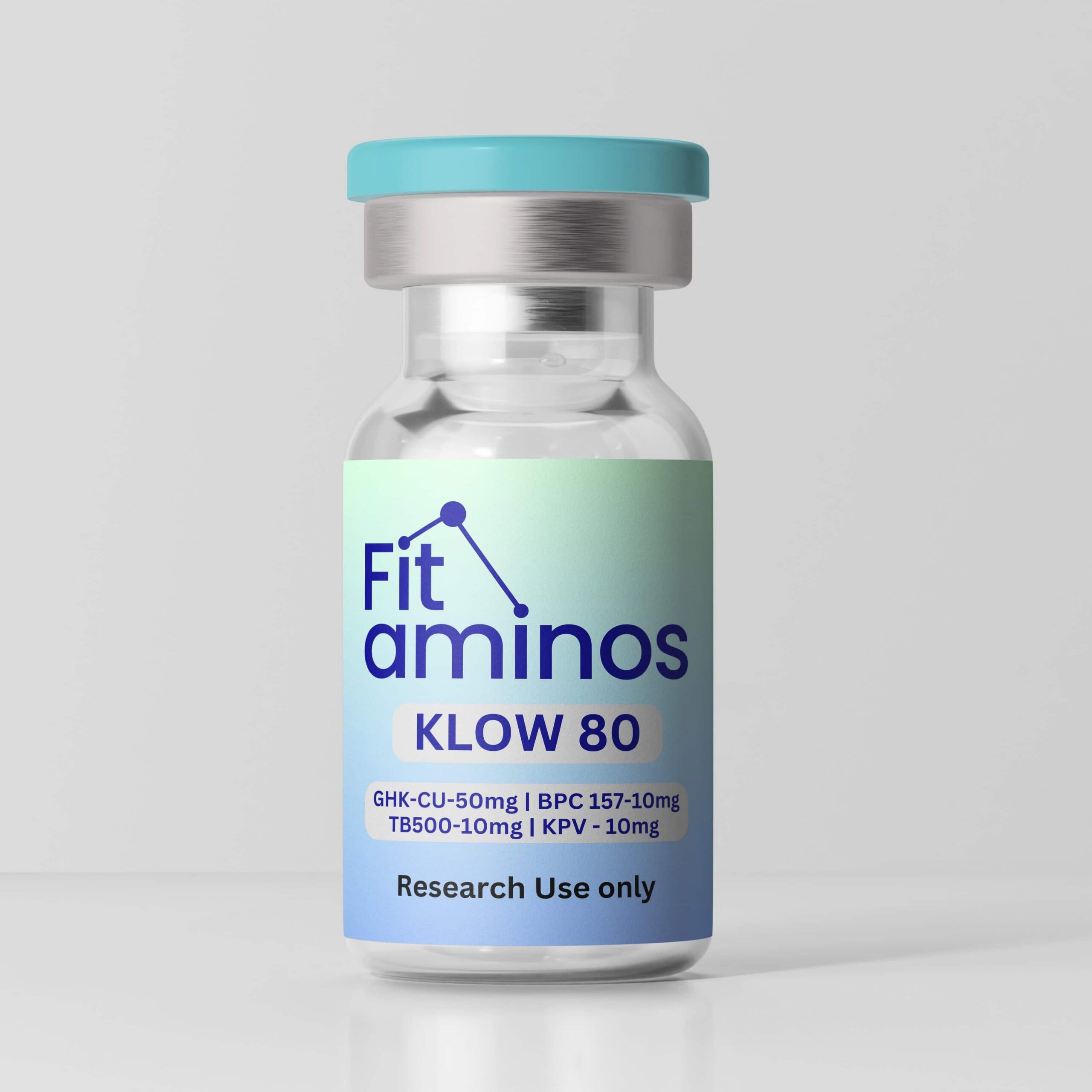
KLOW peptide is one of the most studied combination protocols in regenerative peptide research. The blend pulls together four peptides (KPV, BPC-157, TB-500, and GHK-Cu) into a single 80 mg vial that targets several biological pathways at once: inflammation control, angiogenesis, collagen production, and cell migration. This guide covers what KLOW peptide is, what’s actually inside the blend, the benefits documented in preclinical research, the dosing protocol researchers typically follow, the side-effect profile observed in studies, and how KLOW compares to running each peptide on its own.
Whether you arrived searching for klow peptide, klow peptide benefits, klow peptide dosage, or klow dosing protocol, every section is built around the same goal: give researchers the cleanest, most accurate reference on the KLOW blend available online. For research use only, not for human consumption, athletic performance, or clinical treatment.
What Is KLOW Peptide?
KLOW peptide is a four-component research blend designed around tissue repair and regenerative biology. The name “KLOW” is taken from the first letters of its components (KPV, BPC-157, TB-500, and GHK-Cu) pre-mixed into a single 80 mg lyophilized vial.
Each ingredient on its own has a substantial body of preclinical literature. What makes KLOW notable is that researchers don’t have to reconstitute and dose four separate vials to test combined effects. A single reconstitution gives a defined concentration of all four peptides at a fixed ratio:
- GHK-Cu: 50 mg (collagen synthesis, copper-peptide signaling)
- TB-500: 10 mg (actin regulation, cell migration)
- BPC-157: 10 mg (soft-tissue repair, angiogenesis)
- KPV: 10 mg (NF-κB pathway, inflammation control)
This is why most search traffic for klow blend, klow blend peptide, and klow peptide blend ends up at the same protocol, they’re all describing this exact KLOW 80 mg formulation. The blend is also referred to in some catalogs as KLOW-80 or KLOW 80mg, which all point to the same vial composition.
What’s in the KLOW Peptide Blend?
The KLOW peptide blend combines four research peptides with complementary mechanisms. The composition is fixed across vials, which is part of what makes it useful as a standardized research tool: every reconstituted dose delivers the same ratio of components.
| Component | Amount per Vial | Primary Research Focus |
|---|---|---|
| GHK-Cu | 50 mg | Collagen synthesis, copper-mediated signaling, skin remodeling |
| TB-500 (Thymosin Beta-4 fragment) | 10 mg | Actin sequestration, cell migration, muscle and tendon repair models |
| BPC-157 | 10 mg | Soft-tissue repair, angiogenic response, GI-tract studies |
| KPV (Lys-Pro-Val) | 10 mg | Anti-inflammatory signaling via the melanocortin and NF-κB pathways |
| Total peptide content | 80 mg | Combined recovery and repair research |
KLOW Peptide Benefits in Preclinical Research
The reason researchers explore klow peptide benefits as a single stack is that each component already shows promising effects in animal and in-vitro models, and the four mechanisms layer rather than overlap. Combined, the documented benefits in preclinical research include:
- Accelerated tissue repair. BPC-157 and TB-500 both demonstrate faster recovery timelines in tendon, ligament, and muscle injury models. When studied together, the effect appears additive rather than redundant.
- Enhanced collagen production. GHK-Cu is one of the most extensively documented copper peptides for collagen synthesis and dermal remodeling. This is the structural backbone of the blend’s skin-related research.
- Significant reduction in inflammation. KPV acts on the NF-κB pathway, blunting pro-inflammatory cytokine signaling. This complements BPC-157’s GI and systemic anti-inflammatory effects.
- Improved skin appearance and dermal repair. The GHK-Cu component is what drives most of the cosmetic-research interest in KLOW; researchers studying post-procedure recovery (microneedling, laser, dermabrasion models) frequently include it.
- Faster post-procedure recovery models. The combination of angiogenic support (BPC-157, GHK-Cu) plus inflammation control (KPV) plus cell-migration support (TB-500) addresses several distinct stages of the wound-healing cascade simultaneously.
- Improved overall resilience markers. Researchers using KLOW in stress-recovery models report cleaner readouts than single-peptide controls in some endpoints, though the literature on full-blend studies is still small.
None of these benefits should be read as human clinical claims. KLOW is a research peptide; the published evidence base sits in animal models, cell culture, and small preclinical studies. The blend is unapproved for human use.
KLOW Components: How Each Peptide Works
GHK-Cu (50 mg per vial)
GHK-Cu is a copper-binding tripeptide (glycyl-L-histidyl-L-lysine) that has been studied for decades in dermal repair and collagen synthesis. It is the largest single component of the KLOW blend by mass. Researchers focused on skin remodeling, hair-follicle signaling, and post-laser recovery typically work with GHK-Cu as a primary endpoint. For an in-depth look, see our GHK-Cu dosage chart and calculator.
TB-500 (10 mg per vial)
TB-500 is a synthetic fragment of Thymosin Beta-4. Its mechanism centers on actin sequestration and the modulation of cell migration, which is why it appears so often in muscle, tendon, and cardiac repair research. In KLOW, it provides the migration-and-remodeling side of the recovery equation while BPC-157 handles the angiogenic side.
BPC-157 (10 mg per vial)
BPC-157 is a 15–amino-acid peptide derived from a protective protein found in gastric juice. Preclinical work covers soft-tissue repair, blood-vessel formation, and GI-mucosa protection. It is one of the most-studied research peptides on the regenerative side and is a heavily-trafficked dosage protocol on its own, see the BPC-157 dosage protocol for component-level dosing.
KPV (10 mg per vial)
KPV is a tripeptide (Lys-Pro-Val) and the C-terminal fragment of alpha-MSH. It is studied for its anti-inflammatory effects via the melanocortin receptor system and through downstream inhibition of NF-κB. Of the four peptides in KLOW, KPV is the strongest anti-inflammatory contributor. See the KPV dosage protocol for monotherapy reference dosing.
KLOW Peptide Dosage Chart
Researchers searching for klow peptide dosage, klow peptide dosage chart, or klow dosage typically want a fast reference for how the 80 mg vial breaks down per dose. The chart below assumes the standard reconstitution of the 80 mg vial with 3.0 mL of bacteriostatic water, which is the protocol PeptidesUnleashed publishes on the KLOW 80 mg dosage page.
| Metric | Value |
|---|---|
| Total peptide per vial | 80 mg (50 mg GHK-Cu + 10 mg each of TB-500, BPC-157, KPV) |
| Reconstitution volume | 3.0 mL bacteriostatic water |
| Final concentration | ~26.7 mg/mL total peptide |
| Standard daily dose | ~2.67 mg (10 units on a U-100 insulin syringe / 0.10 mL) |
| GHK-Cu delivered per dose | ~1.66 mg |
| TB-500 delivered per dose | ~0.33 mg |
| BPC-157 delivered per dose | ~0.33 mg |
| KPV delivered per dose | ~0.33 mg |
| Administration route (in research) | Subcutaneous, once daily |
| Typical research protocol length | 8–16 weeks with gradual titration |
| Reconstituted shelf life | ~4 weeks refrigerated at 2–8 °C (storage guide) |
This chart standardizes what “one dose of KLOW” actually delivers across all four components. For accurate volume conversions when adjusting the reconstitution ratio, the peptide reconstitution calculator is the fastest way to recalculate mcg-per-unit if a different bacteriostatic water volume is used.
KLOW Peptide Dosing Protocol: Step by Step
For researchers searching klow dosing protocol, klow peptide dosing, klow dosing, or klow peptide protocol, the standard published protocol for the 80 mg KLOW vial follows the steps below. This is the same procedure described in detail on the KLOW 80 mg vial dosage protocol page.
- Gather supplies. KLOW 80 mg vial, 3.0 mL bacteriostatic water (sterile, benzyl-alcohol preserved), U-100 insulin syringes, alcohol swabs, and a clean work surface.
- Reconstitute. Draw 3.0 mL bacteriostatic water and inject it slowly down the side of the vial, avoiding direct impact on the lyophilized powder. Swirl gently, do not shake, until fully dissolved. This produces a ~26.7 mg/mL total peptide concentration.
- Refrigerate. Store the reconstituted vial at 2–8 °C. Avoid repeated freeze–thaw cycles. Plan to use within ~4 weeks for protocol consistency.
- Measure the dose. Standard research protocol: 10 units on a U-100 insulin syringe = 0.10 mL = ~2.67 mg of total peptide blend per injection.
- Administer (in research models). Subcutaneous, once daily, at a consistent time. Rotate injection sites to reduce localized irritation in animal studies.
- Run the protocol window. Most KLOW research protocols span 8 to 16 weeks with gradual dose titration, depending on the study endpoint.
- Track and adjust. Document any changes in the relevant research endpoints (recovery time, inflammation markers, dermal response) and adjust within the protocol’s design parameters.
Researchers running combination work involving copper peptides often note that GHK-Cu can shift the copper-to-zinc ratio over a long protocol window; pairing the protocol with zinc supplementation in the animal model is a common control. This is purely a research-design consideration, not a human recommendation.
KLOW Peptide Side Effects in Preclinical Research
One of the most common queries researchers raise (klow peptide side effects) has a relatively quiet answer in the preclinical literature, but quiet is not the same as zero. The side-effect profile observed in animal and in-vitro studies includes:
- Injection-site irritation. The most frequently reported finding across BPC-157, TB-500, and KPV studies. Typically mild, localized, and resolved by site rotation.
- Transient redness or warmth at the injection site. Commonly associated with the GHK-Cu component due to its vascular effects.
- Copper accumulation considerations. Because GHK-Cu carries copper into the system, long-window protocols typically pair with zinc in the model to maintain copper-zinc balance. Imbalance can manifest as mild GI effects or fatigue patterns in animal models.
- Possible dose-dependent fatigue or lethargy. Reported infrequently with TB-500 in higher-dose protocols.
- Allergic or hypersensitivity-type responses. Rare but documented across all four components, a baseline consideration for any peptide research.
- Unknown long-term effects. The combination has not been studied across extended timeframes in humans. Any long-term claim about KLOW’s safety profile is outside the current preclinical evidence base.
The side-effect dataset is preclinical only. KLOW has not been evaluated in formal human clinical trials, so any extrapolation to human safety is speculative. This is the same disclaimer applicable to BPC-157, TB-500, GHK-Cu, and KPV individually.
How KLOW Compares to Individual Peptides
| Function | BPC-157 | TB-500 | GHK-Cu | KPV |
|---|---|---|---|---|
| Tissue Repair | Strong | Strong | Mild | Weak |
| Anti-inflammatory | Mild | Mild | Mild | Strong |
| Collagen Production | Mild | Weak | Strong | None |
| Angiogenesis | Strong | Strong | Mild | None |
| Skin Regeneration | Mild | Weak | Strong | Mild |
| Cell Migration | Mild | Strong | Mild | Weak |
KLOW vs Single Peptides: When the Blend Makes Sense
A common research question: why use the KLOW blend instead of running each peptide individually? The answer comes down to study design, not magic.
Single-peptide research is the cleaner read when the goal is to isolate one mechanism, for example, characterizing collagen output from GHK-Cu alone. The single-peptide protocols on the PeptidesUnleashed dosage hub are designed for exactly that kind of mechanistic work.
KLOW is the cleaner read when the goal is to characterize combined recovery effects: multi-pathway healing models, post-procedure recovery models, or studies where the endpoint is whole-organism resilience rather than a single mechanism. The fixed ratio of the 80 mg vial keeps the inter-peptide variables constant across animals in a cohort, which makes between-subject comparisons cleaner than asking each researcher to reconstitute four separate vials.
For comparison frameworks, the related GLOW peptide protocol tackles a similar combination question on the dermal-recovery side.
Where to Source the KLOW Peptide Blend for Research
On the diluent side, see where to buy bacteriostatic water, which covers the pharmacy, marketplace and research-supplier routes and the current supply position.
Research-grade KLOW vials are available from peptide research suppliers that publish third-party Certificates of Analysis (COAs). One vendor PeptidesUnleashed has documented in detail is the FitAminos KLOW-80 research vial, which publishes per-lot COAs showing purity and composition. Whichever supplier is used, verify that the COA matches the vial’s lot number before incorporating the material into a protocol.
Frequently Asked Questions About KLOW Peptide
What is KLOW peptide?
KLOW peptide is a research blend combining KPV, BPC-157, TB-500, and GHK-Cu into a single 80 mg vial. It is studied for combined tissue repair, inflammation control, and regenerative effects.
What does KLOW stand for?
KLOW takes the leading letters from KPV, the BPC-157 / TB-500 repair pair, and the GHK-Cu copper peptide, a memory aid for the four-component formulation.
What is the standard KLOW peptide dosage?
For an 80 mg vial reconstituted with 3.0 mL of bacteriostatic water, the standard published research dose is ~2.67 mg per day, equal to 10 units on a U-100 insulin syringe (0.10 mL).
How long is a typical KLOW protocol?
Most published KLOW research protocols span 8–16 weeks with gradual titration. The protocol length should match the recovery model being studied.
Is the KLOW peptide blend safe for human use?
No. KLOW is a research chemical, not a treatment. It is not approved for personal, clinical, or athletic use, and it should never be administered to humans.
What are the most reported KLOW peptide side effects in research?
The most common findings in preclinical work are injection-site irritation, transient redness or warmth at the injection site (often associated with GHK-Cu), and copper-zinc balance considerations on longer protocols.
Which peptide in KLOW provides the strongest anti-inflammatory effect?
KPV is the strongest anti-inflammatory contributor in the blend, backed by NF-κB pathway research and melanocortin-system signaling work.
What makes KLOW different from a single peptide?
KLOW targets several stages of the healing cascade (inflammation control, angiogenesis, collagen production, and cell migration) simultaneously. Single peptides typically address one or two of those stages.
Is KLOW allowed in sports or athletic performance?
No. KLOW components are not approved for athletes, sports use, or human performance enhancement. It is strictly a research peptide.
How should reconstituted KLOW be stored?
Refrigerated at 2–8 °C, used within approximately four weeks, and protected from repeated freeze–thaw cycles.
Final Thoughts on the KLOW Peptide Blend
The KLOW peptide blend is one of the most comprehensive combination protocols available in regenerative peptide research. By packaging GHK-Cu, BPC-157, TB-500, and KPV at a fixed ratio in an 80 mg vial, it lets researchers study multi-pathway recovery (inflammation, angiogenesis, collagen production, and cell migration) without juggling four separate reconstitutions. The preclinical evidence base for each component is substantial; the combined-stack literature is smaller but growing.
KLOW remains a research-only tool. It is not approved for human use, clinical treatment, or athletic performance. For researchers designing recovery, repair, or dermal-remodeling protocols, KLOW offers a standardized starting point, and the rest of the PeptidesUnleashed dosage library covers the single-peptide protocols if you’d rather isolate one mechanism at a time.
Related reading: GLOW Peptide Protocol · BPC-157 Dosage Protocol · KPV Dosage Protocol · GHK-Cu Dosage Chart & Calculator · Peptide Reconstitution Calculator
The references below are component-level. Each peptide in the KLOW blend has its own preclinical literature. There are no published clinical trials of the four-component blend itself, so no reference here should be read as evidence for the combination.
References
- Pickart L, Vasquez-Soltero JM, Margolina A. GHK peptide as a natural modulator of multiple cellular pathways in skin regeneration. BioMed Research International. 2015;2015:648108. PubMed 26236730 (GHK-Cu component)
- Goldstein AL, Hannappel E, Kleinman HK. Thymosin β4: actin-sequestering protein moonlights to repair injured tissues. Trends in Molecular Medicine. 2005;11(9):421-429. PubMed 16099219 (TB-500 component)
- Sikiric P, Seiwerth S, Rucman R, et al. Stress in gastrointestinal tract and stable gastric pentadecapeptide BPC 157. Finally, do we have a solution? Current Pharmaceutical Design. 2017;23(27):4012-4028. PubMed 28228068 (BPC-157 component)
- Dalmasso G, Charrier-Hisamuddin L, Nguyen HT, et al. PepT1-mediated tripeptide KPV uptake reduces intestinal inflammation. Gastroenterology. 2008;134(1):166-178. PubMed 18061177 (KPV component)
Where to source KLOW-80
Fit Aminos stocks KLOW-80, a research blend of GHK-Cu, BPC-157, TB-500 and KPV in a single vial.
We are affiliated with Fit Aminos and may earn from purchases made through this link.
