
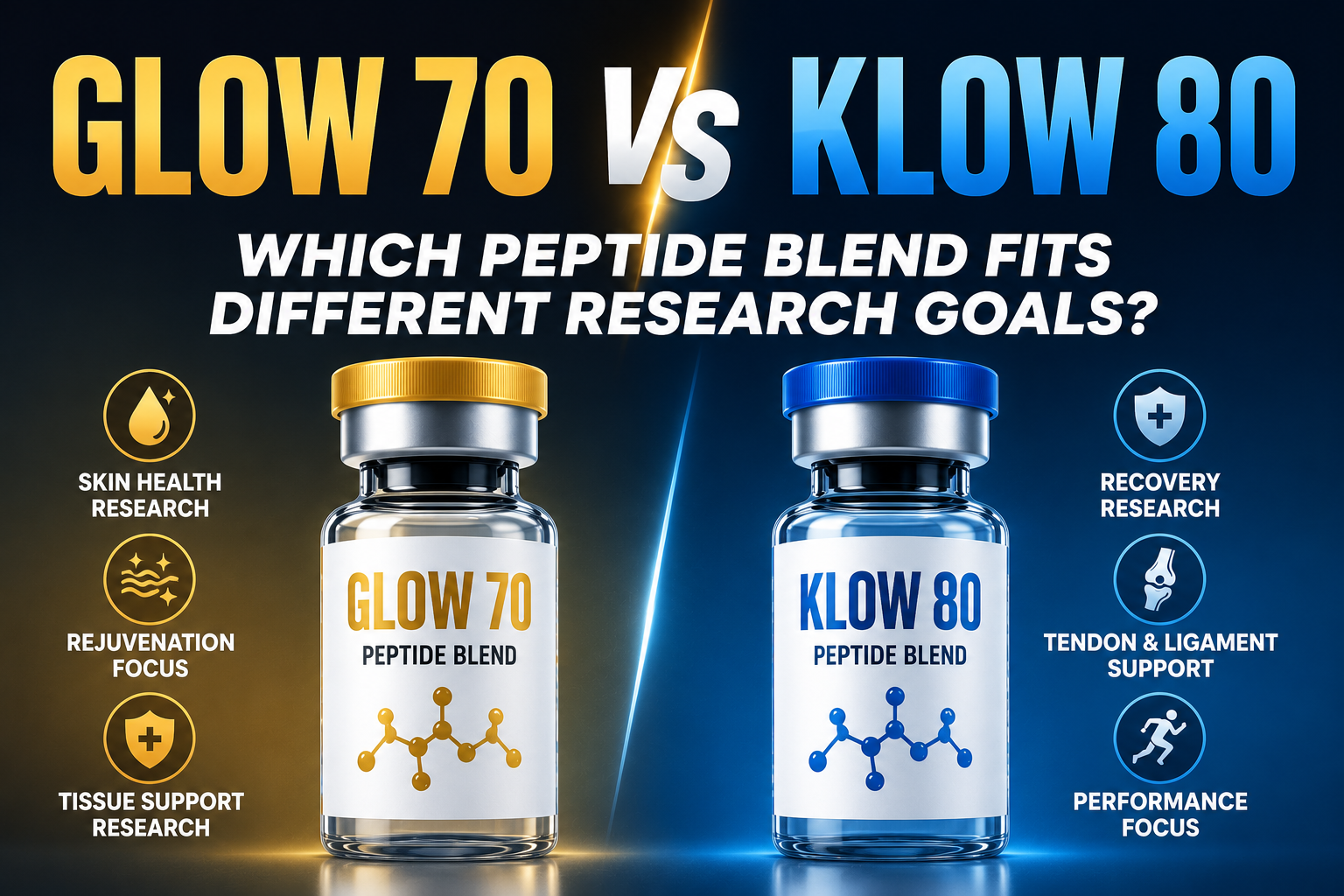
The comparison of GLOW 70 vs KLOW 80 has become increasingly popular among researchers interested in regenerative medicine and peptide science. Both peptide blends combine multiple research peptides into a single formulation, but they are designed with slightly different research objectives.
While GLOW 70 focuses primarily on tissue repair, collagen production, and skin regeneration, KLOW 80 expands on those goals by adding an additional peptide that researchers are studying for its potential role in inflammatory regulation. As a result, scientists may choose one blend over the other depending on the biological pathways they want to investigate.
It is important to understand that both blends are research compounds only. Neither product has been approved as a medical treatment, and most available evidence comes from laboratory and animal studies rather than large human clinical trials.
In this guide, we compare GLOW 70 vs KLOW 80, explain their ingredients, discuss their potential research applications, and highlight the differences that may influence future scientific investigations.

What Is GLOW 70?
GLOW 70 is a multi-peptide research blend developed to study tissue repair and regenerative biology. It combines three well-known peptides that have been individually investigated for their potential roles in wound healing, collagen production, and cellular repair.
A typical GLOW 70 formulation contains:
- GHK-Cu – 50 mg
- BPC-157 – 10 mg
- TB-500 – 10 mg
Together, these peptides provide a total of 70 mg, giving the blend its name.
Researchers study GLOW 70 because each ingredient targets different stages of tissue repair. GHK-Cu is widely known for collagen production, while BPC-157 and TB-500 have been investigated for their roles in connective tissue healing and cell migration.
What Is KLOW 80?
When comparing GLOW 70 vs KLOW 80, the first major difference is the addition of a fourth peptide.
KLOW 80 contains:
- GHK-Cu – 50 mg
- BPC-157 – 10 mg
- TB-500 – 10 mg
- KPV – 10 mg
The inclusion of KPV increases the total peptide content to 80 mg.
Researchers are particularly interested in KPV because of its potential role in regulating inflammatory pathways. This makes KLOW 80 a broader research blend that combines regenerative peptides with a peptide commonly studied for immune and inflammation-related signaling.
Ingredient Comparison
Understanding the ingredients is the easiest way to compare GLOW 70 vs KLOW 80.
GHK-Cu
Both blends contain GHK-Cu, which represents the largest portion of each formulation.
Researchers have investigated GHK-Cu for its potential effects on:
- Collagen production
- Skin regeneration
- Wound healing
- Tissue remodeling
- Gene expression related to repair
Because of these properties, GHK-Cu serves as the foundation of both peptide blends.
BPC-157
BPC-157 appears in both formulations.
Research has explored its possible role in:
- Tendon repair
- Ligament healing
- Muscle recovery
- Gastrointestinal tissue repair
- Blood vessel formation
Although results from laboratory studies are encouraging, more human research is needed.
TB-500
TB-500 is another shared ingredient.
Scientists study this peptide because it may support:
- Cell migration
- Tissue remodeling
- Angiogenesis
- Connective tissue repair
- Muscle recovery
Like BPC-157, TB-500 remains an experimental research peptide.
KPV
KPV is found only in KLOW 80.
This naturally occurring tripeptide has become an important subject of inflammation research. Experimental studies suggest KPV may influence cytokine signaling and immune regulation, although additional human studies are necessary.
Its inclusion is the primary reason researchers compare GLOW 70 vs KLOW 80 when selecting a peptide blend for laboratory investigations.
Key Differences Between GLOW 70 and KLOW 80
Although the two formulations share three peptides, they are not identical.
The most important differences include:
| Feature | GLOW 70 | KLOW 80 |
|---|---|---|
| Total Peptide Content | 70 mg | 80 mg |
| GHK-Cu | ✔ | ✔ |
| BPC-157 | ✔ | ✔ |
| TB-500 | ✔ | ✔ |
| KPV | ✘ | ✔ |
| Main Research Focus | Tissue repair and regeneration | Tissue repair plus inflammation research |
Because KLOW 80 includes KPV, researchers may choose it when they want to investigate inflammatory signaling alongside tissue regeneration.
On the other hand, GLOW 70 remains focused on regenerative biology without the additional inflammation-focused peptide.

Potential Research Applications
Researchers continue comparing GLOW 70 vs KLOW 80 across several areas of regenerative medicine.
Tissue Repair
Both blends have attracted attention for their potential roles in tissue healing. Laboratory studies involving their individual ingredients suggest they may influence cellular repair and connective tissue remodeling.
Skin Health
GHK-Cu makes both formulations attractive for studies involving collagen synthesis and skin regeneration.
Researchers continue investigating its role in improving extracellular matrix remodeling and wound healing.
Blood Vessel Formation
BPC-157 and TB-500 have both been studied for their possible involvement in angiogenesis, which is an important process during tissue repair.
Inflammation Research
This is where GLOW 70 vs KLOW 80 differ most significantly.
Because KLOW 80 includes KPV, it offers researchers an opportunity to investigate inflammation-related pathways in addition to tissue regeneration.
Here’s Part 2, which completes your SEO-friendly blog.
Scientific Evidence
When comparing GLOW 70 vs KLOW 80, it is important to understand that most scientific evidence focuses on the individual peptides rather than the complete blends. Researchers have published studies on GHK-Cu, BPC-157, TB-500, and KPV separately, but there are currently very few peer-reviewed studies evaluating either combination as a finished product.
GHK-Cu Research
GHK-Cu is one of the most extensively studied peptides in regenerative medicine. Research suggests it may promote collagen production, support wound healing, and regulate genes involved in tissue repair. Scientists are also investigating its potential role in improving skin quality and reducing oxidative stress.
BPC-157 Research
BPC-157 has shown encouraging results in laboratory and animal studies involving tendon, ligament, muscle, and gastrointestinal tissue repair. Researchers continue to explore its effects on angiogenesis and connective tissue healing. However, well-designed human clinical trials remain limited.
TB-500 Research
TB-500 is commonly studied for its influence on cell migration and tissue remodeling. Experimental research suggests it may support the movement of cells involved in healing and regeneration. While these findings are promising, additional clinical research is necessary.
KPV Research
KPV is the unique component that separates GLOW 70 vs KLOW 80. Scientists study KPV because of its potential role in regulating inflammatory pathways. Early laboratory studies indicate that it may influence immune signaling and cytokine activity, but stronger human evidence is still needed.
Overall, both peptide blends remain investigational. Current knowledge is based primarily on preclinical research, and future clinical trials will be essential for understanding their full biological effects.
Safety and Research Limitations
Both GLOW 70 and KLOW 80 are experimental peptide blends intended for laboratory research. They should not be viewed as approved medical treatments.
Researchers should consider several limitations before interpreting study results.
Limited Clinical Evidence
The majority of published research has been performed in laboratories or animal models. Human studies evaluating these blends are still lacking.
Unknown Long-Term Safety
Because comprehensive clinical trials have not been completed, the long-term safety of either peptide blend remains unknown.
Product Quality
Research peptides may vary in purity depending on the manufacturer. Independent third-party testing is important for ensuring consistent quality in laboratory studies.
Regulatory Status
Neither GLOW 70 nor KLOW 80 is approved by the U.S. Food and Drug Administration (FDA) for treating or preventing disease. These products are generally marketed for research purposes only.
Which Blend Fits Different Research Goals?
The answer depends on the biological pathways researchers want to investigate.
Choose GLOW 70 for Regenerative Research
Researchers interested primarily in tissue repair, collagen production, and connective tissue regeneration may prefer GLOW 70. Its three-peptide combination focuses on regenerative processes without including an inflammation-focused peptide.
Choose KLOW 80 for Broader Research
Researchers who want to study both regeneration and inflammatory signaling may find KLOW 80 more suitable. The addition of KPV expands the blend’s potential research applications by introducing a peptide associated with immune regulation.
Ultimately, the comparison of GLOW 70 vs KLOW 80 is less about which blend is “better” and more about selecting the formulation that aligns with specific research objectives.
Frequently Asked Questions
What is the main difference between GLOW 70 and KLOW 80?
The primary difference is that KLOW 80 includes KPV in addition to GHK-Cu, BPC-157, and TB-500. GLOW 70 does not contain KPV.
Which blend contains more peptides?
KLOW 80 contains four peptides, while GLOW 70 contains three.
Is KLOW 80 more effective than GLOW 70?
Current scientific evidence does not demonstrate that one blend is more effective than the other. Their intended research goals differ, and clinical studies comparing the two formulations are not yet available.
Are these peptide blends approved medications?
No. Both GLOW 70 and KLOW 80 are research compounds and are not approved medical treatments.
Why do researchers compare GLOW 70 vs KLOW 80?
Researchers compare these blends because they share several regenerative peptides but differ in their inclusion of KPV. This difference may influence the biological pathways investigated during laboratory research.
Conclusion
The comparison of GLOW 70 vs KLOW 80 highlights how small differences in peptide composition can influence research goals. Both blends contain GHK-Cu, BPC-157, and TB-500, making them valuable tools for studying tissue repair, collagen production, and regenerative biology.
However, KLOW 80 expands upon the GLOW 70 formula by adding KPV, a peptide commonly investigated for its potential role in inflammatory regulation. As a result, KLOW 80 may be more appropriate for studies that explore both tissue regeneration and inflammation, while GLOW 70 remains focused on core regenerative pathways.
Although the individual peptides have shown promising results in laboratory and animal research, evidence supporting either complete blend is still limited. Large, well-designed human clinical trials are needed before any conclusions can be made regarding their effectiveness or safety in clinical settings.
As peptide science continues to evolve, researchers will gain a better understanding of how these multi-peptide formulations interact and whether combining peptides offers advantages over studying them individually.
Reference
Pickart, L., & Margolina, A. (2018). Regenerative and protective actions of the GHK-Cu peptide in the light of the new gene data. International Journal of Molecular Sciences, 19(7), 1987. https://doi.org/10.3390/ijms19071987
Goldstein, A. L., & Kleinman, H. K. (2015). Advances in the basic and clinical applications of thymosin β4. Expert Opinion on Biological Therapy, 15(Suppl. 1), S139–S145. https://doi.org/10.1517/14712598.2015.1014791
National Library of Medicine. PubMed. https://pubmed.ncbi.nlm.nih.gov/
National Center for Biotechnology Information (NCBI). https://www.ncbi.nlm.nih.gov/
