
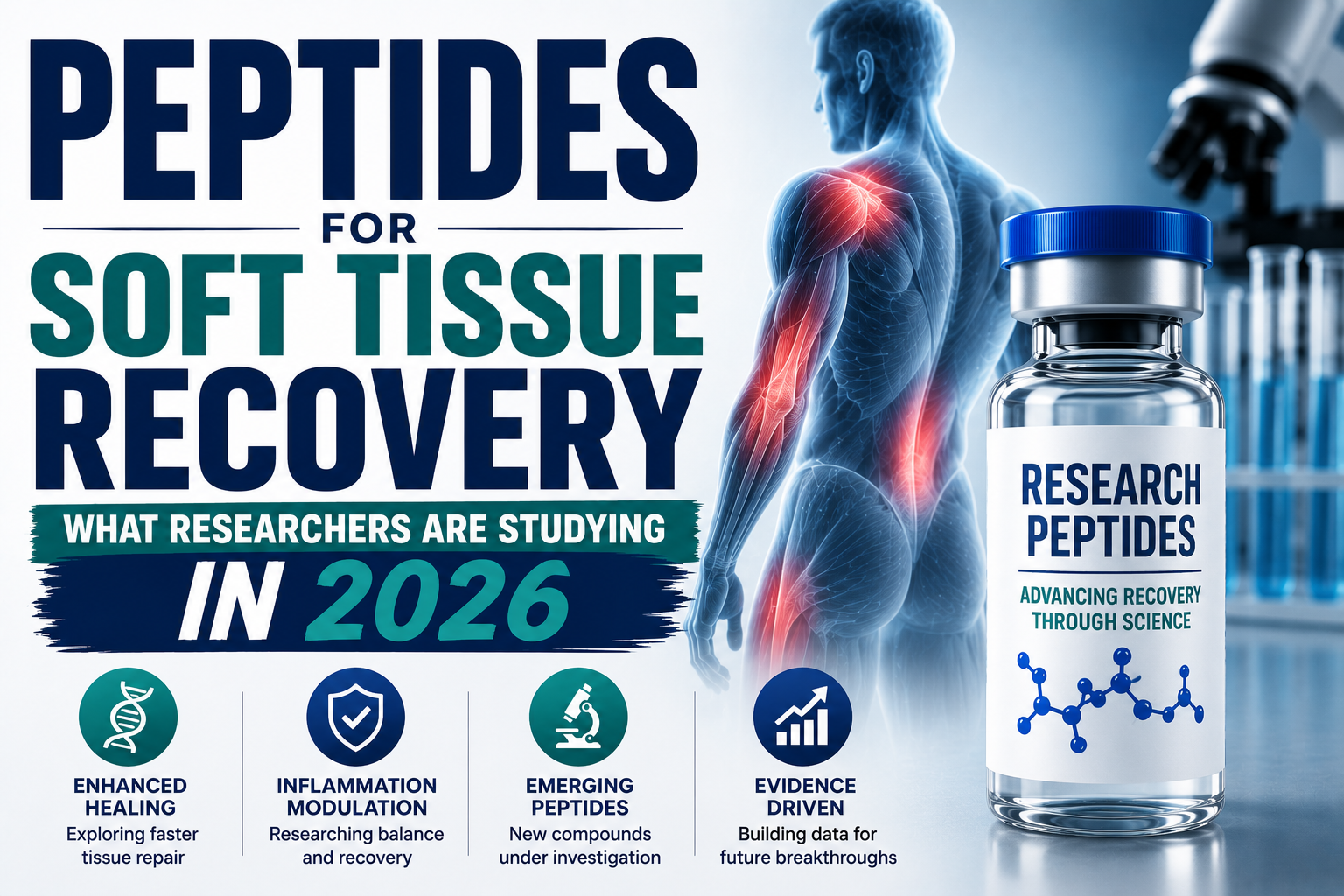
Soft tissue injuries are among the most common problems in sports medicine, orthopedics, and rehabilitation. Damage to tendons, ligaments, muscles, fascia, and connective tissue can take weeks or months to heal, especially when blood supply is limited. Because of these challenges, scientists continue to investigate peptides for soft tissue recovery as potential tools for improving tissue repair.
In 2026, interest in regenerative peptides remains high. Laboratory studies suggest several peptides may influence inflammation, collagen production, angiogenesis, stem cell signaling, and tissue remodeling. However, researchers also emphasize an important limitation: most of these compounds still lack large, high-quality human clinical trials.
This article reviews the latest research trends, the peptides receiving the most scientific attention, and where evidence currently stands.

What Are Peptides?
Peptides are short chains of amino acids that act as signaling molecules throughout the body. Some occur naturally, while others are synthesized for research purposes. Unlike structural proteins, peptides often function as biological messengers that help regulate healing, immune responses, hormone activity, and cellular communication.
Researchers studying peptides for soft tissue recovery are interested in how these molecules may influence:
- Tissue regeneration
- Blood vessel formation (angiogenesis)
- Collagen synthesis
- Inflammatory signaling
- Cell migration
- Fibroblast activity
- Extracellular matrix remodeling
Rather than replacing damaged tissue directly, peptides appear to influence the biological environment in which healing occurs.
Why Soft Tissue Recovery Is Difficult
Unlike bone, many soft tissues receive relatively poor blood flow.
Examples include:
- Tendons
- Ligaments
- Rotator cuff tissue
- Meniscus
- Plantar fascia
- Cartilage attachments
Limited circulation slows nutrient delivery and waste removal, making healing significantly slower.
Researchers therefore continue exploring biological approaches that may improve the body’s natural repair mechanisms rather than simply reducing pain.
BPC-157 Remains the Most Studied Recovery Peptide
Among experimental peptides, BPC-157 continues to receive the greatest scientific attention for soft tissue repair.
Originally derived from a protective gastric protein sequence, BPC-157 has demonstrated encouraging findings across numerous animal models involving:
- Tendon injuries
- Ligament damage
- Muscle tears
- Peripheral nerves
- Bone healing
- Gastrointestinal tissue
Researchers believe BPC-157 may support recovery through several mechanisms:
- Improved angiogenesis
- Enhanced fibroblast migration
- Increased collagen organization
- Reduced inflammatory signaling
- Protection against oxidative stress
A large 2025 review concluded that animal evidence for BPC-157 is extensive across multiple tissue types. However, investigators also emphasized that robust human clinical evidence remains very limited, making it impossible to confirm effectiveness in patients.
TB-500 and Thymosin Beta-4 Research
Another major focus of peptides for soft tissue recovery is TB-500, a synthetic fragment based on the naturally occurring protein Thymosin Beta-4.
Laboratory research suggests Thymosin Beta-4 plays important roles in:
- Cell migration
- Blood vessel growth
- Inflammation regulation
- Tissue remodeling
- Wound healing
TB-500 is being investigated because it may reproduce some of these biological effects.
Animal studies suggest possible benefits for:
- Muscle regeneration
- Tendon repair
- Reduced scar formation
- Improved mobility after injury
Some researchers believe TB-500 may work particularly well in widespread soft tissue injuries because its biological effects are systemic rather than localized.
However, similar to BPC-157, high-quality human clinical evidence remains scarce.
Why Researchers Sometimes Study BPC-157 and TB-500 Together
Many laboratory investigators explore combining BPC-157 with TB-500 because their proposed mechanisms appear complementary.
Potential research advantages include:
- Improved blood vessel formation
- Enhanced collagen organization
- Better inflammatory regulation
- Greater cell migration
- Faster tissue remodeling
Although this combination has become popular within research communities, there are currently no large randomized clinical trials confirming superior outcomes in humans. Most available evidence comes from animal studies and anecdotal reports.
KPV and Inflammation Control
Inflammation is necessary during the early stages of healing, but excessive inflammation can delay tissue repair.
KPV is a small peptide fragment derived from alpha-melanocyte-stimulating hormone (α-MSH).
Researchers are studying KPV because it appears capable of reducing inflammatory signaling without broadly suppressing immune function.
Current laboratory studies are evaluating whether KPV may help:
- Reduce inflammatory cytokines
- Support tissue regeneration
- Improve chronic inflammatory environments
- Enhance recovery when excessive inflammation limits healing
Although research remains early, KPV represents an interesting area for future regenerative medicine.
GHK-Cu and Connective Tissue Remodeling
GHK-Cu (glycyl-L-histidyl-L-lysine copper) has been studied for decades in wound healing and skin regeneration.
Unlike several experimental recovery peptides, GHK-Cu has relatively stronger human evidence for improving skin repair and connective tissue remodeling.
Researchers have observed that GHK-Cu may:
- Stimulate collagen production
- Promote extracellular matrix repair
- Improve skin regeneration
- Encourage fibroblast activity
- Support angiogenesis
Because connective tissue healing depends heavily on collagen remodeling, GHK-Cu continues to receive significant attention in regenerative medicine.
Emerging Areas of Research in 2026
The field of peptides for soft tissue recovery is evolving beyond simply testing individual peptides.
Researchers are now investigating:
Combination Therapies
Scientists are studying whether peptides may work alongside:
- Platelet-rich plasma (PRP)
- Stem cell therapy
- Physical rehabilitation
- Biologic scaffolds
- Growth factors
The goal is to create synergistic healing environments rather than relying on a single intervention.
Biomaterial Delivery Systems
Instead of repeated injections, researchers are designing smart delivery systems capable of releasing peptides gradually over time.
Examples include:
- Hydrogels
- Nanofibers
- Bioactive scaffolds
- Controlled-release implants
These technologies may improve local tissue exposure while reducing repeated dosing.
Precision Regenerative Medicine
Future research is increasingly focused on identifying which peptide works best for specific injury types.
Rather than using one peptide for every condition, researchers hope to match therapies according to:
- Tendon injuries
- Muscle tears
- Ligament damage
- Surgical recovery
- Chronic degeneration
Current Limitations of the Evidence
Despite widespread interest, important scientific limitations remain.
Most evidence supporting peptides for soft tissue recovery comes from:
- Animal studies
- Laboratory research
- Cell culture experiments
- Small observational studies
Researchers continue to identify several unanswered questions:
- Optimal dosage
- Treatment duration
- Long-term safety
- Best delivery method
- Interaction with rehabilitation
- Patient selection
Because of these uncertainties, experts caution against assuming laboratory findings automatically translate into clinical benefit.
Regulatory Status
An important distinction in 2026 is that many recovery peptides remain experimental.
Several peptides discussed for tissue repair—including BPC-157 and TB-500—are not approved as prescription medicines for treating soft tissue injuries in many jurisdictions. Regulatory agencies continue reviewing available evidence while emphasizing the need for larger clinical trials.
Researchers therefore continue to describe these compounds as investigational rather than established medical therapies.
Future Directions
The future of peptide research looks promising but remains evidence-driven.
Scientists are now prioritizing:
- Larger randomized clinical trials
- Better safety monitoring
- Standardized dosing protocols
- Long-term follow-up
- Comparative effectiveness studies
- Combination regenerative therapies
If future human studies confirm encouraging laboratory findings, peptides may eventually become valuable components of regenerative medicine for tendon, ligament, muscle, and connective tissue injuries.
Conclusion
Research into peptides for soft tissue recovery continues to expand in 2026, with BPC-157, TB-500, KPV, and GHK-Cu attracting significant scientific interest. Animal studies suggest these peptides may influence inflammation, collagen production, angiogenesis, and tissue remodeling—key biological processes involved in healing.
However, enthusiasm should be balanced with scientific caution. Most evidence remains preclinical, and high-quality human trials are still limited. Until stronger clinical data become available, these peptides should be viewed as promising research compounds rather than proven treatments for soft tissue injuries.
As regenerative medicine advances, future studies will determine whether these experimental peptides can safely improve recovery outcomes in patients.
Frequently Asked Questions
What are peptides for soft tissue recovery?
They are short amino acid chains being studied for their potential effects on tissue repair, inflammation, collagen production, and healing of muscles, tendons, and ligaments.
Which peptide has the most research for soft tissue healing?
BPC-157 currently has the largest body of preclinical research involving tendon, ligament, muscle, nerve, and connective tissue healing, although human evidence remains limited.
Is TB-500 proven to repair injuries?
Not yet. Animal research is encouraging, but large human clinical trials are still lacking.
Are these peptides FDA-approved for injury treatment?
Many peptides promoted for soft tissue recovery, including BPC-157 and TB-500, are not approved for treating musculoskeletal injuries in many countries.
What is the biggest challenge in peptide research?
The biggest limitation is the shortage of large, well-designed human clinical trials that can confirm long-term safety and effectiveness.
- Regeneration or Risk? A Narrative Review of BPC-157 for Musculoskeletal Healing (PMC): https://pmc.ncbi.nlm.nih.gov/articles/PMC12446177/
- Local and Systemic Peptide Therapies for Soft Tissue Regeneration (PMC): https://pmc.ncbi.nlm.nih.gov/articles/PMC11426299/
- Multifunctionality and Possible Medical Application of the BPC 157 Peptide (MDPI): https://www.mdpi.com/1424-8247/18/2/185
- PubMed – BPC-157 Musculoskeletal Healing Review: https://pubmed.ncbi.nlm.nih.gov/40789979/
