
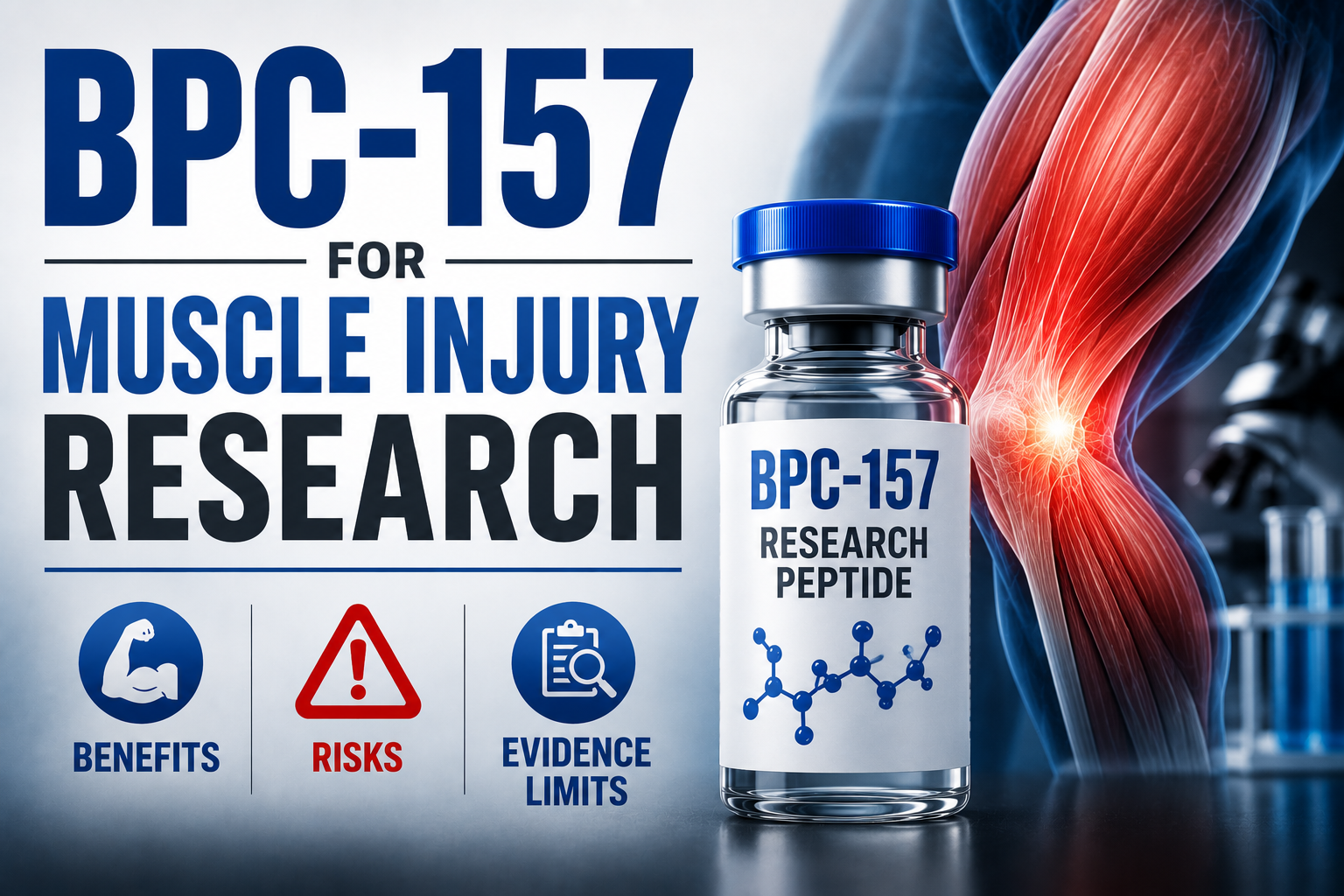
Muscle injuries are among the most common problems affecting athletes, physically active individuals, and people recovering from surgery or trauma. Because recovery can take weeks or even months, researchers continue to investigate new compounds that may support tissue repair. One peptide that has received significant attention is BPC-157.
Interest in BPC-157 muscle injury research has grown rapidly over the past few years. Laboratory and animal studies suggest that this peptide may influence tissue healing, blood vessel formation, inflammation, and collagen production. However, despite growing popularity online, there is still limited clinical evidence supporting its use in humans.
This article explores what BPC-157 is, how it may affect muscle healing, current research findings, possible risks, and the important limitations researchers continue to face.
What Is BPC-157?
BPC-157 (Body Protection Compound-157) is a synthetic peptide derived from a protective protein naturally found in gastric juice. It consists of 15 amino acids and has been investigated for its potential effects on tissue repair in preclinical research.
Scientists have studied BPC-157 in various injury models involving:
- Skeletal muscle
- Tendons
- Ligaments
- Bones
- Peripheral nerves
- Gastrointestinal tissue
Although laboratory findings have been promising, BPC-157 remains an experimental research peptide. It has not been approved by the U.S. Food and Drug Administration (FDA) for treating muscle injuries or any medical condition.
Why Researchers Are Interested in BPC-157 Muscle Injury Studies
Muscle healing is a complex biological process involving several overlapping phases:
- Inflammation
- Removal of damaged tissue
- New blood vessel formation
- Muscle fiber regeneration
- Tissue remodeling
Researchers believe BPC-157 may influence several of these stages simultaneously.
Potential mechanisms currently being investigated include:
- Enhanced angiogenesis (formation of new blood vessels)
- Improved collagen organization
- Reduced inflammatory signaling
- Support for fibroblast activity
- Better communication between growth factors involved in repair
These proposed mechanisms explain why BPC-157 continues attracting scientific interest.
How Muscle Injuries Heal
Understanding muscle healing helps explain why peptides are being investigated.
Phase 1: Inflammation
Immediately after injury, immune cells remove damaged tissue while releasing inflammatory signals.
Phase 2: Regeneration
Satellite cells become activated and begin rebuilding damaged muscle fibers.
Phase 3: Remodeling
New muscle fibers mature while collagen strengthens the repaired tissue.
Researchers hope that BPC-157 may positively influence multiple stages without disrupting normal healing processes.
What Animal Studies Show About BPC-157 Muscle Injury
Most available evidence comes from animal models rather than human clinical trials.
Several experimental studies have reported:
Faster Muscle Regeneration
Rodent studies found improved regeneration after experimentally induced muscle injuries.
Researchers observed:
- Faster recovery of damaged fibers
- Better muscle organization
- Reduced scar tissue formation
However, animal outcomes cannot automatically predict human results.
Improved Blood Vessel Formation
Healthy muscles require adequate blood flow during recovery.
Research suggests BPC-157 may stimulate angiogenesis through pathways involving:
- VEGF (Vascular Endothelial Growth Factor)
- Nitric oxide signaling
- Endothelial cell activity
Improved circulation could theoretically enhance nutrient and oxygen delivery to healing tissues.
Reduced Fibrosis
One major concern after muscle injury is excessive scar tissue.
Some laboratory studies suggest BPC-157 may reduce fibrosis while supporting healthier tissue remodeling.
Less fibrosis could potentially improve long-term muscle flexibility and function.
Better Functional Recovery
Animal research has also reported improvements in:
- Muscle strength
- Range of motion
- Weight-bearing ability
- Functional movement
These findings remain preliminary until confirmed in larger human trials.
Proposed Biological Mechanisms
Although researchers continue studying the exact mechanisms, several pathways appear particularly important.
Angiogenesis
New blood vessels are essential for delivering oxygen and nutrients.
BPC-157 appears to interact with vascular repair pathways that may support tissue regeneration.
Nitric Oxide Regulation
Nitric oxide helps regulate:
- Blood flow
- Inflammation
- Cell signaling
Some studies suggest BPC-157 may help maintain healthy nitric oxide activity after injury.
Collagen Production
Collagen provides structural support during muscle healing.
Researchers have observed improved collagen organization in some experimental injury models.
Growth Factor Activity
BPC-157 may influence growth factors involved in tissue repair, although this area requires further investigation.
Potential Benefits Being Investigated
Current research suggests several possible benefits of BPC-157 muscle injury studies.
1. Faster Recovery
Some animal studies report shorter recovery times compared with untreated controls.
2. Reduced Inflammation
Lower inflammatory markers have been observed in several experimental models.
3. Improved Tissue Organization
Researchers have noted better alignment of healing muscle fibers.
4. Support for Connective Tissue
BPC-157 has also been studied for injuries involving:
- Tendons
- Ligaments
- Fascia
Since these tissues often heal alongside muscle injuries, researchers continue exploring combined effects.
5. Better Functional Outcomes
Some studies suggest improved movement and muscle function during recovery.
Again, these observations primarily come from laboratory research rather than human clinical trials.
Human Evidence Remains Limited
One of the biggest limitations in current knowledge is the lack of high-quality human studies.
At present:
- Large randomized clinical trials are lacking.
- Most evidence comes from rodents.
- Optimal dosing remains unknown.
- Long-term safety has not been established.
- Comparative studies are minimal.
As a result, researchers cannot confidently determine whether laboratory findings translate into routine clinical use.
Risks and Safety Concerns
Although BPC-157 is often described online as “safe,” scientific evidence remains incomplete.
Important concerns include:
Limited Human Safety Data
Very few controlled human studies have evaluated long-term safety.
Researchers still do not know:
- Appropriate dosage
- Treatment duration
- Potential long-term effects
Product Quality Issues
Many products sold online are marketed as research peptides.
Independent testing has found that some peptide products may contain:
- Incorrect concentrations
- Impurities
- Different peptides than listed
- Contamination
This creates significant quality-control concerns.
Unknown Drug Interactions
Researchers have limited information regarding interactions with:
- Prescription medications
- Anti-inflammatory drugs
- Blood thinners
- Hormonal therapies
Additional research is needed.
Regulatory Status
BPC-157 is not approved by the FDA for treating muscle injuries.
It is also prohibited in competitive sports by the World Anti-Doping Agency (WADA) under the S0 category for non-approved substances.
Athletes should understand these regulations before considering any experimental peptide.
Current Evidence Limitations
Several factors limit current scientific conclusions.
Heavy Reliance on Animal Research
Rodent healing differs from human muscle regeneration.
Positive laboratory findings do not guarantee identical clinical outcomes.
Small Sample Sizes
Many published studies involve relatively few experimental subjects.
Larger studies improve confidence in scientific findings.
Short Follow-Up Periods
Most research evaluates recovery over weeks rather than months or years.
Long-term effects remain uncertain.
Lack of Standardized Protocols
Researchers use different:
- Dosages
- Delivery methods
- Injury models
- Study designs
This makes direct comparisons difficult.
Who Is Studying BPC-157?
Research involving BPC-157 includes scientists working in:
- Regenerative medicine
- Sports medicine
- Orthopedics
- Tissue engineering
- Muscle biology
- Experimental pharmacology
Future research will likely focus on:
- Human clinical trials
- Standardized dosing
- Long-term safety
- Mechanism confirmation
- Combination therapies
Frequently Asked Questions
Is BPC-157 approved for muscle injuries?
No. BPC-157 has not been approved by the FDA for treating muscle injuries or other medical conditions.
Does BPC-157 repair muscle tissue?
Animal studies suggest it may support muscle healing, but human evidence remains limited.
Is BPC-157 legal in professional sports?
No. WADA lists BPC-157 as a prohibited substance in competition and out of competition.
Are there human clinical trials?
Only limited human research is available. Most published evidence comes from laboratory and animal studies.
Is BPC-157 considered safe?
Its long-term safety has not been established through large, high-quality clinical trials.
Final Thoughts
Research into BPC-157 muscle injury continues to generate scientific interest because of encouraging findings from laboratory and animal studies. Investigators have observed potential improvements in muscle regeneration, blood vessel formation, collagen organization, and functional recovery. These early results suggest that BPC-157 may influence several biological pathways involved in tissue repair.
However, the current evidence has important limitations. Most studies have been conducted in animals, while robust human clinical trials remain scarce. Questions about optimal dosing, long-term safety, product quality, and real-world effectiveness have not yet been answered.
Until larger, well-designed clinical studies become available, BPC-157 should be viewed as an experimental research peptide rather than an established treatment for muscle injuries. Ongoing scientific investigation will determine whether its promising preclinical findings can eventually translate into safe and effective clinical applications.
Reference
U.S. Food and Drug Administration. (n.d.). FDA. https://www.fda.gov
World Anti-Doping Agency. (2025). The World Anti-Doping Code International Standard: Prohibited List. https://www.wada-ama.org/en/prohibited-list
National Library of Medicine. (n.d.). PubMed. https://pubmed.ncbi.nlm.nih.gov/?term=BPC-157
National Center for Biotechnology Information. (n.d.). NCBI. https://www.ncbi.nlm.nih.gov
International Journal of Molecular Sciences. (Various years). Research articles on tissue repair and regenerative medicine. https://www.mdpi.com/journal/ijms
