
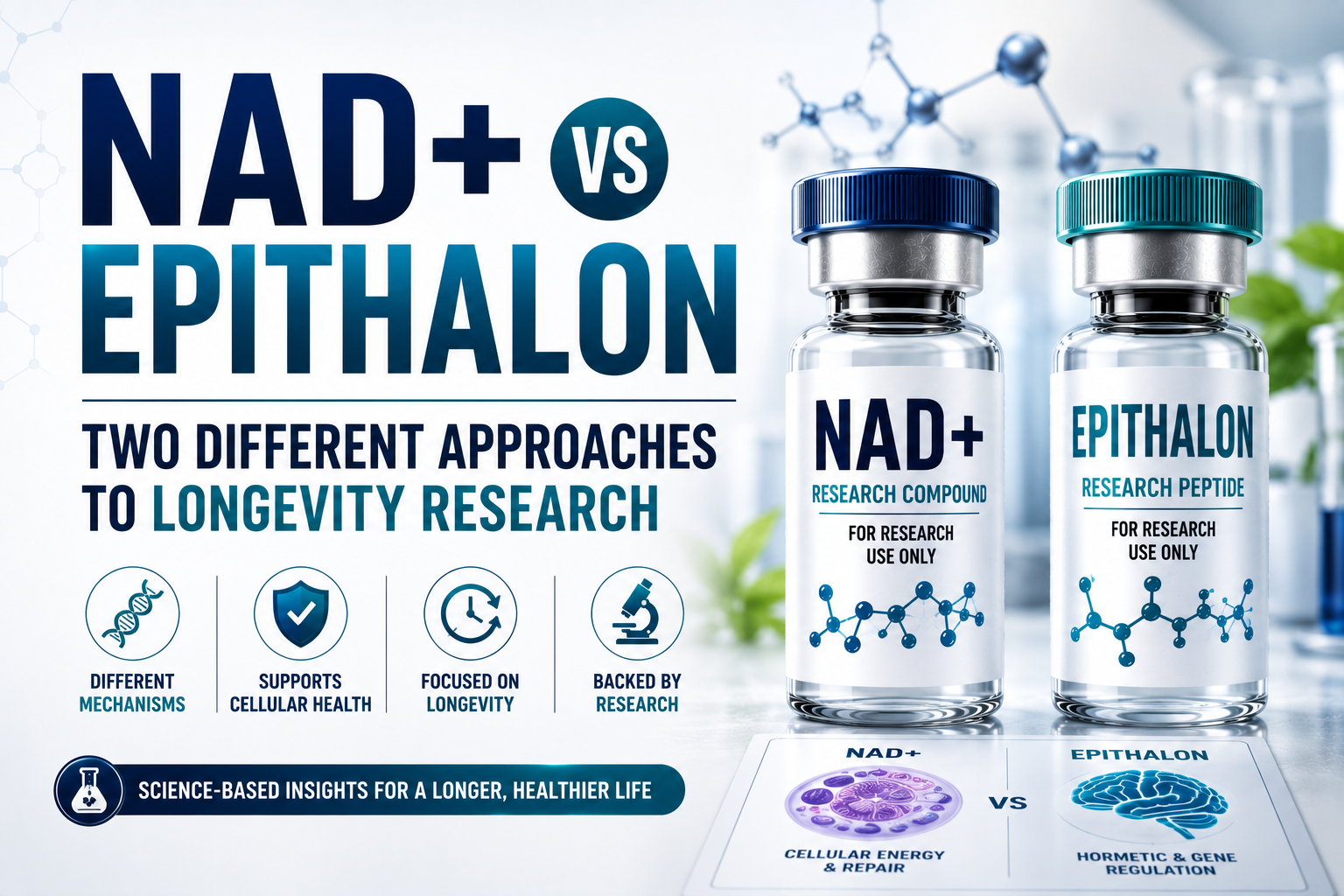
As longevity science advances, researchers are exploring a growing number of compounds that may influence healthy aging. Two of the most widely discussed are NAD+ and the Epithalon peptide. Although both are investigated for their potential roles in aging research, they work through entirely different biological pathways.
NAD+ (Nicotinamide Adenine Dinucleotide) is a naturally occurring coenzyme essential for cellular energy production and DNA repair. In contrast, Epithalon is a synthetic tetrapeptide primarily studied for its potential effects on telomerase activity, pineal gland function, and cellular aging.
Understanding the differences between NAD+ vs Epithalon is important because they target distinct mechanisms rather than competing for the same biological function. This article explores how each compound works, compares the available scientific evidence, and reviews their potential benefits and limitations.
What Is NAD+?
NAD+ is a coenzyme found in every living cell. It plays a critical role in numerous biological processes, including:
- Cellular energy production
- DNA repair
- Mitochondrial function
- Cellular metabolism
- Oxidative stress regulation
- Activation of sirtuin proteins
Natural NAD+ levels decline with age, prompting researchers to investigate whether increasing NAD+ availability may help support healthy aging.
What Is Epithalon?
Epithalon (also known as Epitalon) is a synthetic peptide composed of four amino acids:
- Alanine
- Glutamic acid
- Aspartic acid
- Glycine
Researchers developed Epithalon from Epithalamin, a peptide complex originally isolated from the pineal gland.
Unlike NAD+, which supports cellular metabolism, Epithalon is primarily investigated for its potential effects on:
- Telomerase activity
- Telomere maintenance
- Pineal gland function
- Melatonin production
- Circadian rhythm
- Cellular aging
How NAD+ Works
NAD+ participates in hundreds of biochemical reactions throughout the body.
Supporting Cellular Energy
One of NAD+’s primary functions is helping mitochondria convert nutrients into ATP, the body’s main energy source.
Activating Sirtuins
NAD+ activates sirtuin proteins, which regulate cellular repair, metabolism, inflammation, and stress resistance.
DNA Repair
Researchers study NAD+ because it supports enzymes known as PARPs, which help repair damaged DNA.
Mitochondrial Health
Healthy mitochondria are essential for proper cell function, and NAD+ plays an important role in maintaining their activity.
How Epithalon Works
Epithalon targets different biological systems than NAD+.
Telomerase Activity
Researchers investigate whether Epithalon increases telomerase activity, an enzyme responsible for maintaining telomeres at the ends of chromosomes.
Pineal Gland Support
Epithalon may influence pineal gland function and melatonin production, which help regulate circadian rhythms.
Oxidative Stress
Laboratory studies suggest Epithalon may increase antioxidant defenses and reduce oxidative damage.
Gene Regulation
Some experimental studies indicate that Epithalon may influence genes involved in cellular repair, inflammation, and aging.
NAD+ vs Epithalon: Key Differences
| Feature | NAD+ | Epithalon |
|---|---|---|
| Compound type | Naturally occurring coenzyme | Synthetic tetrapeptide |
| Primary research focus | Cellular energy and metabolism | Telomerase and longevity |
| Main biological target | Mitochondria and sirtuins | Telomeres and pineal gland |
| DNA repair | Strong research focus | Indirect research interest |
| Cellular energy | Primary function | Not primary focus |
| Sleep regulation | Limited | Potential role through melatonin |
| Human research | Moderate | Limited |
| Clinical status | Investigational for longevity | Investigational |
Potential Research Benefits of NAD+
Current research is investigating whether NAD+ may support:
Healthy Cellular Metabolism
Higher NAD+ availability may improve cellular energy production in aging tissues.
Mitochondrial Function
Researchers continue studying whether maintaining NAD+ levels supports healthier mitochondria.
DNA Repair
NAD+ activates enzymes involved in repairing damaged DNA.
Healthy Aging
Scientists are exploring whether NAD+ influences biological pathways associated with age-related decline.
Potential Research Benefits of Epithalon
Current research focuses on several possible biological effects.
Telomere Maintenance
Epithalon is primarily investigated for its potential influence on telomerase activity.
Circadian Rhythm
Researchers are studying whether Epithalon affects melatonin production and sleep regulation.
Cellular Protection
Laboratory studies suggest antioxidant activity that may reduce oxidative stress.
Healthy Aging
Scientists continue investigating whether Epithalon influences biomarkers associated with aging.
Scientific Evidence
NAD+
Research involving NAD+ is considerably more extensive than research on Epithalon.
Human studies have investigated NAD+ and its precursors in relation to:
- Aging
- Metabolic health
- Muscle function
- Neurological health
- Cardiovascular function
Although results remain mixed, the body of evidence continues to expand.
Epithalon
Most published studies involve:
- Cell cultures
- Animal models
- Small human studies
- Scientific reviews
Laboratory findings are encouraging, but larger independent clinical trials remain necessary.
Safety Considerations
NAD+
Research generally suggests NAD+ and related compounds are well tolerated in clinical studies.
Reported side effects vary depending on the formulation and delivery method but are often mild.
Epithalon
Available research also suggests good tolerability in experimental settings.
However, long-term safety data remain limited, and optimal dosing has not been established.
Research Limitations
Both compounds have important limitations.
NAD+
Researchers continue studying:
- Optimal dosing
- Long-term effectiveness
- Best delivery methods
- Clinical significance of increased NAD+ levels
Epithalon
Major limitations include:
- Limited human studies
- Small sample sizes
- Older research
- Lack of independent replication
- Unknown long-term safety
Which Has Stronger Scientific Evidence?
Based on current research, NAD+ has a stronger evidence base than Epithalon.
NAD+ has been investigated in numerous human studies, while Epithalon research relies more heavily on laboratory experiments and animal models.
This does not necessarily mean NAD+ is more effective for longevity. Instead, it means researchers currently have more clinical data available to evaluate its biological effects.
Can NAD+ and Epithalon Be Compared Directly?
Although they are often mentioned together in longevity discussions, they are not direct substitutes.
NAD+ primarily supports:
- Cellular metabolism
- Energy production
- DNA repair
- Mitochondrial health
Epithalon primarily targets:
- Telomerase activity
- Pineal gland biology
- Circadian rhythm
- Cellular aging pathways
Because they work through different mechanisms, researchers view them as complementary areas of investigation rather than competing therapies.
Future Research
Scientists continue exploring both compounds in relation to:
- Healthy aging
- Cellular repair
- Regenerative medicine
- Biomarkers of aging
- Mitochondrial biology
- Genomic stability
Future clinical trials will help determine how each compound may contribute to longevity research.
Conclusion
The comparison of NAD+ vs Epithalon highlights two very different approaches to longevity research. NAD+ focuses on improving cellular energy production, mitochondrial function, DNA repair, and metabolic health. Epithalon, by contrast, is primarily studied for its potential effects on telomerase activity, pineal gland function, circadian rhythm, and cellular aging.
Current evidence supporting NAD+ is broader and includes more human research, while Epithalon remains an intriguing investigational peptide with encouraging laboratory findings but limited clinical data. As longevity science evolves, both compounds will continue to play important roles in helping researchers better understand the biology of aging.
Frequently Asked Questions
What is the difference between NAD+ and Epithalon?
NAD+ is a naturally occurring coenzyme involved in cellular energy production and DNA repair, whereas Epithalon is a synthetic peptide studied for its potential effects on telomerase activity and healthy aging.
Which has more scientific evidence?
NAD+ currently has a larger body of human research. Epithalon research is promising but relies mainly on laboratory studies, animal models, and small clinical investigations.
Do NAD+ and Epithalon work the same way?
No. NAD+ primarily supports mitochondrial function and cellular metabolism, while Epithalon is investigated for its potential influence on telomerase, pineal gland function, and circadian biology.
Are NAD+ and Epithalon approved anti-aging treatments?
No. Both remain under investigation for longevity research and are not approved as anti-aging therapies by major regulatory agencies.
References
Verdin, E. (2015). NAD+ in aging, metabolism, and neurodegeneration. Science, 350(6265), 1208–1213.
Yoshino, J., Baur, J. A., & Imai, S. (2018). NAD+ intermediates: The biology and therapeutic potential of NMN and NR. Cell Metabolism, 27(3), 513–528.
Khavinson, V., et al. (2025). Overview of Epitalon—Highly Bioactive Pineal Tetrapeptide with Promising Properties. International Journal of Molecular Sciences, 26(6).
National Center for Biotechnology Information. PubMed. https://pubmed.ncbi.nlm.nih.gov
