
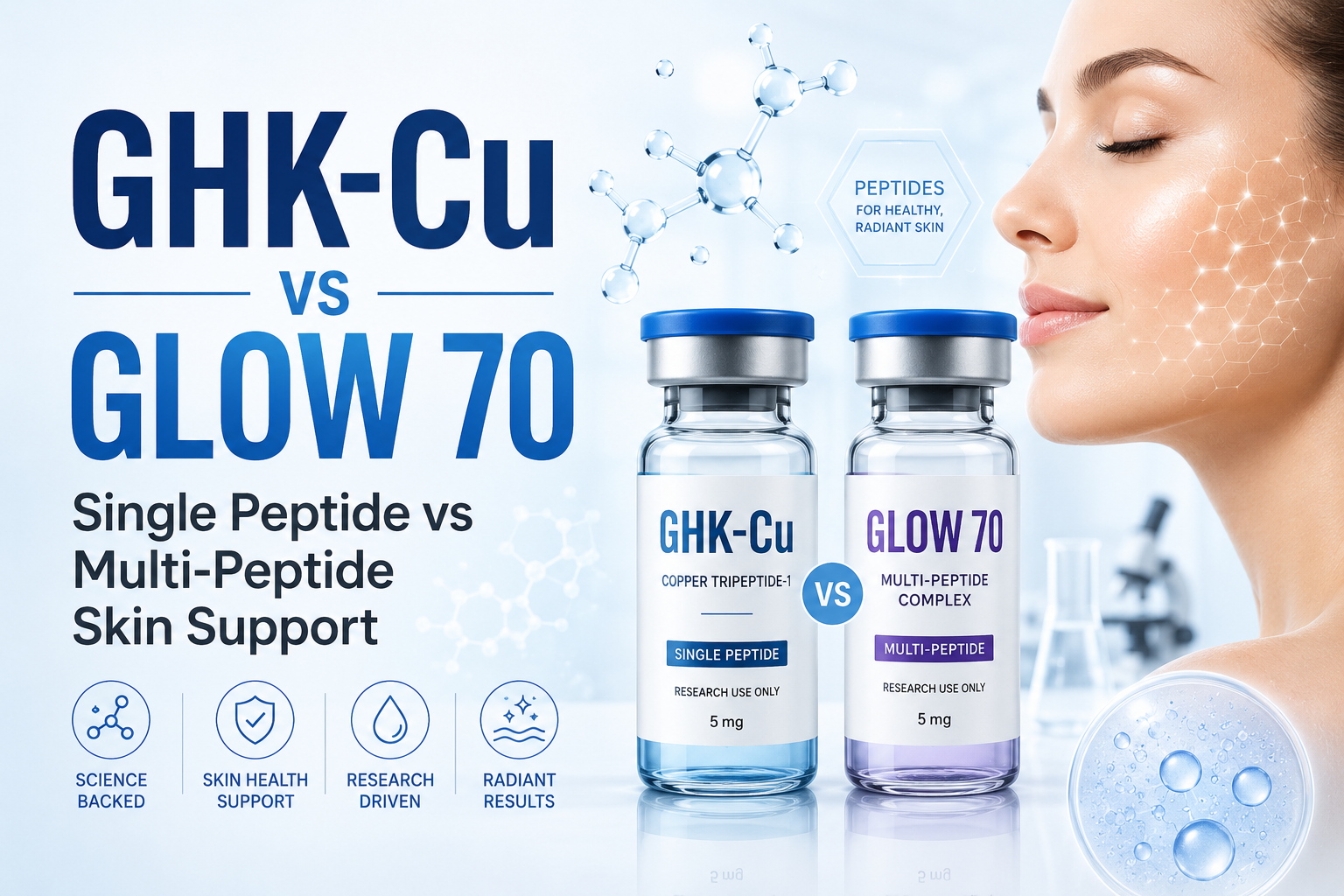
Peptides have become a major focus in regenerative medicine and cosmetic research. Among the many compounds being investigated, GHK-Cu vs GLOW 70 is a comparison that often appears in discussions about skin rejuvenation, collagen production, and tissue repair. While both are associated with skin support, they are very different in composition and scientific evidence.
GHK-Cu is a naturally occurring copper peptide that has been studied for decades. Researchers have explored its potential role in collagen synthesis, wound healing, and healthy skin aging. GLOW 70, on the other hand, is a multi-peptide blend created for research purposes. Instead of relying on a single peptide, it combines several peptides that may work together to support tissue regeneration.
This article compares GHK-Cu vs GLOW 70, explains how each works, reviews current research, and discusses important safety considerations.

What Is GHK-Cu?
GHK-Cu, also known as glycyl-L-histidyl-L-lysine copper, is a naturally occurring tripeptide found in human plasma, saliva, and urine. It binds to copper ions and helps regulate several biological processes involved in tissue maintenance and repair.
Scientists discovered that natural GHK-Cu levels decline with age. As a result, researchers began studying whether restoring these levels could support healthier skin and connective tissue.
Laboratory studies suggest that GHK-Cu may:
- Stimulate collagen production
- Support elastin synthesis
- Promote wound healing
- Reduce oxidative stress
- Help regulate inflammation
- Improve tissue remodeling
Because of these findings, GHK-Cu has become one of the most researched peptides in cosmetic science.
What Is GLOW 70?
Unlike GHK-Cu, GLOW 70 is not a naturally occurring peptide. It is a research blend that combines multiple peptides intended to support skin health through different biological pathways.
Although formulations may vary, GLOW 70 is generally designed to promote:
- Skin repair
- Tissue regeneration
- Collagen formation
- Cellular communication
- Structural protein production
- Recovery following tissue stress
Researchers believe that combining multiple peptides may provide broader regenerative support than using a single peptide alone. However, clinical evidence for GLOW 70 remains limited.
GHK-Cu vs GLOW 70: Main Differences
The biggest difference between GHK-Cu vs GLOW 70 is their composition.
GHK-Cu is one naturally occurring peptide with decades of published research. GLOW 70 is a blend of several peptides designed to influence multiple repair pathways simultaneously.
| Feature | GHK-Cu | GLOW 70 |
|---|---|---|
| Type | Single peptide | Multi-peptide blend |
| Naturally occurring | Yes | No |
| Primary focus | Collagen and skin repair | Broad regenerative support |
| Human research | Moderate | Limited |
| Cosmetic use | Common | Primarily research |
| Scientific evidence | Stronger | Emerging |
Although both compounds are studied for skin support, GHK-Cu currently has a much stronger evidence base.
Skin Rejuvenation Research
Skin aging is associated with lower collagen production, reduced elasticity, and slower tissue repair. Researchers continue investigating peptides that may help support these natural processes.
GHK-Cu
GHK-Cu has been widely studied for skin health. Laboratory research suggests it may activate fibroblasts, the cells responsible for producing collagen and elastin.
Early studies have reported potential improvements in:
- Skin firmness
- Elasticity
- Fine lines
- Skin texture
- Hydration
- Recovery following minor skin injury
These findings explain why GHK-Cu is commonly found in anti-aging skincare products.
GLOW 70
GLOW 70 approaches skin support differently. Instead of depending on one peptide, it combines several compounds that may work together to support tissue repair.
Researchers believe this multi-peptide strategy could encourage healthier skin by influencing multiple biological pathways at the same time. However, large human studies confirming these effects are still unavailable.
Collagen Production
Collagen gives skin its strength and structure. As collagen levels decrease with age, wrinkles and loss of firmness become more noticeable.
One reason GHK-Cu receives so much scientific attention is its potential ability to stimulate collagen synthesis. Studies suggest it may activate fibroblasts while also supporting elastin and extracellular matrix production.
GLOW 70 may also influence collagen production through the combined action of multiple peptides. While this approach appears promising, researchers have not yet demonstrated that it produces greater benefits than GHK-Cu alone.
Tissue Repair and Recovery
Researchers are also studying both compounds for tissue repair.
GHK-Cu has shown encouraging results in laboratory studies involving wound healing, scar remodeling, and connective tissue repair. Scientists believe it may help coordinate the natural healing process by supporting cell communication and collagen formation.
GLOW 70 is being investigated for broader regenerative support. Because it contains multiple peptides, researchers hope it may assist several stages of tissue recovery simultaneously. Even so, more clinical evidence is needed before these possibilities can be confirmed.
Safety Considerations
Current research suggests topical GHK-Cu is generally well tolerated when used in cosmetic products. Reported side effects are usually mild and may include temporary redness, itching, or skin irritation.
The safety profile of GLOW 70 is less established. Since it contains multiple peptides, its safety may depend on the specific formulation and manufacturing quality. Long-term human safety data remain limited.
It is also important to remember that neither compound should be viewed as an approved treatment for medical conditions based on current evidence.
Advantages and Limitations
Advantages of GHK-Cu
- Naturally occurring peptide
- Extensive laboratory research
- Strong evidence for collagen support
- Common ingredient in skincare products
- Well-understood biological mechanisms
Limitations of GHK-Cu
- Human clinical studies remain relatively small
- Long-term injectable safety requires further research
- Individual responses may vary
Advantages of GLOW 70
- Multi-peptide approach
- Designed to target several repair pathways
- Potential for broader regenerative support
Limitations of GLOW 70
- Limited peer-reviewed research
- Few controlled human studies
- Variable formulations between manufacturers
- Long-term safety remains uncertain
Which Has Stronger Scientific Support?
When comparing GHK-Cu vs GLOW 70, GHK-Cu currently has the stronger scientific foundation. Researchers have studied it for decades, and numerous laboratory studies support its role in collagen production, tissue repair, and skin regeneration.
GLOW 70 remains an emerging peptide blend with promising theoretical advantages. However, more high-quality clinical trials are needed before researchers can determine whether it offers meaningful benefits beyond established peptides such as GHK-Cu.
Frequently Asked Questions
Is GHK-Cu better than GLOW 70?
GHK-Cu currently has stronger scientific evidence. However, GLOW 70 is still being investigated, and future studies may provide additional insights.
Does GHK-Cu support collagen production?
Laboratory research suggests GHK-Cu may stimulate collagen production by activating fibroblasts, although more large-scale human studies are needed.
Is GLOW 70 approved for medical use?
No. GLOW 70 is an investigational peptide blend and is not approved as a treatment for medical conditions.
Can either peptide reverse aging?
Current evidence does not support claims that either peptide reverses aging. Research focuses on supporting normal tissue repair and improving markers of skin health.
Conclusion
The comparison of GHK-Cu vs GLOW 70 highlights two different approaches to peptide research. GHK-Cu is a naturally occurring peptide with decades of scientific investigation supporting its potential role in collagen production, skin repair, and tissue regeneration. Its biological mechanisms are relatively well understood, making it one of the most extensively studied peptides in cosmetic research.
GLOW 70 represents a newer multi-peptide strategy designed to support several regenerative pathways simultaneously. While this broader approach is scientifically interesting, published clinical evidence remains limited. More well-designed human studies are needed to evaluate its effectiveness and long-term safety.
Based on current research, GHK-Cu has the stronger evidence base. However, ongoing studies may provide a clearer understanding of whether multi-peptide formulations such as GLOW 70 offer additional benefits for skin support in the future.
References
Maquart, F. X., Pickart, L., Laurent, M., Gillery, P., Monboisse, J. C., & Borel, J. P. (1988). Stimulation of collagen synthesis in fibroblast cultures by the tripeptide-copper complex GHK-Cu. FEBS Letters, 238(2), 343–346. https://doi.org/10.1016/0014-5793(88)80479-7
Pickart, L., & Margolina, A. (2018). Regenerative and protective actions of the GHK-Cu peptide in the light of the new gene data. International Journal of Molecular Sciences, 19(7), 1987. https://doi.org/10.3390/ijms19071987
National Center for Biotechnology Information. https://pubmed.ncbi.nlm.nih.gov/
National Institutes of Health. https://www.nih.gov/
