
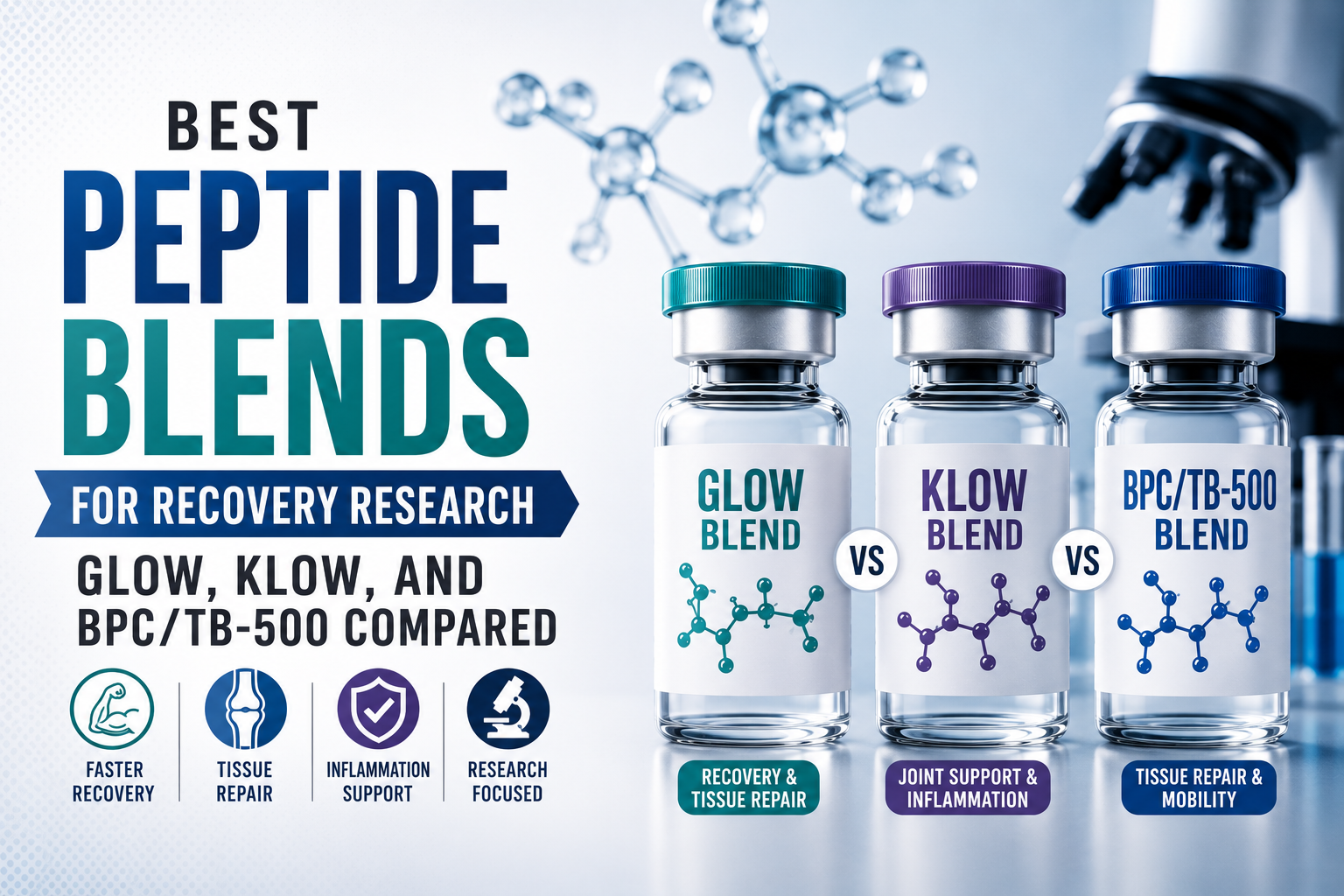
Recovery is one of the most active areas of peptide research. Scientists continue investigating how different peptide combinations influence tissue repair, inflammation, collagen formation, and cellular signaling. Rather than studying a single peptide, many researchers now evaluate peptide blends because multiple compounds may target different biological pathways simultaneously.
Among the most discussed combinations are GLOW, KLOW, and the BPC-157/TB-500 blend. Each has a different composition and research focus, making direct comparisons important for laboratories and investigators.
This guide explains the best peptide blends for recovery based on current research, discusses their proposed mechanisms, compares their strengths and limitations, and reviews what the scientific literature currently supports.
Important: These compounds are intended for laboratory and scientific research only. Most peptides discussed here are not approved by the U.S. Food and Drug Administration (FDA) for treating injuries or diseases in humans.
What Are Peptide Blends?
Peptide blends combine two or more peptides into a single research formulation.
Researchers investigate blends because different peptides may influence separate biological mechanisms, including:
- Tissue remodeling
- Cell migration
- Angiogenesis
- Collagen synthesis
- Inflammatory signaling
- Muscle regeneration
- Connective tissue repair
Instead of evaluating one pathway alone, blends allow scientists to study whether multiple biological processes work together during recovery.
Why Researchers Study the Best Peptide Blends for Recovery
Recovery after tissue injury involves numerous biological events rather than a single repair process.
Research commonly examines:
- Inflammatory response
- Fibroblast activation
- Blood vessel development
- Extracellular matrix remodeling
- Stem cell signaling
- Tendon adaptation
- Ligament remodeling
- Muscle regeneration
Different peptide blends target different parts of these complex pathways.
Understanding the Three Major Recovery Blends
The three most frequently discussed recovery blends include:
| Blend | Primary Research Focus |
|---|---|
| GLOW | Cellular regeneration, skin, connective tissue, recovery |
| KLOW | Inflammation, immune signaling, tissue remodeling |
| BPC-157 + TB-500 | Tendons, ligaments, muscles, wound healing |
Although researchers sometimes compare them directly, they were designed with different biological goals.
GLOW Blend
The GLOW blend typically combines several research peptides that may include:
- GHK-Cu
- BPC-157
- TB-500
- KPV (depending on formulation)
Exact ingredients vary by research supplier.
Primary Research Areas
Researchers investigate GLOW for:
- Skin regeneration
- Collagen production
- Connective tissue recovery
- Wound healing
- Cellular signaling
- Cosmetic tissue research
GHK-Cu contributes significant interest because numerous laboratory studies suggest it influences collagen remodeling and extracellular matrix regulation.
Proposed Biological Mechanisms
Current research suggests GLOW ingredients may influence:
- Fibroblast activity
- Growth factor signaling
- Matrix metalloproteinases
- Collagen synthesis
- Angiogenesis
- Oxidative stress regulation
These mechanisms remain under investigation.
KLOW Blend
KLOW is another peptide combination studied for recovery and inflammatory regulation.
Although formulations differ, KLOW frequently contains peptides such as:
- KPV
- BPC-157
- TB-500
- GHK-Cu
Its emphasis generally leans more toward inflammatory signaling than cosmetic tissue remodeling.
Primary Research Areas
Scientists investigate KLOW for:
- Soft tissue recovery
- Inflammatory pathways
- Gut barrier research
- Connective tissue remodeling
- Joint recovery
- Muscle recovery
Some laboratories explore whether KPV may complement the regenerative properties of BPC-157 and TB-500.
Proposed Biological Mechanisms
Research suggests KLOW ingredients may affect:
- Cytokine signaling
- Immune cell regulation
- Collagen remodeling
- Tissue repair pathways
- Cellular migration
However, these findings largely come from preclinical studies.
BPC-157 + TB-500 Blend
Among the best peptide blends for recovery, the BPC-157 and TB-500 combination receives some of the greatest research attention.
These peptides have been studied separately for years before researchers began combining them.
BPC-157 Research
BPC-157 is investigated for:
- Tendon repair
- Ligament recovery
- Muscle injury
- Gastrointestinal tissue
- Blood vessel formation
Animal research suggests it may influence angiogenesis and fibroblast activity.
TB-500 Research
TB-500 is a synthetic fragment derived from thymosin beta-4.
Researchers study it for:
- Cell migration
- Tissue remodeling
- Muscle regeneration
- Tendon repair
- Flexibility
- Recovery after injury
Much of the current evidence comes from animal models and laboratory experiments.
Why Researchers Combine Them
Rather than targeting identical pathways, researchers believe the two peptides may complement one another.
Proposed interactions include:
- Enhanced cellular migration
- Greater angiogenesis
- Improved collagen organization
- More efficient connective tissue remodeling
Human clinical evidence remains extremely limited.
Comparison of the Best Peptide Blends for Recovery
| Feature | GLOW | KLOW | BPC/TB-500 |
|---|---|---|---|
| Skin research | Excellent | Moderate | Limited |
| Tendon research | High | High | Very High |
| Ligament research | High | High | Very High |
| Muscle recovery | Moderate | High | Very High |
| Connective tissue | Excellent | Excellent | Excellent |
| Inflammation research | Moderate | High | Moderate |
| Gut research | Moderate | High | High |
| Cosmetic research | Very High | Moderate | Low |
| Human clinical evidence | Limited | Limited | Limited |
Which Blend Appears Most Versatile?
Different research objectives favor different blends.
GLOW
Best suited for studies involving:
- Skin remodeling
- Collagen production
- Cosmetic tissue regeneration
- Connective tissue biology
KLOW
Often selected for research involving:
- Inflammatory signaling
- Immune response
- Gut tissue
- Joint recovery
- Soft tissue repair
BPC/TB-500
Frequently investigated for:
- Tendons
- Ligaments
- Muscle recovery
- Orthopedic injury models
- Wound repair
Current Scientific Evidence
Despite growing popularity, important limitations remain.
Most published studies involve:
- Rodents
- Cell cultures
- Laboratory models
High-quality randomized human clinical trials remain scarce.
Scientists therefore cannot conclude that these blends produce the same biological effects in humans.
Safety Considerations
Because these blends remain investigational:
Researchers still do not fully understand:
- Long-term biological effects
- Optimal dosing strategies
- Drug interactions
- Safety during prolonged exposure
- Population-specific risks
Commercial formulations also vary considerably between manufacturers.
Limitations of Current Research
When reviewing the literature, several limitations appear repeatedly:
- Small sample sizes
- Heavy reliance on animal studies
- Limited human trials
- Variable peptide purity
- Different blend formulations
- Lack of standardized protocols
These issues make comparisons difficult.
Future Directions
Researchers continue exploring whether peptide combinations may offer advantages over single-peptide approaches.
Future research may focus on:
- Orthopedic recovery
- Sports medicine
- Regenerative biology
- Stem cell interactions
- Biomaterial integration
- Tissue engineering
- Chronic wound models
Large human clinical trials will be necessary before any therapeutic conclusions can be drawn.
Frequently Asked Questions
Which is considered one of the best peptide blends for recovery?
The answer depends on the research objective. GLOW is commonly studied for skin and connective tissue, KLOW for inflammatory signaling and soft tissue recovery, and BPC-157/TB-500 for tendon, ligament, and muscle research.
Is BPC-157 stronger than GLOW?
Not necessarily. GLOW contains multiple peptides designed to investigate broader recovery pathways, while BPC-157 is a single peptide often focused on connective tissue and gastrointestinal research.
Does KLOW reduce inflammation?
Some laboratory studies suggest ingredients commonly found in KLOW may influence inflammatory signaling. However, these findings are primarily preclinical and should not be interpreted as proven clinical effects.
Are peptide blends FDA-approved?
No. Blends such as GLOW, KLOW, and BPC-157/TB-500 are generally marketed for research purposes and are not FDA-approved treatments for injury recovery.
Which blend has the most published research?
Among the three, the BPC-157 and TB-500 combination has received considerable attention because both peptides have been extensively studied individually in animal and laboratory models.
Conclusion
The search for the best peptide blends for recovery continues to expand as regenerative medicine advances. GLOW, KLOW, and the BPC-157/TB-500 blend each target different aspects of tissue biology, including collagen remodeling, inflammatory signaling, angiogenesis, and connective tissue repair.
Current evidence suggests these blends are promising tools for laboratory investigation, but most findings remain limited to preclinical research. Human clinical evidence is still insufficient to establish safety or effectiveness for medical use. As future clinical studies emerge, researchers will gain a clearer understanding of how these peptide combinations compare and whether any offer meaningful advantages in regenerative science.
References
Food and Drug Administration. (n.d.). Human drug compounding. https://www.fda.gov/drugs/human-drug-compounding
National Center for Biotechnology Information. (n.d.). PubMed. https://pubmed.ncbi.nlm.nih.gov/
Goldstein, A. L., Hannappel, E., & Kleinman, H. K. (2005). Thymosin beta-4: Actin-sequestering protein moonlights to repair injured tissues. Trends in Molecular Medicine, 11(9), 421–429. https://doi.org/10.1016/j.molmed.2005.07.006
Wang, X., et al. (2019). The role of GHK-Cu in tissue remodeling and wound healing. International Journal of Molecular Sciences. https://www.mdpi.com/journal/ijms
Sikiric, P., et al. (2018). Stable gastric pentadecapeptide BPC-157 and wound healing. Current Pharmaceutical Design. https://pubmed.ncbi.nlm.nih.gov/
