
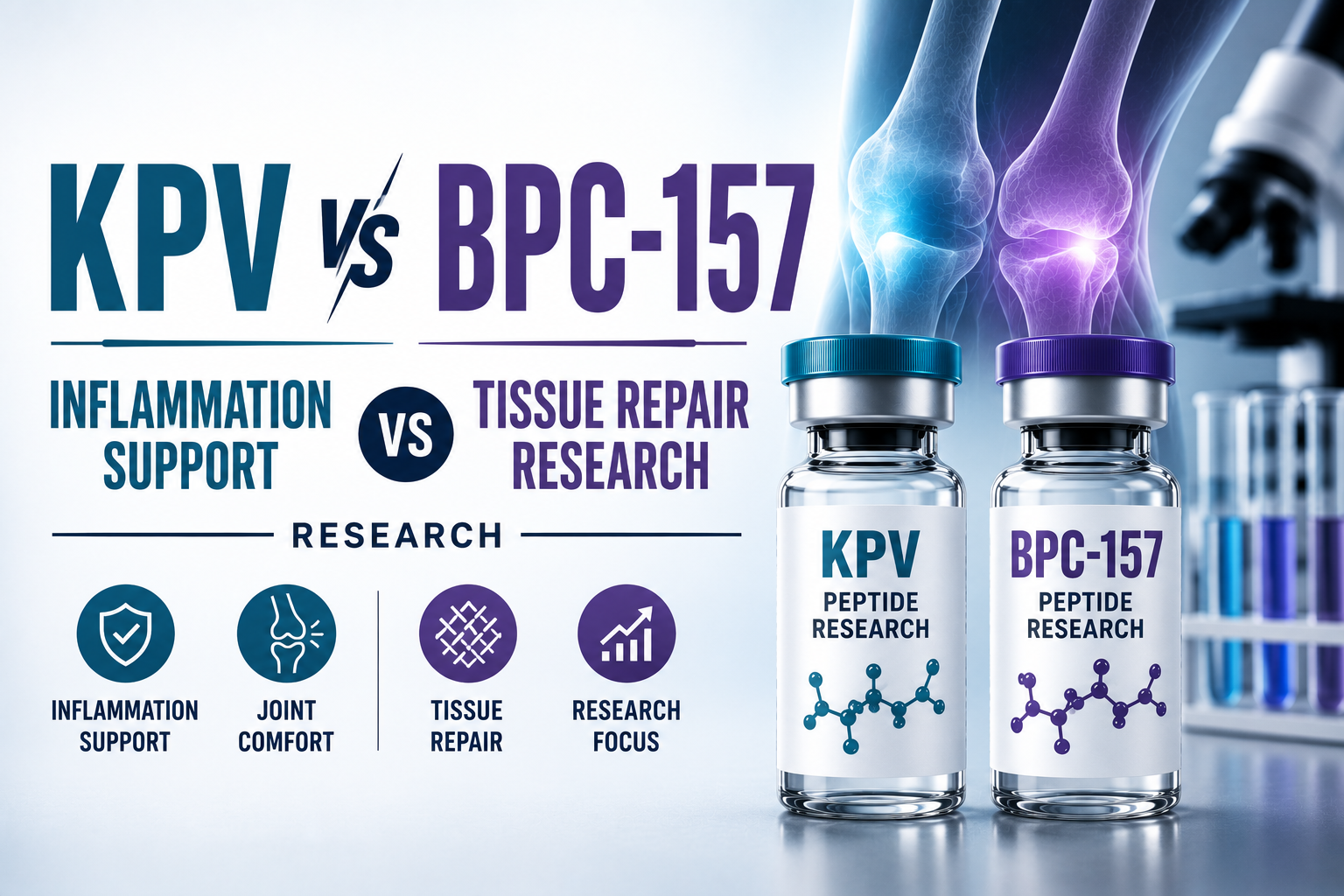
Peptide research has grown rapidly over the past few years. As a result, KPV vs BPC-157 has become a popular comparison among researchers studying inflammation and tissue healing.
Although these peptides are often mentioned together, they serve different research purposes. KPV is mainly studied for its potential role in regulating inflammation and immune responses. In contrast, BPC-157 is being investigated for tissue repair, wound healing, and connective tissue remodeling.
It is important to note that neither KPV nor BPC-157 is approved by the U.S. Food and Drug Administration (FDA) for treating injuries or diseases. Most available evidence comes from laboratory and animal studies, while high-quality human clinical trials remain limited.
This guide explains the differences between KPV and BPC-157, how they work, what current research suggests, and the limitations researchers continue to face.

What Is KPV?
KPV is a short peptide made of three amino acids: Lysine, Proline, and Valine. It is derived from alpha-melanocyte-stimulating hormone (α-MSH), a naturally occurring peptide involved in regulating inflammation and immune activity.
Researchers are interested in KPV because laboratory studies suggest it may help regulate inflammatory signals without broadly suppressing the immune system.
Current research focuses on conditions involving excessive inflammation rather than tissue regeneration.
What Is BPC-157?
BPC-157 stands for Body Protection Compound-157. It is a synthetic peptide derived from a protective protein naturally found in gastric juice.
Unlike KPV, BPC-157 is primarily studied for its potential role in tissue repair. Researchers are investigating how it may influence wound healing, collagen organization, blood vessel formation, and connective tissue recovery.
Most findings come from animal studies, so additional human research is still needed.
KPV vs BPC-157 at a Glance
| Feature | KPV | BPC-157 |
|---|---|---|
| Main Research Focus | Inflammation regulation | Tissue repair |
| Derived From | Alpha-MSH | Gastric protective protein |
| Primary Biological Activity | Immune signaling | Cell migration and tissue remodeling |
| Common Research Areas | Gut inflammation, skin health | Tendons, muscles, ligaments |
| Human Clinical Evidence | Limited | Limited |
| FDA Approved | No | No |
Although both peptides are associated with recovery research, they work through different biological pathways.
How Does KPV Work?
Scientists believe KPV influences inflammatory signaling by interacting with immune cells and cytokines.
Research suggests KPV may help regulate:
- Inflammatory cytokines
- Immune cell activity
- Intestinal barrier function
- Skin inflammation
- Oxidative stress
Instead of directly repairing damaged tissue, KPV appears to support a balanced inflammatory response.
Researchers continue investigating these mechanisms in laboratory settings.
How Does BPC-157 Work?
BPC-157 appears to support healing by affecting several biological processes involved in tissue repair.
Experimental studies suggest it may:
- Promote fibroblast migration
- Support collagen production
- Encourage new blood vessel formation
- Improve cellular communication
- Enhance tissue remodeling
These mechanisms explain why BPC-157 is commonly studied in research involving connective tissues.
KPV vs BPC-157 for Inflammation
One of the biggest differences in KPV vs BPC-157 is their primary research focus.
KPV is mainly investigated for inflammation regulation. Laboratory studies suggest it may help reduce excessive inflammatory signaling while maintaining normal immune function.
Researchers have explored KPV in models involving:
- Inflammatory bowel disease
- Colitis
- Skin inflammation
- Immune disorders
- Intestinal barrier dysfunction
Although these findings are promising, they have not yet been confirmed in large human studies.
KPV vs BPC-157 for Tissue Repair
BPC-157 has received considerably more attention in tissue repair research.
Scientists are studying its potential effects on:
- Muscle recovery
- Tendon healing
- Ligament repair
- Bone healing
- Wound closure
- Connective tissue remodeling
Many of these studies report encouraging findings in animals. However, human evidence remains limited.
Research on Gut Health
Both peptides have been studied for gastrointestinal health, but they appear to work differently.
KPV research focuses on reducing inflammation within the intestinal lining. Researchers are also studying its effects on immune regulation in digestive tissues.
BPC-157 research examines protection of the stomach lining and repair of damaged gastrointestinal tissues.
Although both peptides are being investigated for gut health, they target different biological pathways.
Skin Research
Researchers have explored KPV for inflammatory skin conditions because of its immune-regulating properties.
Experimental studies have investigated its role in:
- Dermatitis
- Psoriasis
- Skin irritation
- Inflammatory skin diseases
Meanwhile, BPC-157 is more commonly studied for wound healing and skin regeneration after injury.
Blood Vessel Formation
Blood vessel formation, also known as angiogenesis, plays an important role in healing.
Laboratory research suggests BPC-157 may promote the growth of new blood vessels. Improved circulation may help deliver oxygen and nutrients to damaged tissues.
KPV has not been studied as extensively for angiogenesis.
Muscle and Tendon Research
When comparing KPV vs BPC-157, BPC-157 has much more research related to muscles and connective tissues.
Scientists continue studying whether BPC-157 may help support:
- Tendon remodeling
- Ligament repair
- Muscle regeneration
- Collagen organization
- Recovery after injury
These findings remain experimental and require further clinical investigation.
Immune System Effects
KPV is being studied because it may influence immune activity without completely suppressing the body’s natural defenses.
Researchers believe this balanced approach may help reduce excessive inflammation while allowing normal healing to continue.
BPC-157 may also influence inflammation, but tissue repair remains its primary research focus.
Safety and Research Limitations
Both peptides remain investigational.
Several important questions remain unanswered, including:
- Long-term safety
- Effective dosing
- Drug interactions
- Treatment duration
- Long-term outcomes
Most products sold online are labeled “for research use only.” Their purity and quality may vary significantly.
Regulatory Status
Neither KPV nor BPC-157 has been approved by the FDA for treating inflammation, injuries, or chronic diseases.
Researchers continue studying both peptides, but current evidence is not sufficient to support routine medical use.
Consumers should be cautious about marketing claims that promise guaranteed healing or recovery.
Which Peptide Has More Scientific Evidence?
When comparing the available research, BPC-157 currently has a larger body of published preclinical studies.
Researchers have explored BPC-157 in models involving:
- Tendon injuries
- Muscle damage
- Ligament healing
- Bone repair
- Wound healing
KPV has fewer published studies but remains an active area of research, particularly for inflammatory diseases and immune regulation.
KPV vs BPC-157: Side-by-Side Comparison
| Category | KPV | BPC-157 |
|---|---|---|
| Primary Research Area | Inflammation | Tissue repair |
| Immune Regulation | Strong research focus | Moderate research |
| Gut Health | Frequently studied | Frequently studied |
| Muscle Recovery | Limited research | Extensive preclinical research |
| Tendon Research | Limited | Stronger evidence |
| Angiogenesis | Limited | More research available |
| Human Clinical Trials | Few | Few |
| FDA Approved | No | No |
Which Peptide Are Researchers Studying More?
The answer depends on the research question.
Scientists interested in inflammatory pathways often choose KPV because of its potential effects on immune regulation.
Researchers studying wound healing, connective tissue repair, or musculoskeletal injuries are more likely to investigate BPC-157.
Rather than competing with each other, these peptides represent two different areas of peptide research.
Future Research
Several important questions remain unanswered.
Future clinical studies may help determine:
- Whether laboratory findings translate to humans
- Long-term safety
- Effective dosing strategies
- Potential medical applications
- Differences between various patient populations
Large randomized clinical trials will be essential before either peptide can be considered for approved therapeutic use.
Conclusion
The comparison of KPV vs BPC-157 highlights two peptides with different research goals. KPV is primarily studied for inflammation support and immune regulation, while BPC-157 is more commonly investigated for tissue repair, connective tissue healing, and wound recovery.
Although early laboratory and animal studies provide encouraging results, human clinical evidence remains limited for both peptides. Neither peptide is approved by the FDA as a treatment for inflammation, injuries, or chronic diseases.
As peptide research continues to evolve, future clinical trials will provide a clearer understanding of their safety, effectiveness, and potential role in medicine.
Frequently Asked Questions
Is KPV better than BPC-157?
Not necessarily. KPV and BPC-157 are studied for different purposes. KPV is mainly researched for inflammation, while BPC-157 is primarily investigated for tissue repair.
Is BPC-157 approved by the FDA?
No. BPC-157 is an investigational peptide and is not approved by the FDA for medical treatment.
What is KPV mainly studied for?
Researchers are studying KPV for inflammation regulation, immune signaling, gut health, and inflammatory skin conditions.
Can KPV and BPC-157 be compared directly?
Yes, but they target different biological pathways. KPV focuses more on inflammation, while BPC-157 focuses on tissue repair.
Which peptide has more published research?
BPC-157 currently has a larger body of preclinical research, especially in wound healing and connective tissue repair. However, both peptides require more high-quality human clinical studies.
References
- Catania, A., et al. (2004). The neuropeptide alpha-MSH and the tripeptide KPV in inflammatory disease. Peptides, 25(3), 437–443. https://doi.org/10.1016/j.peptides.2003.12.014
- Goldstein, A. L., & Kleinman, H. K. (2015). Thymosin beta 4: A multi-functional regenerative peptide. Experimental Eye Research, 138, 62–65. https://doi.org/10.1016/j.exer.2014.08.010
- U.S. Food and Drug Administration. Human Drug Compounding Information. https://www.fda.gov/drugs/human-drug-compounding
- World Anti-Doping Agency. The Prohibited List. https://www.wada-ama.org/en/prohibited-list
