
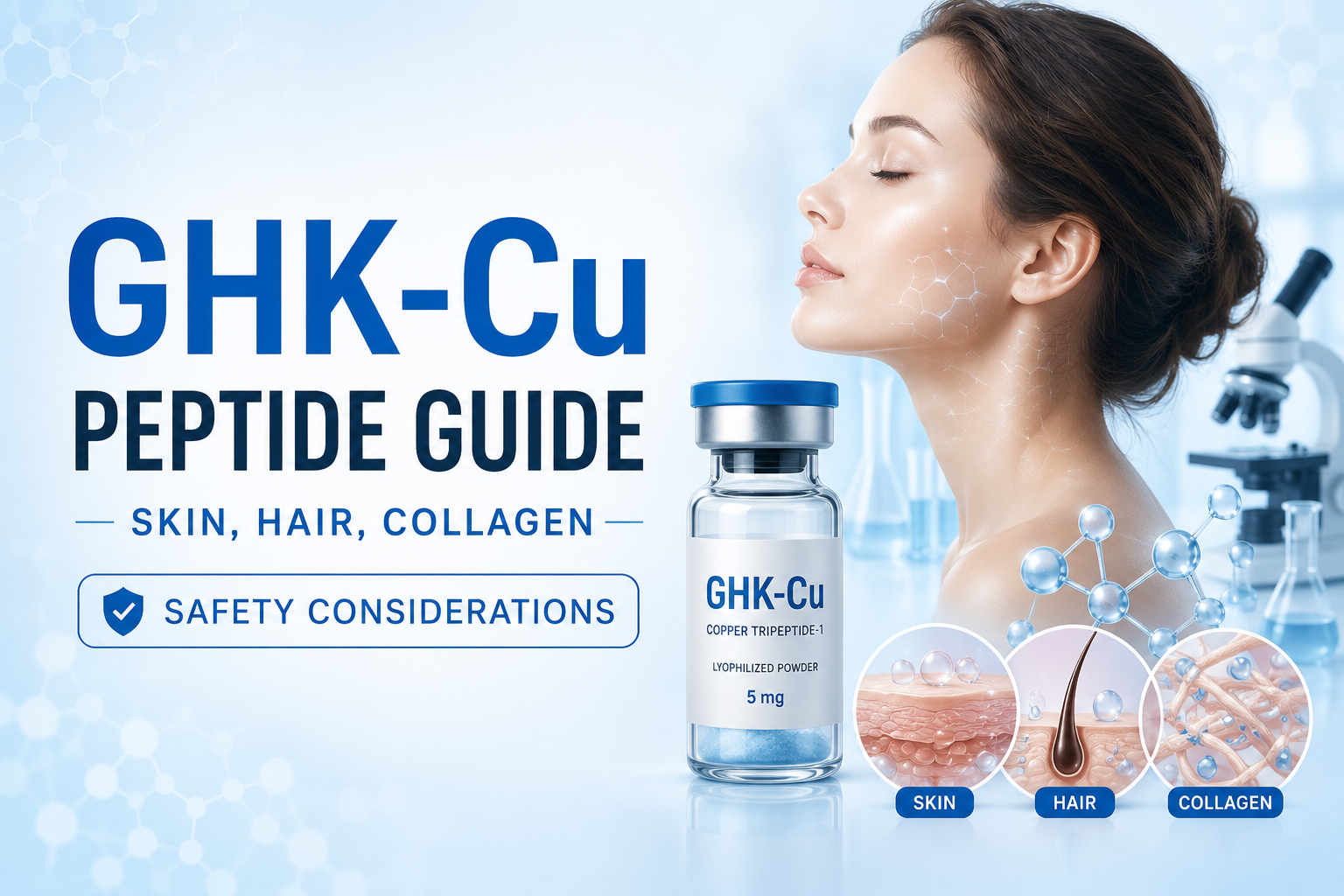
The GHK-Cu peptide has attracted growing attention in regenerative medicine and cosmetic research because of its potential role in skin repair, collagen production, hair health, and wound healing. Originally identified in human plasma, this naturally occurring copper-binding peptide decreases with age, leading researchers to investigate whether restoring its levels may support healthy tissue function.
Although GHK-Cu is widely discussed in skincare products and research communities, it is important to understand that much of the evidence comes from laboratory experiments, animal studies, and limited human clinical research. Many questions about its long-term effectiveness and safety remain unanswered.
This guide reviews what researchers currently know about the GHK-Cu peptide, how it may work, its potential applications, possible side effects, and the limitations of current scientific evidence.
What Is GHK-Cu Peptide?
GHK-Cu, also known as glycyl-L-histidyl-L-lysine copper, is a naturally occurring tripeptide that binds copper ions. It was first discovered in human plasma during the 1970s and has since been detected in saliva and urine.
Researchers believe GHK-Cu functions as a signaling molecule that helps regulate tissue repair, inflammation, and cellular regeneration. Because copper is essential for many biological processes, the peptide acts as a carrier that delivers copper where it is needed.
As people age, natural GHK-Cu levels decline significantly. This observation has encouraged scientists to explore whether supplemental GHK-Cu may help support aging tissues.
How Does GHK-Cu Work?
Researchers believe the GHK-Cu peptide influences several biological pathways involved in tissue maintenance.
Potential mechanisms include:
- Supporting collagen and elastin production
- Promoting wound healing
- Regulating inflammatory responses
- Protecting cells from oxidative stress
- Supporting blood vessel formation (angiogenesis)
- Influencing gene expression involved in tissue remodeling
Rather than acting as a hormone, GHK-Cu appears to influence communication between cells, helping coordinate repair processes after tissue damage.
GHK-Cu Peptide and Skin Health
One of the most studied applications of the GHK-Cu peptide involves skin rejuvenation.
Collagen and elastin naturally decrease with age, contributing to wrinkles, reduced elasticity, and slower healing. Laboratory studies suggest GHK-Cu may stimulate fibroblasts—the cells responsible for producing collagen and other structural proteins.
Researchers have observed possible improvements in:
- Skin firmness
- Elasticity
- Fine lines
- Wrinkle appearance
- Overall skin texture
- Hydration
- Recovery following minor skin injury
Some cosmetic products containing GHK-Cu have reported improvements in skin appearance after consistent topical use. However, results vary among individuals, and larger controlled clinical trials are still needed.
Can GHK-Cu Support Collagen Production?
Collagen production is one of the primary reasons researchers continue studying GHK-Cu.
Fibroblasts create collagen fibers that provide strength and structure to skin, tendons, ligaments, and connective tissues. Laboratory research suggests GHK-Cu may encourage fibroblasts to increase collagen synthesis while also supporting elastin and glycosaminoglycan production.
Researchers have also proposed that GHK-Cu may reduce excessive tissue breakdown by influencing enzymes involved in extracellular matrix remodeling.
These combined effects may contribute to healthier connective tissue during normal aging, although the extent of these benefits in humans remains under investigation.
GHK-Cu Peptide and Hair Research
Hair restoration is another growing area of interest.
Several laboratory studies suggest GHK-Cu may influence hair follicle activity by promoting healthier scalp tissue and improving the environment surrounding hair follicles.
Researchers have investigated whether the peptide may:
- Support hair follicle growth cycles
- Improve follicle survival
- Reduce inflammation around follicles
- Enhance blood supply to scalp tissues
- Encourage thicker hair growth
While these findings are promising, evidence in humans remains limited. GHK-Cu should not currently be viewed as an established treatment for hair loss.
Wound Healing and Tissue Repair
GHK-Cu has demonstrated encouraging results in wound-healing research.
Animal and laboratory studies suggest it may accelerate several phases of healing by supporting cell migration, collagen deposition, angiogenesis, and immune regulation.
Researchers have explored its potential role in:
- Surgical wound recovery
- Burn healing
- Skin ulcers
- Tissue remodeling
- Scar formation
Because chronic wounds often involve persistent inflammation and impaired collagen production, GHK-Cu continues to be investigated as a possible therapeutic candidate.
However, more human clinical trials are needed before firm conclusions can be made.
Anti-Inflammatory and Antioxidant Properties
Inflammation plays an important role in tissue damage and aging.
Some laboratory studies suggest GHK-Cu may help regulate inflammatory signaling molecules while reducing oxidative stress caused by free radicals.
Researchers believe this combination may contribute to healthier tissue repair and reduced cellular damage.
Potential mechanisms include:
- Lower oxidative stress
- Balanced inflammatory responses
- Protection against cellular damage
- Support for normal healing processes
Although these findings remain encouraging, many studies have been conducted outside human clinical settings.
Forms of GHK-Cu
Researchers have investigated several delivery methods.
Topical Creams and Serums
Topical formulations are the most common products available for cosmetic use. These products aim to deliver GHK-Cu directly to the skin.
Injectable Research Preparations
Some research settings investigate injectable formulations. However, these products are generally intended for research purposes and should not be considered approved medical treatments.
Cosmetic Products
Many anti-aging skincare products include GHK-Cu alongside other moisturizing ingredients designed to improve skin appearance.
Safety Considerations
Current research suggests GHK-Cu is generally well tolerated when used in cosmetic formulations. However, long-term safety data remain limited.
Potential side effects reported in research and cosmetic use include:
- Mild skin irritation
- Temporary redness
- Itching
- Burning sensation
- Allergic skin reactions in sensitive individuals
Because injectable research products have not been extensively studied in large clinical trials, their safety profile remains uncertain.
Individuals should avoid assuming that research compounds have the same safety standards as approved medications.
Current Limitations of Research
Despite growing interest, important limitations remain.
Many studies involve:
- Cell cultures
- Animal models
- Small human trials
- Short study durations
Large randomized controlled trials are still lacking for many proposed uses.
Researchers also continue investigating optimal dosing, treatment duration, delivery methods, and long-term safety.
As a result, many claims circulating online exceed what current scientific evidence can support.
Frequently Asked Questions
Is GHK-Cu peptide approved for medical treatment?
No. While GHK-Cu is widely used in cosmetic products and researched extensively, it is not approved as a treatment for most medical conditions.
Can GHK-Cu increase collagen?
Laboratory studies suggest GHK-Cu may stimulate collagen production by activating fibroblasts. However, larger human studies are needed to confirm these effects.
Does GHK-Cu help hair growth?
Early research suggests potential benefits for supporting healthy hair follicles, but evidence remains limited and inconclusive.
Is topical GHK-Cu safe?
Most cosmetic studies report good tolerability with mild skin irritation being the most common side effect. Individuals with sensitive skin should perform a patch test before regular use.
Is injectable GHK-Cu safe?
Injectable formulations remain investigational, and long-term human safety data are currently insufficient.
Conclusion
The GHK-Cu peptide remains one of the most extensively researched regenerative peptides because of its potential roles in skin repair, collagen production, wound healing, and hair biology. Laboratory and early clinical studies suggest encouraging biological activity, particularly in tissue remodeling and cellular repair.
However, enthusiasm should be balanced with scientific caution. Much of the available evidence comes from preclinical research, while larger human clinical trials are still needed to determine effectiveness, ideal dosing strategies, and long-term safety.
For now, GHK-Cu represents a promising area of ongoing research rather than a proven medical therapy. As scientific understanding continues to evolve, future studies will help clarify where this naturally occurring peptide may ultimately fit within regenerative medicine and dermatology.
References
Maquart, F. X., Pickart, L., Laurent, M., Gillery, P., Monboisse, J. C., & Borel, J. P. (1988). Stimulation of collagen synthesis in fibroblast cultures by the tripeptide-copper complex GHK-Cu. FEBS Letters, 238(2), 343–346. https://doi.org/10.1016/0014-5793(88)80479-7
Pickart, L., & Margolina, A. (2018). Regenerative and protective actions of the GHK-Cu peptide in the light of the new gene data. International Journal of Molecular Sciences, 19(7), 1987. https://doi.org/10.3390/ijms19071987
Pickart, L. (2008). The human tripeptide GHK and tissue remodeling. Journal of Biomaterials Science, Polymer Edition, 19(8), 969–988. https://doi.org/10.1163/156856208784909435
National Center for Biotechnology Information. PubMed. https://pubmed.ncbi.nlm.nih.gov/
National Institutes of Health. https://www.nih.gov/
