
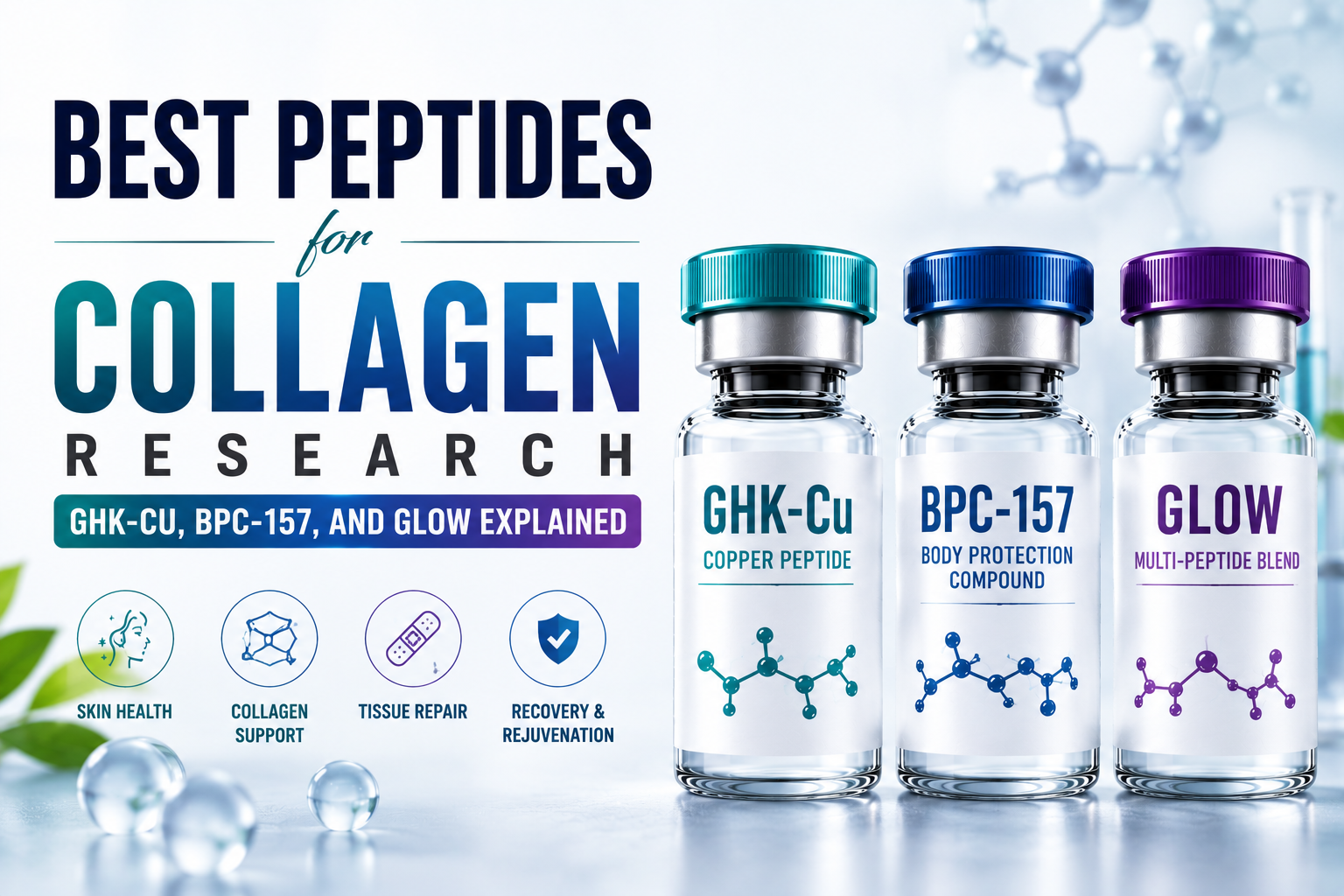
Collagen is the most abundant structural protein in the human body, providing strength and flexibility to the skin, tendons, ligaments, bones, and other connective tissues. As people age, natural collagen production gradually declines, contributing to wrinkles, slower wound healing, and reduced tissue elasticity. Because of this, researchers have become increasingly interested in peptides for collagen and their potential role in supporting the body’s natural repair processes.
Among the many compounds under investigation, GHK-Cu, BPC-157, and GLOW are frequently discussed in research related to skin regeneration, tissue remodeling, and collagen synthesis. While each has unique characteristics, all are being explored for their possible influence on cellular signaling involved in tissue repair.
This article explains how these peptides differ, what current scientific evidence suggests, and why they continue to attract attention in regenerative medicine and wellness research.

Understanding Collagen and Why It Matters
Collagen accounts for approximately 30% of the body’s total protein content. It serves as the primary structural framework for many tissues, helping maintain strength, flexibility, and integrity.
Collagen supports:
- Skin firmness and elasticity
- Tendons and ligaments
- Bones and cartilage
- Blood vessels
- Muscle connective tissue
- Wound healing
Beginning in early adulthood, collagen production naturally decreases. Factors such as UV exposure, smoking, poor nutrition, chronic inflammation, and oxidative stress can accelerate this decline.
Because collagen is essential for tissue maintenance, researchers are investigating compounds that may influence collagen-related biological pathways.
What Are Peptides for Collagen?
Peptides are short chains of amino acids that can act as signaling molecules within the body. Rather than serving as building blocks alone, many peptides communicate with cells and influence biological processes involved in growth, repair, and regeneration.
Some peptides being studied for collagen-related applications may:
- Stimulate fibroblast activity
- Support extracellular matrix remodeling
- Encourage collagen synthesis
- Promote tissue regeneration
- Reduce oxidative stress
- Support wound healing mechanisms
Although laboratory findings are promising, these effects vary depending on the specific peptide and the research model used.
GHK-Cu: The Most Studied Peptide for Collagen Research
Among all peptides for collagen, GHK-Cu (glycyl-L-histidyl-L-lysine copper) is one of the most extensively researched.
Discovered in human plasma, GHK-Cu naturally binds copper ions and participates in several biological processes associated with tissue repair.
Researchers have investigated GHK-Cu for its ability to:
- Stimulate collagen production
- Support elastin synthesis
- Promote fibroblast growth
- Improve extracellular matrix remodeling
- Reduce oxidative stress
- Encourage skin regeneration
Several laboratory studies suggest that GHK-Cu may influence genes involved in tissue repair while helping regulate inflammatory responses.
Because of these findings, GHK-Cu is widely used in cosmetic and research formulations focused on skin health and healthy aging.
BPC-157 and Tissue Repair Research
Unlike GHK-Cu, BPC-157 is primarily studied for tissue healing rather than direct collagen stimulation.
Derived from a protein found in gastric juice, BPC-157 has attracted attention for its potential effects on soft tissue repair.
Researchers are exploring whether BPC-157 may support:
- Tendon healing
- Ligament repair
- Muscle recovery
- Blood vessel formation (angiogenesis)
- Cellular migration
- Connective tissue regeneration
Although BPC-157 may indirectly influence collagen remodeling during tissue repair, current evidence does not suggest it stimulates collagen production to the same extent as GHK-Cu.
Most research has been conducted in animal models, and robust human clinical trials remain limited.
GLOW Peptide Blend Explained
GLOW is a multi-peptide research blend designed to combine several compounds with complementary biological activities.
Although formulations may vary between manufacturers, GLOW blends are often intended to investigate multiple pathways involved in skin wellness and tissue regeneration.
Researchers are studying GLOW blends for their potential to support:
- Collagen synthesis
- Skin hydration
- Cellular repair
- Antioxidant defenses
- Tissue remodeling
- Healthy skin appearance
Because GLOW combines several peptides rather than relying on a single active compound, researchers hope to better understand how these ingredients may work together.
However, scientific evidence specifically evaluating complete GLOW formulations remains limited compared with individual peptides such as GHK-Cu.
Comparing GHK-Cu, BPC-157, and GLOW
Each peptide offers a different research focus.
| Peptide | Primary Research Area | Potential Collagen Support | Current Evidence |
|---|---|---|---|
| GHK-Cu | Skin regeneration and collagen synthesis | Strong laboratory evidence | Extensive preclinical research |
| BPC-157 | Tissue repair and healing | Indirect support during repair | Mostly animal studies |
| GLOW Blend | Multi-pathway skin wellness | Combination approach | Limited direct clinical evidence |
Rather than competing, these compounds are often viewed as complementary tools for studying different aspects of tissue biology.
How Peptides May Influence Collagen Production
Collagen production is a complex process involving specialized cells known as fibroblasts.
Researchers believe certain peptides may influence this process by:
- Activating fibroblasts
- Increasing extracellular matrix proteins
- Supporting angiogenesis
- Regulating inflammatory signaling
- Reducing oxidative stress
- Promoting tissue remodeling
Because collagen synthesis depends on many biological pathways, no single peptide is likely responsible for every aspect of tissue regeneration.
Current Scientific Evidence
Scientific interest in peptides for collagen has expanded considerably over the past decade.
Current evidence suggests:
- GHK-Cu has the strongest laboratory evidence supporting collagen-related activity.
- BPC-157 shows promise for tissue healing and connective tissue repair.
- Multi-peptide blends such as GLOW remain an emerging area of investigation.
Despite encouraging findings, researchers continue to emphasize that most available evidence comes from laboratory and animal studies.
Large, placebo-controlled human clinical trials remain necessary before definitive conclusions can be reached.
Safety and Research Limitations
Although peptide research continues to grow, several important limitations should be considered.
These include:
- Limited long-term human safety data
- Differences between peptide formulations
- Variable dosing protocols
- Small clinical study populations
- Inconsistent manufacturing quality
- Lack of standardized treatment guidelines
Because of these limitations, many peptide applications remain investigational.
Frequently Asked Questions
Which peptide is most studied for collagen production?
Among currently available research compounds, GHK-Cu has the strongest scientific evidence supporting its potential influence on collagen synthesis and skin regeneration.
Does BPC-157 increase collagen?
Research suggests BPC-157 may indirectly support collagen remodeling during tissue repair, but it is primarily investigated for healing rather than direct collagen stimulation.
What is GLOW peptide?
GLOW is a multi-peptide research blend designed to study several pathways involved in skin health, tissue remodeling, and collagen support. Scientific evidence on complete GLOW formulations is still limited.
Are peptides for collagen proven treatments?
No. While laboratory and preclinical findings are encouraging, these peptides remain under investigation, and more high-quality human studies are needed to establish their effectiveness and safety.
Can different peptides be studied together?
Researchers often investigate combinations of peptides to better understand how different biological pathways involved in tissue repair and collagen synthesis may interact. However, the effectiveness of combination approaches has not yet been fully established.
Final Thoughts
Interest in peptides for collagen continues to grow as scientists explore new strategies for supporting tissue repair, skin health, and healthy aging. Among the compounds currently under investigation, GHK-Cu stands out for its extensive research on collagen synthesis and fibroblast activity, making it one of the most promising candidates for collagen-related studies.
BPC-157 offers a different perspective by focusing on tissue repair, connective tissue healing, and angiogenesis, while GLOW represents a broader, multi-peptide approach aimed at supporting several pathways involved in skin regeneration and extracellular matrix remodeling.
Although the available evidence is encouraging, much of it comes from laboratory and animal research. Well-designed human clinical trials are still needed to clarify the effectiveness, optimal dosing, long-term safety, and potential applications of these peptides. For now, GHK-Cu, BPC-157, and GLOW should be viewed as promising research compounds rather than established medical treatments for collagen-related conditions.
References
- Pickart, L., & Margolina, A. (2018). Regenerative and protective actions of the GHK-Cu peptide in the light of the new gene data. International Journal of Molecular Sciences, 19(7), 1987. https://doi.org/10.3390/ijms19071987
- Goldstein, A. L., & Kleinman, H. K. (2015). Advances in the development of BPC-157 as a therapeutic peptide. Current Pharmaceutical Design, 21(11), 1571–1577.
- Rodrigues, M., Kosaric, N., Bonham, C. A., & Gurtner, G. C. (2019). Wound healing: A cellular perspective. Physiological Reviews, 99(1), 665–706. https://doi.org/10.1152/physrev.00067.2017
- National Center for Biotechnology Information. Peptide and collagen research resources. https://www.ncbi.nlm.nih.gov/
- Office of Dietary Supplements, National Institutes of Health. https://ods.od.nih.gov/
