
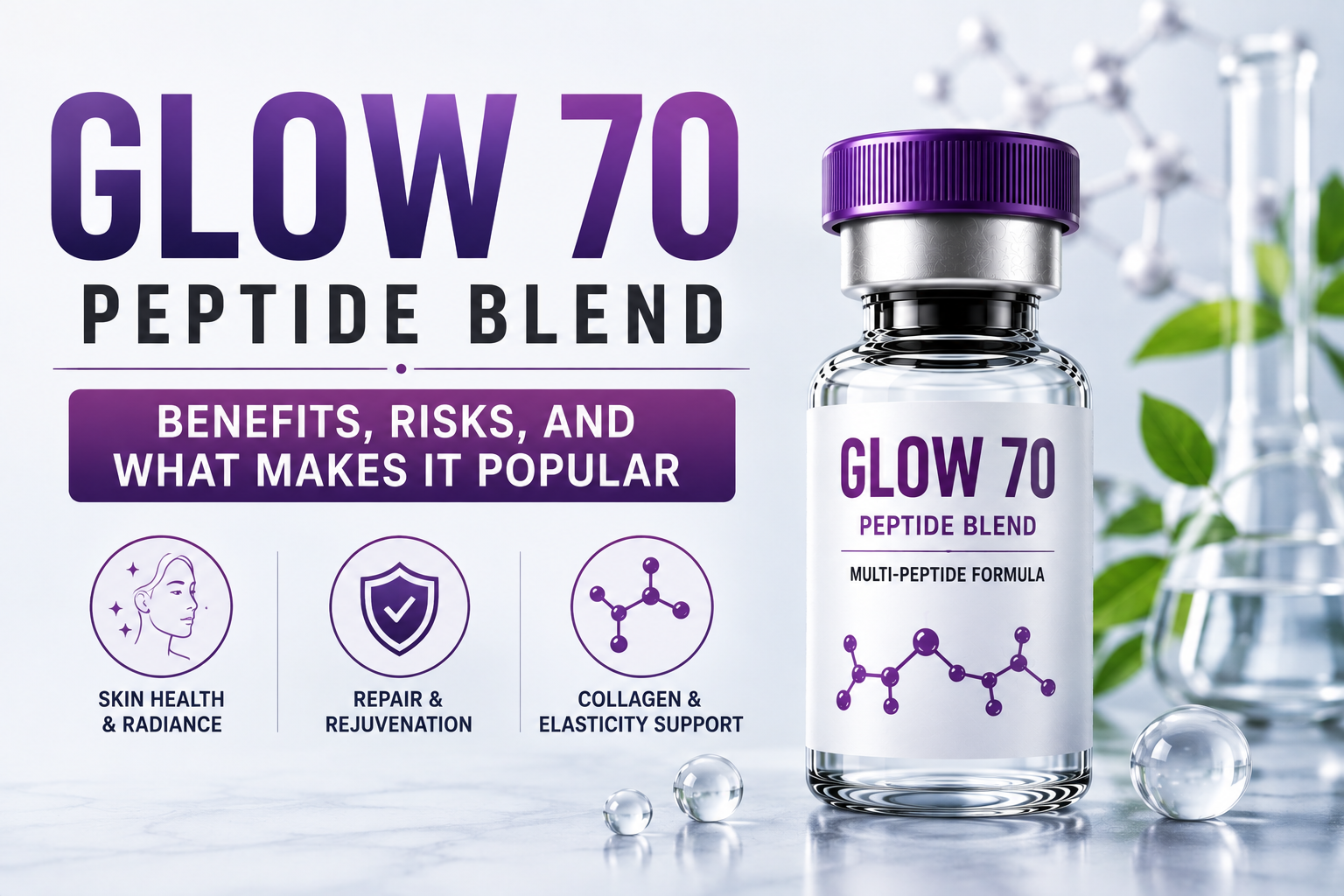
GLOW 70 peptide has become increasingly popular in online peptide research communities because it combines three different research compounds into one formulation: GHK-Cu, BPC-157, and TB-500. The idea behind the blend is straightforward: instead of investigating one biological pathway, researchers can examine several pathways associated with tissue repair, extracellular-matrix activity, inflammation, and regeneration.
However, popularity should not be confused with clinical proof. GLOW 70 itself has not been established as an approved treatment, and there is no strong clinical evidence demonstrating that the combination works better than its individual components. Much of the interest in GLOW 70 comes from research on the three separate peptides rather than studies of the finished blend.

What Is GLOW 70 Peptide?
GLOW 70 is generally described as a 70 mg multi-peptide research blend containing:
| Peptide | Common amount in GLOW 70 | Main research interest |
|---|---|---|
| GHK-Cu | 50 mg | Collagen and extracellular-matrix research |
| BPC-157 | 10 mg | Tissue-repair and gastrointestinal research |
| TB-500 | 10 mg | Cell migration and tissue-repair research |
| Total | 70 mg | Multi-pathway research |
This 50/10/10 formulation is commonly reported by peptide suppliers and research sources. Importantly, formulations can vary between products, so researchers should not assume that every product labeled “GLOW 70” has exactly the same composition.
The name can also create confusion. “GLOW 70” is not the name of a single naturally occurring peptide. It is a blend designation used for a formulation containing multiple peptides.
Why Is GLOW 70 Peptide Popular?
The main attraction is the combination of different biological research targets.
GHK-Cu has a relatively long history of investigation, particularly in relation to collagen production, extracellular-matrix remodeling, and skin repair. BPC-157 has attracted interest primarily from preclinical tissue-repair research. TB-500 is related to research on thymosin beta-4 and processes such as cell migration and wound repair.
Researchers may therefore view the combination as a convenient way to investigate several mechanisms at once.
But there is an important limitation: evidence for individual ingredients cannot automatically be treated as evidence for GLOW 70 as a complete formulation. A combination can behave differently from its components when they are studied separately.
GHK-Cu: The “Skin and Collagen” Component
GHK-Cu is probably the best-known component of GLOW 70 when it comes to skin-related research.
GHK, or glycyl-L-histidyl-L-lysine, naturally occurs in the human body and can bind copper ions. Laboratory research has found that GHK-Cu can stimulate collagen synthesis in fibroblast cultures.
Animal research has also reported increases in connective-tissue accumulation, collagen production, and other extracellular-matrix components following GHK-Cu exposure.
A review of GHK research has described effects involving collagen, glycosaminoglycans, fibroblasts, and several pathways involved in skin regeneration.
These findings help explain why GHK-Cu is frequently associated with:
- Collagen research
- Skin elasticity
- Extracellular-matrix remodeling
- Wound-healing research
- Hair-follicle research
- Skin-aging research
Still, it would be inaccurate to turn these laboratory findings into a guarantee that an injectable GHK-Cu-containing blend will make human skin younger or repair injuries faster.
BPC-157: What Does the Research Suggest?
BPC-157 is another major reason people are interested in the GLOW 70 peptide.
Most of the scientific interest surrounding BPC-157 comes from preclinical research, including laboratory and animal studies investigating tissue repair, blood-vessel formation, gastrointestinal effects, and inflammatory pathways.
That distinction is important because promising animal research does not automatically translate into proven human treatment.
Regulatory documents also highlight the evidence gap. The FDA has stated that it has limited safety information for BPC-157 and identified potential concerns involving immunogenicity and peptide-related impurities and characterization.
Therefore, BPC-157 should be described as an experimental research compound, rather than a proven human healing therapy.
TB-500 and Thymosin Beta-4 Research
TB-500 is commonly discussed in connection with thymosin beta-4 research.
Thymosin beta-4 is an endogenous peptide that has been studied for its involvement in tissue repair, cell migration, angiogenesis, and wound healing. Research in animal models has reported accelerated dermal healing, while some clinical investigations have examined topical thymosin beta-4 in patients with chronic wounds.
These findings provide a scientific rationale for investigating the pathway.
However, researchers should avoid making a simple leap from studies of thymosin beta-4 to claims that every TB-500 product produces the same effects. Formulation, molecular structure, route of administration, dose, purity, and study design all matter.
Potential Benefits Being Investigated
The potential benefits associated with GLOW 70 are better described as research areas rather than proven clinical benefits.
1. Skin and Collagen Research
Because GHK-Cu has been investigated for collagen synthesis and extracellular-matrix activity, GLOW 70 is frequently discussed in relation to skin structure and remodeling.
2. Tissue Repair Research
BPC-157 and thymosin beta-4-related research has generated interest in tissue-repair mechanisms. Researchers are investigating how these compounds may influence cellular migration, vascular processes, and repair pathways.
3. Wound-Healing Research
Both GHK-Cu and thymosin beta-4 have been investigated in wound-healing models. GHK-Cu research has demonstrated effects on collagen and connective-tissue formation, while thymosin beta-4 research has explored dermal repair.
4. Multi-Pathway Research
The biggest conceptual advantage of a blend is that researchers can investigate several biological pathways simultaneously.
This is also the biggest scientific complication.
If an experiment produces an effect, it can become difficult to determine which component caused it, whether the components interacted, or whether the observed result came from the combination itself.
GLOW 70 Peptide Risks and Limitations
The risks of GLOW 70 deserve as much attention as its potential benefits.
Limited Research on the Complete Blend
This is the biggest limitation.
There is research on GHK-Cu, BPC-157, and thymosin beta-4, but that does not mean there are high-quality human clinical trials proving the safety and effectiveness of the specific GLOW 70 combination.
In other words, researchers should distinguish between:
“This ingredient has been studied.”
and
“This exact combination has been clinically proven.”
Those statements are not equivalent.
Product Quality Can Vary
Research peptides purchased through online sources may differ in purity, identity, sterility, concentration, and manufacturing quality.
A label claiming “99% purity” is not, by itself, sufficient evidence of product quality. Independent analytical testing and appropriate documentation are much more meaningful.
Immunogenicity and Unknown Long-Term Effects
Peptides can potentially trigger immune responses, and long-term effects may not be adequately characterized for experimental compounds.
The FDA has specifically identified limited safety information and potential immunogenicity concerns regarding BPC-157.
Injection-Related Risks
When an experimental peptide is administered by injection, the risks are not limited to the peptide itself. Sterility problems, contamination, incorrect preparation, improper storage, and injection-site reactions can create additional hazards.
This is one reason “research use only” should not be interpreted as equivalent to pharmaceutical-grade medication.
GLOW 70 vs. Individual Peptides
One reason GLOW 70 is attractive is convenience. A researcher investigating several pathways may prefer a combined formulation rather than obtaining three separate research compounds.
However, individual peptides offer an important scientific advantage: better experimental control.
If GHK-Cu, BPC-157, and TB-500 are studied separately, researchers can identify which compound is associated with an observed effect. With a fixed blend, that becomes more difficult.
For controlled research, the choice between a blend and individual compounds therefore depends on the research question.
What Makes GLOW 70 Popular?
Several factors explain the growing interest in the GLOW 70 peptide.
First, it combines three compounds that already have significant discussion surrounding tissue repair and regenerative biology.
Second, GHK-Cu gives the blend a strong connection to skin and collagen research, which makes the name “GLOW” particularly marketable.
Third, BPC-157 and TB-500 are already widely discussed in peptide communities because of their experimental research into tissue repair.
Finally, the idea of combining several mechanisms into one formulation is appealing to people interested in multi-pathway research.
But popularity is not evidence of efficacy.
Online testimonials, influencer claims, and peptide-community discussions can generate interest, but they cannot replace properly controlled human trials.
Is GLOW 70 Proven to Work?
No—not as a complete formulation.
The individual components have interesting scientific histories, particularly GHK-Cu and thymosin beta-4-related research. But the evidence supporting GLOW 70 specifically is much weaker.
GLOW 70 should be viewed as an experimental peptide blend, not as a clinically established treatment.
The distinction becomes especially important when marketing claims promise faster healing, dramatic anti-aging effects, muscle recovery, or guaranteed skin improvements.
Final Thoughts
The GLOW 70 peptide blend is popular because it combines GHK-Cu, BPC-157, and TB-500 into a multi-peptide research formulation. Each component has attracted scientific interest in areas such as collagen synthesis, tissue repair, wound healing, cell migration, and extracellular-matrix biology.
GHK-Cu has particularly interesting research surrounding collagen and skin biology, while BPC-157 and thymosin beta-4-related compounds remain areas of substantial experimental interest.
However, the evidence needs to be interpreted carefully. Research on individual peptides is not the same as clinical evidence for GLOW 70 itself. Questions about optimal formulation, long-term safety, human effectiveness, product quality, and interactions between the components remain.
For that reason, GLOW 70 is best understood as a research-oriented peptide blend with interesting biological hypotheses, but limited direct clinical evidence. That balanced view is much more scientifically defensible than presenting it as a proven anti-aging or recovery solution.
Frequently Asked Questions
What is GLOW 70 peptide?
GLOW 70 is generally a 70 mg peptide blend containing GHK-Cu, BPC-157, and TB-500. A commonly reported formulation contains 50 mg GHK-Cu, 10 mg BPC-157, and 10 mg TB-500.
What is GLOW 70 used for in research?
Research interest centers on skin biology, collagen, extracellular-matrix remodeling, tissue repair, wound healing, and related cellular pathways.
Is GLOW 70 FDA approved?
GLOW 70 itself should not be described as an FDA-approved treatment. The individual compounds in the blend also have important regulatory and evidence limitations.
Does GLOW 70 contain GHK-Cu?
Yes. Common GLOW 70 formulations contain GHK-Cu as the largest component, often 50 mg in a 70 mg total blend.
Yes. For the blog, I recommend using primary scientific sources and FDA sources, rather than peptide-supplier websites. These are stronger references for SEO and credibility.
References
- GHK-Cu and collagen synthesis
Pickart, L., & Thaler, M. M. (1988). Stimulation of collagen synthesis in fibroblast cultures by the tripeptide-copper complex glycyl-L-histidyl-L-lysine-Cu²⁺. FEBS Letters, 228(1), 66–70.
PubMed – GHK-Cu and collagen synthesis (PubMed) - Thymosin beta-4 and wound healing
Malinda, K. M., et al. (1999). Thymosin beta4 accelerates wound healing. Journal of Investigative Dermatology, 113(3), 364–368.
PubMed – Thymosin beta-4 wound healing (PubMed) - Thymosin beta-4 regenerative research
Treadwell, T., et al. (2012). The regenerative peptide thymosin β4 accelerates the rate of dermal healing in preclinical animal models and in patients. Annals of the New York Academy of Sciences, 1270, 87–96.
PubMed – Thymosin β4 regenerative research (PubMed) - FDA safety information on BPC-157
U.S. Food and Drug Administration. Certain Bulk Drug Substances for Use in Compounding That May Present Significant Safety Risks. The FDA notes limited safety information for BPC-157 and potential concerns involving immunogenicity and peptide-related impurities.
FDA – BPC-157 safety information (U.S. Food and Drug Administration) - FDA review of BPC-157 and TB-500
U.S. Food and Drug Administration. July 23–24, 2026: Meeting of the Pharmacy Compounding Advisory Committee. The FDA lists BPC-157 and TB-500 among the substances reviewed for potential inclusion on the 503A bulk-drug list.
FDA – July 2026 Pharmacy Compounding Advisory Committee (U.S. Food and Drug Administration)
