
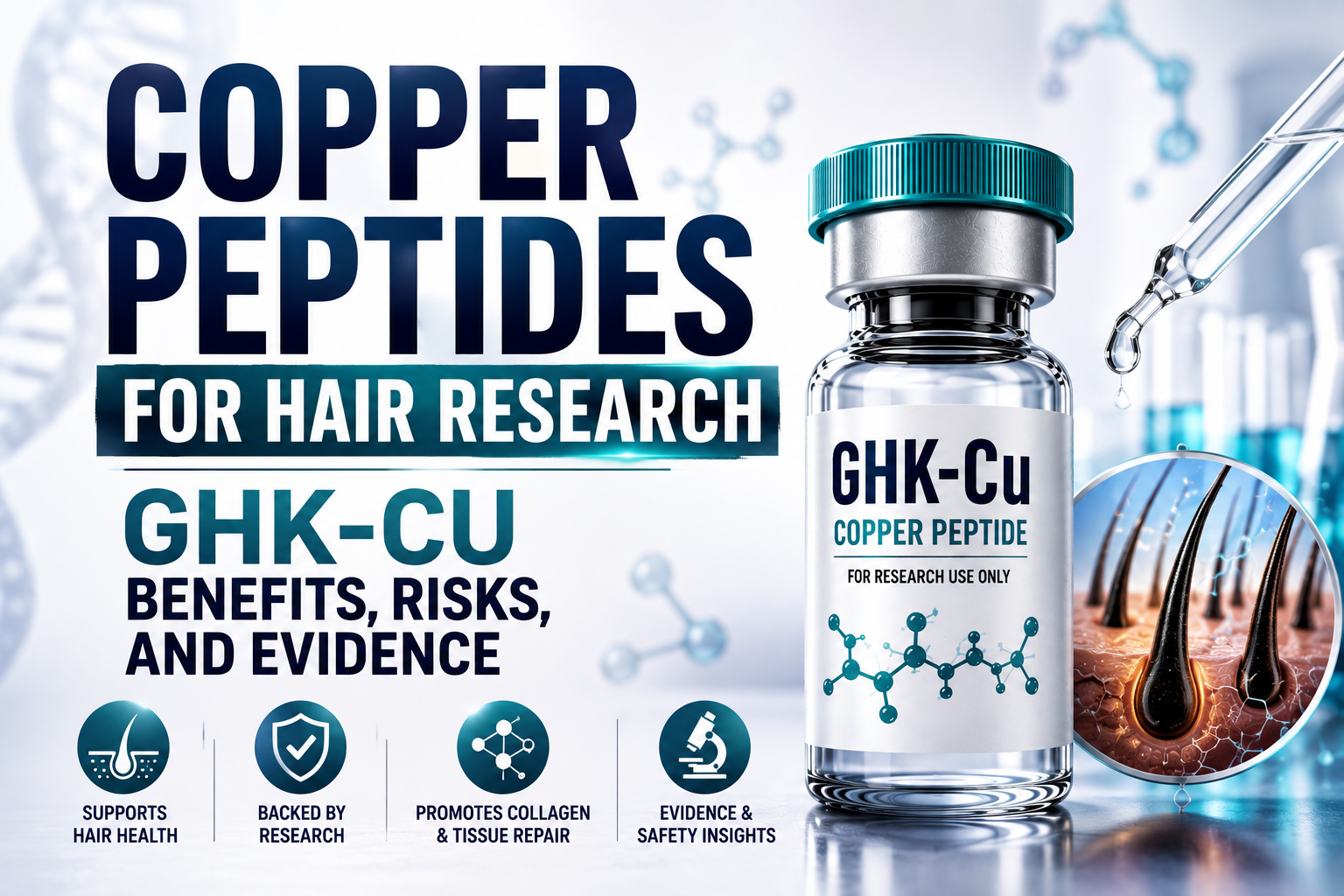
Interest in copper peptides for hair has increased as researchers explore new ways to support hair follicle health and scalp regeneration. Among the different copper-binding peptides, GHK-Cu (glycyl-L-histidyl-L-lysine copper) is the most extensively studied. Originally investigated for its role in wound healing and skin repair, GHK-Cu has since become a focus of hair research because of its potential effects on cellular regeneration, collagen production, and follicle function.
Although laboratory and animal studies have produced encouraging findings, clinical evidence in humans is still limited. Researchers continue to investigate how copper peptides influence hair biology, optimal delivery methods, long-term safety, and their potential role alongside established hair restoration therapies.
This article reviews what current science says about copper peptides for hair, including their mechanisms, potential benefits, known risks, and research limitations.

What Are Copper Peptides?
Copper peptides are naturally occurring molecules made by combining a short chain of amino acids with a copper ion. The best-known example is GHK-Cu, a tripeptide consisting of:
- Glycine
- Histidine
- Lysine
- One copper ion
GHK-Cu occurs naturally in the human body and is found in blood plasma, saliva, and urine. Research has shown that natural levels decline with age, leading scientists to investigate whether restoring GHK-Cu may support tissue repair and healthy aging.
Why Researchers Study Copper Peptides for Hair
Hair follicles are among the body’s most biologically active structures. Healthy hair growth depends on complex interactions involving stem cells, dermal papilla cells, blood vessels, growth factors, and the extracellular matrix.
Researchers are studying copper peptides because they appear to influence several of these biological systems at the same time.
Potential areas of research include:
- Hair follicle regeneration
- Scalp tissue repair
- Cellular communication
- Collagen remodeling
- Blood vessel formation
- Inflammatory regulation
- Oxidative stress reduction
These combined effects make GHK-Cu an attractive candidate for regenerative hair research.
How GHK-Cu May Support Hair Growth
Stimulating Dermal Papilla Cells
Dermal papilla cells control much of the hair growth cycle. Laboratory studies suggest GHK-Cu may increase the activity of these cells, helping maintain healthy follicles and encouraging continued hair growth.
Researchers believe this stimulation may contribute to healthier follicle function over time.
Supporting Blood Vessel Formation
Hair follicles require oxygen and nutrients delivered through small blood vessels.
Research suggests GHK-Cu may increase vascular endothelial growth factor (VEGF), a protein involved in angiogenesis, or the formation of new blood vessels.
Improved circulation may help provide follicles with the nutrients required for normal growth.
Encouraging Collagen Production
Healthy follicles depend on surrounding connective tissue for structural support.
GHK-Cu has demonstrated an ability to stimulate collagen production while regulating extracellular matrix remodeling. These effects may help maintain the environment surrounding hair follicles.
Reducing Oxidative Stress
Oxidative stress contributes to aging and may negatively affect hair follicle function.
Copper peptides possess antioxidant properties that researchers believe may help reduce cellular damage caused by free radicals.
Supporting Wound Healing
Because GHK-Cu promotes tissue repair, scientists are also studying whether healthier scalp tissue may indirectly improve follicle function and hair quality.
Potential Benefits Being Studied
Current research suggests several possible benefits of copper peptides for hair.
Improved Hair Follicle Health
Copper peptides may help maintain healthier follicles by supporting cellular repair and reducing biological stress.
Longer Hair Growth Phase
Hair naturally cycles through growth, transition, and resting phases.
Experimental studies suggest copper peptides may help follicles remain in the active growth phase longer, potentially supporting greater hair density.
Reduced Hair Shedding
Researchers are investigating whether healthier follicle function and reduced inflammation may decrease excessive shedding.
Improved Hair Thickness
Healthier follicles may produce thicker hair fibers over time, although clinical evidence remains limited.
Healthier Scalp Environment
The anti-inflammatory and tissue remodeling properties of GHK-Cu may contribute to improved scalp health.
Current Scientific Evidence
Most research involving copper peptides comes from laboratory experiments and animal studies.
These investigations have reported:
- Increased dermal papilla cell activity
- Enhanced collagen synthesis
- Improved wound healing
- Better extracellular matrix remodeling
- Increased angiogenesis
- Reduced inflammatory markers
- Greater antioxidant activity
Although these findings provide strong biological support, laboratory studies cannot fully predict results in humans.
Human Research
Human studies remain relatively limited.
Several clinical investigations evaluating topical formulations containing GHK peptides have reported improvements in hair count and overall hair appearance. However, many of these products contain multiple active ingredients, making it difficult to determine how much of the observed benefit comes specifically from GHK-Cu.
Researchers continue to conduct larger clinical trials to better understand the effectiveness of copper peptides when used alone.
Copper Peptides Compared With Traditional Hair Loss Treatments
| Feature | Copper Peptides (GHK-Cu) | Minoxidil | Finasteride |
|---|---|---|---|
| Primary focus | Tissue repair and follicle support | Follicle stimulation | DHT reduction |
| Hormonal effects | None known | No | Yes |
| Main evidence | Laboratory and early clinical research | Extensive clinical trials | Extensive clinical trials |
| FDA-approved for pattern hair loss | No | Yes | Yes (men) |
| Current status | Investigational | Established therapy | Established therapy |
Copper peptides are currently considered investigational and should not be viewed as replacements for approved medical treatments.
Potential Risks
Available research suggests copper peptides are generally well tolerated, particularly when used in topical formulations.
Reported side effects may include:
- Mild scalp irritation
- Temporary redness
- Itching
- Tingling sensation
- Dryness
Most reported reactions are temporary and resolve without intervention.
Long-term safety data remain limited, especially for newer peptide formulations.
Research Limitations
Although interest continues to grow, several limitations remain.
Many published studies involve:
- Small participant groups
- Animal models
- Cell culture experiments
- Short treatment durations
- Different peptide formulations
- Combination products rather than pure GHK-Cu
These differences make direct comparisons difficult and highlight the need for additional research.
Future Research Directions
Scientists continue exploring new ways to improve copper peptide therapies.
Areas of ongoing investigation include:
Better Delivery Systems
Researchers are developing improved topical formulations that may enhance peptide absorption through the scalp.
Combination Therapies
Copper peptides are being studied alongside other regenerative compounds to determine whether combined approaches provide greater benefits.
Personalized Hair Research
Future studies may identify which individuals respond best based on genetics, age, and hair loss patterns.
Regenerative Medicine
Copper peptides may eventually become part of broader regenerative medicine strategies designed to support tissue repair throughout the body.
Who May Benefit From Future Research?
Researchers continue studying copper peptides in relation to:
- Age-related hair thinning
- Androgenetic alopecia
- Scalp aging
- Hair follicle regeneration
- Recovery after scalp procedures
- General scalp health
However, these areas remain under investigation and should not be interpreted as proven clinical uses.
Conclusion
Research into copper peptides for hair continues to expand as scientists gain a better understanding of how GHK-Cu influences hair follicle biology. Laboratory and animal studies consistently demonstrate promising effects on collagen production, angiogenesis, inflammation, and tissue repair, all of which are important for maintaining healthy hair follicles.
While early human studies are encouraging, current evidence is not yet strong enough to establish copper peptides as a proven treatment for hair loss. Larger, well-designed clinical trials are needed to determine optimal dosing, long-term safety, and overall effectiveness.
For now, GHK-Cu remains one of the most promising investigational peptides in regenerative hair research and an important area for future scientific exploration.
Frequently Asked Questions
What are copper peptides for hair?
Copper peptides are small molecules, such as GHK-Cu, that bind copper ions and are being studied for their potential to support hair follicle health, tissue repair, and scalp regeneration.
Can GHK-Cu regrow hair?
Current research suggests GHK-Cu may support biological processes involved in healthy hair growth, but more clinical studies are needed to determine whether it can reliably regrow hair in humans.
Are copper peptides approved for treating hair loss?
No. Copper peptides such as GHK-Cu are currently being studied in research settings and are not approved as treatments for pattern hair loss.
Are copper peptides safe?
Available studies generally report good tolerability with mainly mild topical side effects. However, additional research is needed to understand their long-term safety.
References
Pickart, L., & Margolina, A. (2018). Regenerative and protective actions of the GHK-Cu peptide in the light of the new gene data. International Journal of Molecular Sciences, 19(7), 1987.
Finkley, M. B. (1998). Copper peptide and skin regeneration research. Clinical Plastic Surgery, 25(1), 17–23.
National Center for Biotechnology Information. PubMed. https://pubmed.ncbi.nlm.nih.gov
International Journal of Molecular Sciences. Copper Peptides in Regenerative Medicine. https://www.mdpi.com/journal/ijms
