
There is no single answer, and any page that gives you one without asking about your vial is guessing. One milligram is a quantity of peptide. A unit on an insulin syringe is a quantity of liquid. What bridges them is the concentration you created when you added water.
This page gives you the chart for the common combinations, the formula behind it, and the reason the number changes.
How Many Units Is 1 mg on an Insulin Syringe?
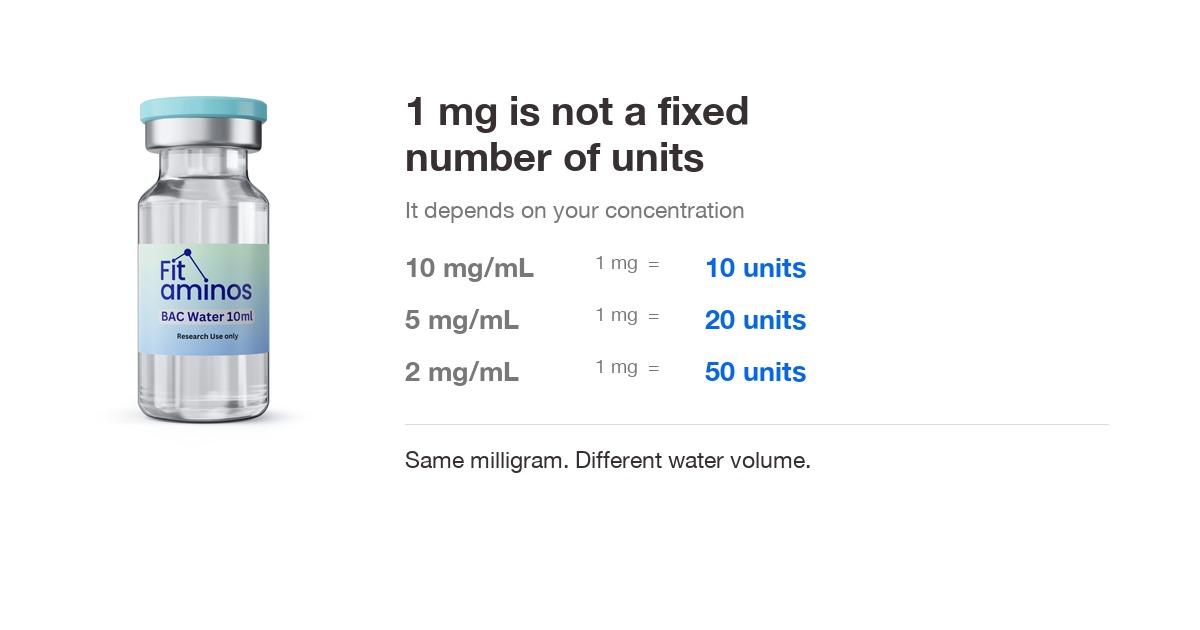
It depends on the concentration of your vial. On a U-100 syringe, 1 mg is 10 units at 10 mg/mL, 20 units at 5 mg/mL, and 50 units at 2 mg/mL.
Those are the same milligram in all three cases. What changed is how much water it is dissolved in.
Concentration comes from two numbers you already have: the milligrams printed on the vial, and the millilitres of bacteriostatic water you added. Divide the first by the second.
- Divide vial mg by water mL to get mg/mL
- Divide your intended dose by that concentration to get mL
- Multiply mL by 100 to get units on a U-100 syringe
- Check the result against the chart below
Why Is There No Fixed mg to Units Answer?
Because the syringe is not measuring the peptide. It is measuring the liquid the peptide is dissolved in.
This trips people up because insulin does have a fixed answer, and most syringe guidance is written for insulin. Insulin sold in the United States is standardised at 100 units per mL, so the scale on the barrel doubles as a dose scale. A prescription can say twenty units and mean the same amount of drug every time.
A reconstituted peptide has no standard concentration. You set it. A 10 mg vial with 1 mL of water is 10 mg/mL. The same vial with 5 mL is 2 mg/mL. Both vials contain 10 mg of peptide. A 20 unit draw takes 0.2 mL from either, which is 2 mg from the first and 0.4 mg from the second.
So “how many units is 1 mg” has as many answers as there are concentrations, and the honest response is a method rather than a number.
This is worth being blunt about because the wrong version of this is everywhere. Forum posts, product pages and printable charts routinely state a mg-to-units figure with no concentration attached. Copied into a different vial, that figure is simply wrong, and it is wrong in whichever direction the concentration differs.
The practical test is short. If a conversion does not mention your vial size and your water volume, it cannot be telling you about your vial.
What Does the mg to Units Conversion Chart Show?
Each table below is one vial size. The rows are how much water you added, which sets the concentration. The columns are the dose you want to draw. The figure in the cell is units on a U-100 syringe.
Figures in red are under 10 units, which is where the graduations on a U-100 barrel get too close together to read reliably. If your combination lands there, adding more water moves the same dose further up the barrel.
Every number in these tables was calculated rather than typed, and the arithmetic is the formula in the section below.
5 mg vial
| Water added | Concentration | 100 mcg | 250 mcg | 500 mcg | 1000 mcg | 2000 mcg |
|---|---|---|---|---|---|---|
| 1 mL | 5 mg/mL | 2 | 5 | 10 | 20 | 40 |
| 2 mL | 2.5 mg/mL | 4 | 10 | 20 | 40 | 80 |
| 3 mL | 1.66667 mg/mL | 6 | 15 | 30 | 60 | 120 |
| 5 mL | 1 mg/mL | 10 | 25 | 50 | 100 | 200 |
10 mg vial
| Water added | Concentration | 100 mcg | 250 mcg | 500 mcg | 1000 mcg | 2000 mcg |
|---|---|---|---|---|---|---|
| 1 mL | 10 mg/mL | 1 | 2.5 | 5 | 10 | 20 |
| 2 mL | 5 mg/mL | 2 | 5 | 10 | 20 | 40 |
| 3 mL | 3.33333 mg/mL | 3 | 7.5 | 15 | 30 | 60 |
| 5 mL | 2 mg/mL | 5 | 12.5 | 25 | 50 | 100 |
30 mg vial
| Water added | Concentration | 100 mcg | 250 mcg | 500 mcg | 1000 mcg | 2000 mcg |
|---|---|---|---|---|---|---|
| 1 mL | 30 mg/mL | 0.333333 | 0.833333 | 1.66667 | 3.33333 | 6.66667 |
| 2 mL | 15 mg/mL | 0.666667 | 1.66667 | 3.33333 | 6.66667 | 13.3333 |
| 3 mL | 10 mg/mL | 1 | 2.5 | 5 | 10 | 20 |
| 5 mL | 6 mg/mL | 1.66667 | 4.16667 | 8.33333 | 16.6667 | 33.3333 |
How Do You Read Your Own Vial Off the Chart?
Find the table for your vial size, then the row for the water you added. Read across to the dose you want. That cell is your unit count.
If your water volume is not one of the four rows, use the formula in the next section. If your vial size is not one of the three tables, the formula covers that too.
One thing to watch when reading across: the row you want is the water you actually added, not the water you intended to add. If you aimed for 2 mL and the syringe delivered slightly under, the concentration moved and so did every figure in that row. Where accuracy matters, note what went in rather than what was planned.
Working the Conversion Out Without the Chart
Three steps, and they work for any vial, any water volume and any dose.
Step one, find your concentration. Divide the milligrams in the vial by the millilitres of water you added. A 10 mg vial in 2 mL is 5 mg/mL.
Step two, convert to the same unit as your dose. If your dose is in micrograms, turn the concentration into micrograms as well. One milligram is 1,000 micrograms, so 5 mg/mL is 5,000 mcg/mL. Skipping this is the most common arithmetic error in the whole process, and it is a factor of a thousand, so it is not subtle.
Step three, divide and multiply. Divide your dose by the concentration to get millilitres, then multiply by 100 for units. A 250 mcg dose at 5,000 mcg/mL is 0.05 mL, which is 5 units.
Written as one line: units = (dose in mcg divided by concentration in mcg/mL) multiplied by 100.
The multiply-by-100 step is the only part specific to the syringe, and it comes from the U-100 scale carrying 100 units in every millilitre. On any U-100 barrel, millilitres to units is always times one hundred.
Worked end to end on a vial that is not in the tables above. A 15 mg vial, 3 mL of water, and a 400 mcg dose. Concentration is 15 divided by 3, so 5 mg/mL, which is 5,000 mcg/mL. Volume is 400 divided by 5,000, so 0.08 mL. Units is 0.08 times 100, so 8 units.
Eight units is under the readable floor, which the formula has just told you before you drew anything. Rerun it at 5 mL of water: concentration 3 mg/mL or 3,000 mcg/mL, volume 0.133 mL, and 13.3 units. Same vial, same dose, a figure you can actually read off the barrel.
The reverse check is worth doing once. Take the units you landed on, divide by 100 to get millilitres, multiply by your concentration, and confirm you get the dose you started with. If it does not come back, one of the unit conversions slipped.
If you would rather not do it by hand, the peptide dosage calculator runs the same three steps.
What About Micrograms Instead of Milligrams?
Micrograms work identically once the concentration is expressed in micrograms too. The conversion is 1 mg equals 1,000 mcg.
Most peptide doses land in the hundreds of micrograms rather than in whole milligrams, which is why the chart columns above are in mcg. A dose written as 0.25 mg and a dose written as 250 mcg are the same amount, and the second form is easier to keep straight on a syringe barrel.
Mixing the two units mid-calculation is where errors come from. Pick micrograms, convert everything to micrograms once at the start, and stay there.
There is a quick sanity check for whether you have slipped a factor of a thousand. A peptide draw on a U-100 barrel almost always lands somewhere between about 5 and 50 units. If your arithmetic produces 0.05 units or 500 units, you have almost certainly divided micrograms by a milligram figure or the other way round. Go back to the concentration line rather than adjusting the answer.
When the Unit Count Comes Out Too Small to Read
If the arithmetic gives you a draw under about 10 units, the problem is the concentration rather than the syringe.
On a U-100 barrel the marks are one unit apart. At a 4 unit draw, being half a mark out is a 12.5% error. At 20 units the same physical slip is 2.5%. Precision is a function of how far apart the lines are.
The fix is more water, not a steadier hand. Reconstituting the same vial at a lower concentration puts the same dose further up the barrel. Our guide to reading an insulin syringe works through the trade-off between readability and injection volume.
Sets your concentration
Fit Aminos stocks bacteriostatic water.
The water volume you choose is what decides every number above.
We are affiliated with Fit Aminos and may earn from purchases made through this link.
Frequently Asked Questions About mg to Units
How many units is 1 mg on an insulin syringe?
It depends on your concentration. At 10 mg/mL it is 10 units, at 5 mg/mL it is 20 units, and at 2 mg/mL it is 50 units. Find your concentration by dividing the vial’s milligrams by the millilitres of water you added.
How many units is 2.5 mg on an insulin syringe?
At 10 mg/mL, 2.5 mg is 25 units. At 5 mg/mL it is 50 units. At 2 mg/mL it is 125 units, which is more than a standard 1 mL barrel holds.
Is 1 mL always 100 units?
On a U-100 syringe, yes. That is what U-100 means. It is worth checking the barrel, because U-40 syringes exist for veterinary use and carry 40 marks per millilitre instead of 100. The same 0.1 mL of liquid reads as 10 units on U-100 and 4 units on U-40, so mixing them up is a 2.5 times error in whichever direction you got it wrong.
Why do two people get different units for the same dose?
Almost always because they reconstituted at different concentrations. Same vial, same intended dose, different water volume, different unit count. Neither of them misread the syringe.
Should I use mg or mcg for peptide doses?
Micrograms are usually easier because most peptide doses fall in the hundreds rather than in whole milligrams, and the conversion is one thousand micrograms to the milligram. The important thing is not which you pick but that you convert everything to the same unit before you start dividing. A dose in micrograms divided by a concentration in milligrams per millilitre gives an answer that is out by a factor of a thousand, and that is the single most common mistake in this arithmetic.
About the author
This article was written by Dr. Bradley Thomas, MD, orthopedic surgeon and sports medicine specialist, for Peptides Unleashed. Dr. Thomas is double board-certified by the American Board of Orthopaedic Surgery in both Orthopaedic Surgery and Orthopaedic Sports Medicine, and specializes in sports medicine, joint preservation and regenerative therapies.
He earned his medical degree at the Keck School of Medicine at the University of Southern California, completed his residency at Montefiore Medical Center and Albert Einstein College of Medicine, and a fellowship at the Southern California Center for Sports Medicine. He has over 24 years of surgical experience and more than 14,000 procedures performed. He is a Master Instructor with the Arthroscopy Association of North America, a Fellow of the American Academy of Orthopaedic Surgeons, the California Orthopaedic Association and the American Orthopaedic Society for Sports Medicine, and a co-founder of Beach Cities Orthopedics.
Peptides Unleashed is not a medical practice and does not prescribe, diagnose or recommend treatment. Every figure in the conversion tables on this page was calculated rather than transcribed.
More about Dr. Bradley Thomas and how we source and check our information
