
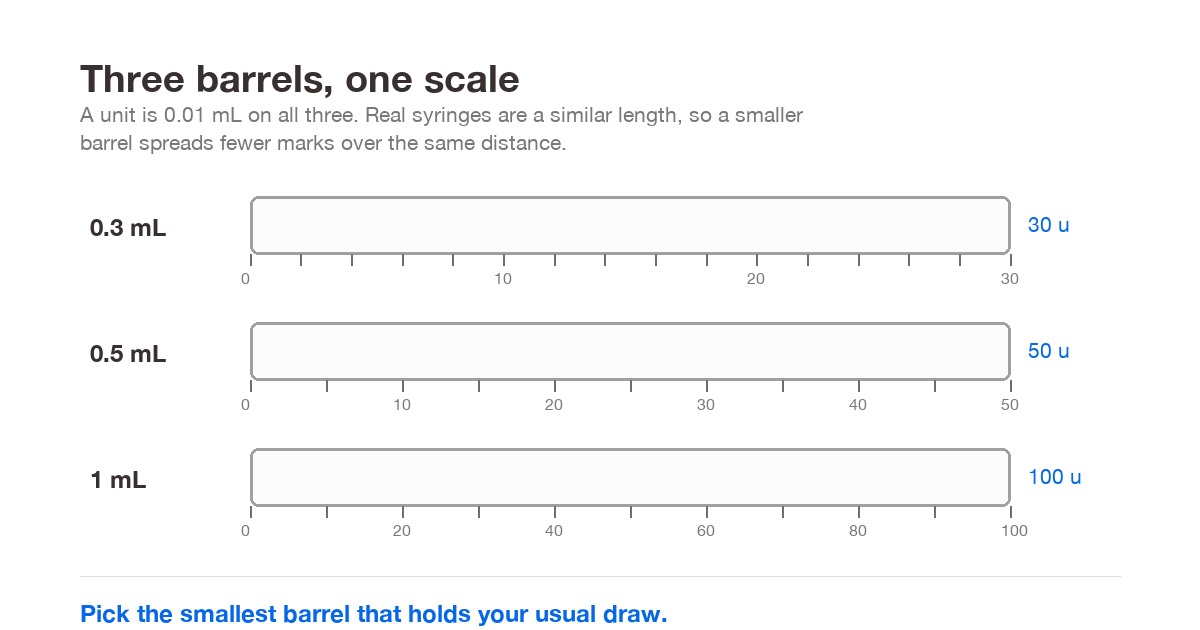
Insulin syringes come in three barrel sizes: 0.3 mL, 0.5 mL and 1 mL, holding 30, 50 and 100 units respectively on the U-100 scale. All three use the same scale, so a unit means the same thing on each one.
What changes is how much you can draw in one go and how far apart the marks are printed. For a reconstituted peptide, the second of those is usually the one that matters, and it is the reason to think about barrel size at all.
What Sizes Do Insulin Syringes Actually Come In?
Three barrel capacities, all on the same U-100 scale where 100 units is 1 mL.
| Barrel | Holds | Full-scale volume | Marks per unit |
|---|---|---|---|
| 0.3 mL | 30 units | 0.3 mL | widest spacing |
| 0.5 mL | 50 units | 0.5 mL | medium spacing |
| 1 mL | 100 units | 1.0 mL | tightest spacing |
Barrels are sometimes labelled by unit capacity rather than millilitres, so a 30-unit syringe and a 0.3 mL syringe are the same thing.
Which Barrel Size Suits a Reconstituted Peptide?
The smallest one that still holds your largest routine draw.
That is a genuinely different answer from the one insulin users need, and the reason is worth spelling out. An insulin dose is prescribed in units and the concentration is fixed, so the barrel is chosen to fit the prescription. A reconstituted peptide has a concentration you chose, which means your unit count is something you set rather than something you were given.
So the sequence runs the other way. You work out roughly what your draw will be, then pick a barrel that puts that draw comfortably inside its range without wasting most of the scale.
A 20 unit draw on a 1 mL barrel occupies a fifth of the length. The same 20 units on a 0.3 mL barrel occupies two thirds, and every mark is more than three times further apart. Nothing about the measurement changed. The readability did.
The constraint on going smaller is capacity. A 0.3 mL barrel cannot draw more than 30 units in one go, so if your volume ever exceeds that you are drawing twice or keeping a second barrel. For most reconstituted peptide work the 0.5 mL barrel is the compromise that handles the range without giving up much spacing.
If you find your draws consistently landing under 10 units on whichever barrel you have, the answer is usually to reconstitute at a lower concentration rather than to buy a different syringe. Our guide to how much bac water to use works through that trade-off.
There is a second reason not to default to the largest barrel. Dead space, the small volume that stays in the hub and needle after the plunger bottoms out, is a fixed quantity rather than a proportional one. On a large draw it is negligible. On a very small one it is a bigger share of what you were trying to move, which is another argument for keeping draws off the bottom of the scale.
Does a Smaller Barrel Change the Units?
No. A unit is 0.01 mL on all three barrels, because they all carry the U-100 scale.
This is worth stating plainly because the sizes are quoted in two different systems and it invites confusion. A 0.3 mL barrel holding 30 units and a 1 mL barrel holding 100 units are the same scale at different lengths, not two different scales.
Ten units drawn on a 0.3 mL barrel and ten units drawn on a 1 mL barrel are the same volume of liquid and the same amount of peptide. The only difference is how easy that ten was to see.
The thing that genuinely does change the meaning of a unit is the scale printed on the barrel, not its capacity. U-40 syringes exist for veterinary insulin and carry 40 marks per millilitre, so on those a unit is 0.025 mL. Check the barrel says U-100.
The practical version: capacity is about how much fits, scale is about what each mark means. Only one of those two changes your arithmetic.
What Do the Gauge Numbers Mean?
Gauge describes the needle’s outside diameter, and the scale runs backwards: a higher gauge number is a thinner needle.
Insulin syringes typically sit in the 28 to 31 gauge range, which is at the fine end of the scale. The number tells you nothing about the barrel capacity or the unit scale, and the two are specified independently.
So a 31 gauge needle is thinner than a 28 gauge one, which reads backwards until you know the convention. It is a legacy measure based on how many tubes of that diameter fitted through a drawing die, which is why smaller numbers mean wider needles.
Reading Accuracy and Graduation Spacing
This is the whole practical case for thinking about barrel size, so it is worth doing the arithmetic rather than asserting it.
On a U-100 barrel the marks are one unit apart, and that is true on every capacity. What differs is the physical distance those marks occupy. A 1 mL barrel spreads 100 marks along its length. A 0.3 mL barrel spreads 30 marks along a similar length, so each mark is roughly three times further from its neighbour.
Now put an error against that. Suppose you are half a mark out, which is an ordinary amount of imprecision.
| Intended draw | Half-mark error | As a percentage |
|---|---|---|
| 4 units | 0.5 units | 12.5% |
| 10 units | 0.5 units | 5% |
| 20 units | 0.5 units | 2.5% |
| 40 units | 0.5 units | 1.25% |
The error does not grow as the draw gets smaller. It stays exactly the same size and simply becomes a larger share of what you were trying to measure. That is why the useful question is not “how steady is my hand” but “how much of the barrel is my draw using”.
Two levers move that number. A smaller barrel spreads the same units further apart, and a lower concentration puts the same dose across more units. The second is usually the stronger of the two, because it changes the unit count itself rather than just the spacing.
Beyond about 20 units the returns flatten out. Getting from 2.5% to 1.25% by doubling the draw is a real improvement on paper and rarely the binding constraint in practice.
Which is why 10 units is a useful floor rather than a target. It is roughly where the percentage error stops being the largest source of imprecision in the process, and pushing well past it buys less than the arithmetic suggests.
What Does the Needle Length Number Mean?
It is the length of the needle in millimetres, and the common lengths on insulin syringes run from about 4 mm to around 12.7 mm.
We are not going to tell you which length to use, because that is a question about administering something to a person and this site does not give that advice. What the number means is simply the distance from the hub to the tip.
Length is specified independently of both the barrel capacity and the gauge, so a given barrel size may be available with several needle options. If you are comparing two products that look otherwise identical, those three numbers are what differ.
Product listings usually quote all three together in a compressed form, something like 0.5 mL 30G 8 mm, which is capacity then gauge then length. Reading them in that order makes most listings decodable without any further explanation.
Where a listing gives only two of the three, the missing one is worth asking about rather than assuming, because it is the specification most likely to vary between otherwise identical-looking products.
Choosing a Barrel: a Short Rule
Work out your typical draw in units, then pick the smallest barrel that holds it with room to spare.
Under 30 units routinely, a 0.3 mL barrel gives the best readability. Up to 50, the 0.5 mL is the sensible default and handles most reconstituted peptide work. Above 50, the 1 mL barrel is the only one with the capacity.
If your draw is small enough that even the 0.3 mL barrel leaves it under 10 units, the concentration is the thing to change rather than the syringe.
Sets your unit count
Fit Aminos stocks bacteriostatic water.
Concentration moves the draw further up the barrel than any syringe swap.
We are affiliated with Fit Aminos and may earn from purchases made through this link.
Frequently Asked Questions About Syringe Sizes
What size insulin syringe is best for peptides?
The smallest barrel that holds your usual draw. For most reconstituted peptide work that is the 0.5 mL, holding 50 units, which handles the common range while keeping the marks reasonably far apart. Drop to 0.3 mL if your draws are routinely under 30 units.
Is a 100 unit syringe the same as 1 mL?
Yes, on the U-100 scale. One hundred units is one millilitre, so the two labels describe the same capacity.
Does the needle gauge affect the dose?
No. Gauge is the needle’s diameter and has nothing to do with the volume markings on the barrel. A 28 gauge and a 31 gauge syringe of the same capacity carry an identical scale.
Why is my draw hard to read on a 1 mL syringe?
Because a 1 mL barrel fits 100 marks along its length, so each unit occupies less physical space than on a smaller barrel. If your draw is a small number of units it will sit in a crowded part of the scale. Two things help: a smaller barrel spreads the same units further apart, and reconstituting at a lower concentration raises the unit count for the same dose. The second is usually more effective because it changes what you are measuring rather than just how it is printed.
Can I use a 0.3 mL syringe for a 40 unit draw?
No. A 0.3 mL barrel holds 30 units, so 40 will not fit in a single draw.
About the author
This article was written by Dr. Bradley Thomas, MD, orthopedic surgeon and sports medicine specialist, for Peptides Unleashed. Dr. Thomas is double board-certified by the American Board of Orthopaedic Surgery in both Orthopaedic Surgery and Orthopaedic Sports Medicine, and specializes in sports medicine, joint preservation and regenerative therapies.
He earned his medical degree at the Keck School of Medicine at the University of Southern California, completed his residency at Montefiore Medical Center and Albert Einstein College of Medicine, and a fellowship at the Southern California Center for Sports Medicine. He has over 24 years of surgical experience and more than 14,000 procedures performed. He is a Master Instructor with the Arthroscopy Association of North America, a Fellow of the American Academy of Orthopaedic Surgeons, the California Orthopaedic Association and the American Orthopaedic Society for Sports Medicine, and a co-founder of Beach Cities Orthopedics.
Peptides Unleashed is not a medical practice and does not prescribe, diagnose or recommend treatment. This page describes what syringe specifications mean and does not advise on administering anything.
More about Dr. Bradley Thomas and how we source and check our information
