
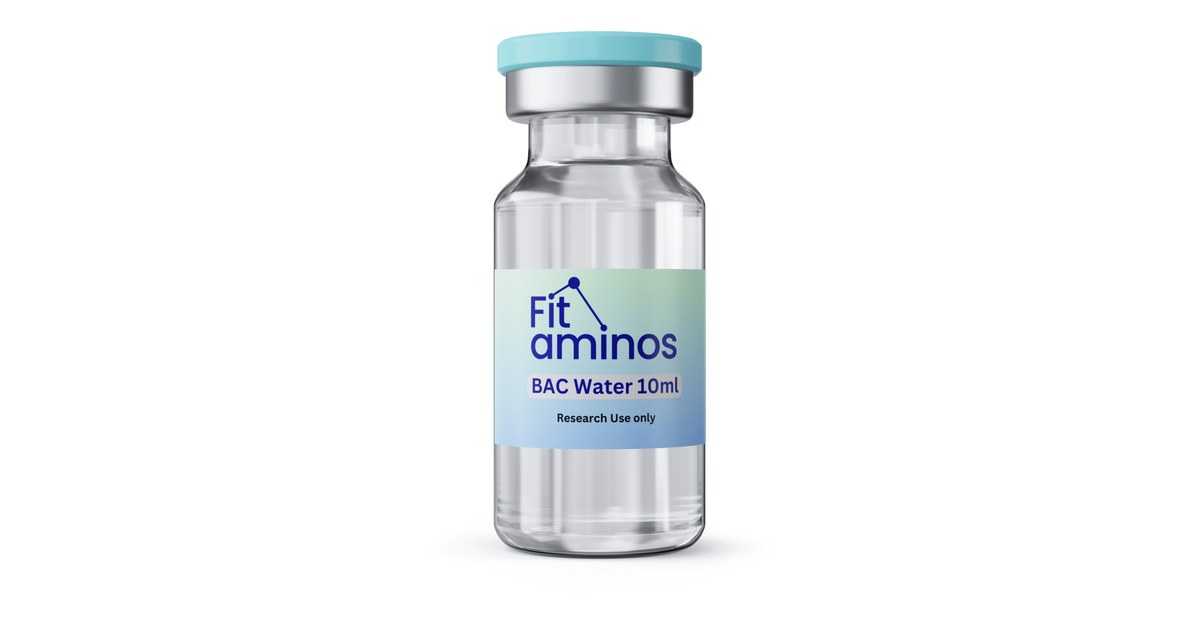
A 10 mg vial takes 1 mL of bacteriostatic water, or 2 mL, or 5 mL. All three are correct. Which one is right depends on something most guides never mention, which is the syringe you are holding rather than the vial you are filling.
Choosing bac water for peptides is a measurement problem before it is a chemistry problem. This page covers how to pick that volume, what bacteriostatic water actually contains, how the three water types differ, and how long an opened vial stays usable. Every number is traced to its source, including one widely repeated figure that does not appear where almost everyone says it does.
How Much Bac Water Do You Need for a Peptide Vial?
Most peptide vials are reconstituted with 1 mL to 3 mL of bacteriostatic water, but the correct volume is the one that puts your intended draw above 10 units on a U-100 insulin syringe.
The vial size does not set the volume. The draw does. A U-100 syringe holds 100 units per millilitre, so 0.1 mL is 10 units and 0.01 mL is 1 unit. A draw landing at 2 or 3 units is measurable in theory and unreliable in practice, because the graduations sit that close together.
The same vial can correctly take different volumes depending on what you plan to draw. Adding water does not change how much peptide is in the vial. It changes the concentration, and therefore how many units a draw occupies.
- Identify the draw you intend to take from the vial
- Divide the vial’s total contents by that draw to get the number of draws
- Choose a water volume that puts one draw at 10 units or more
- Confirm the arithmetic on a peptide dosage calculator before you draw
What Is Bacteriostatic Water, and What Is In It?
Bacteriostatic water is sterile water containing a preservative that stops bacterial growth, which is what allows the same vial to be punctured more than once.
The preservative is benzyl alcohol. Here is the detail almost every competing page gets incomplete: it is not always 0.9%. The Hospira label on DailyMed states the product contains “0.9% (9 mg/mL) or 1.1% (11 mg/mL) of benzyl alcohol added as a bacteriostatic preservative”. Two strengths are on the same label. If you have read that bacteriostatic water is always 0.9%, that is a simplification, and it is worth checking the vial in front of you rather than assuming.
The word bacteriostatic is doing precise work. It means the preservative stops bacteria from multiplying. It does not mean the water sterilises anything, and it does not mean the contents cannot be contaminated by poor technique.
This matters for a lyophilized vial because the powder itself carries no preservative. Whatever protection the reconstituted solution has comes from the water you added.
Neither strength is the premium option. Both appear on the same manufacturer labelling and both are doing the same job, which is holding back microbial growth between punctures rather than sterilising anything. The number is worth knowing because it should be printed, not because one figure is better to buy than the other.
Choosing Your Volume: Start With the Syringe
Every guide on this topic tells you to use 1 mL to 3 mL. That advice is not wrong, it is just answering the wrong question. It describes what people typically do rather than what makes a draw measurable.
We give a rule here instead of a number, and the reason is specific. A number cannot know what you are drawing. The same 2 mL that produces a comfortable 20 unit draw for one person produces an unreadable 2 unit draw for another, from an identical vial. A rule travels. A number does not.
Call it the syringe-first volume rule: choose the water volume so that one intended draw lands at 10 units or more on a U-100 syringe, then work backwards to the concentration.
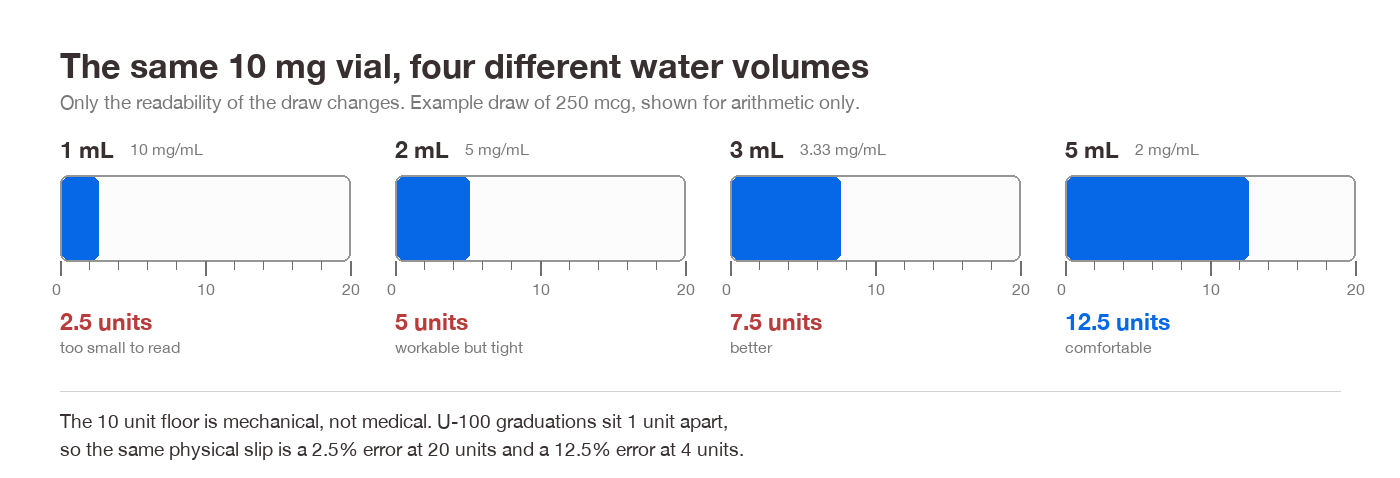
The reason 10 units is the floor is mechanical rather than medical. On a U-100 syringe the markings are 1 unit apart. At a 20 unit draw, being off by half a graduation is a 2.5% error. At a 4 unit draw, the same physical slip is a 12.5% error. Precision is not a property of the peptide, it is a property of how far apart the lines are.
Here is the arithmetic on a 10 mg vial. The 250 mcg draw below is an arbitrary figure chosen to show the maths. It is not a recommendation, and this page does not tell you what to draw.
| Water added | Concentration | Volume of a 250 mcg draw | Units on a U-100 syringe |
|---|---|---|---|
| 1 mL | 10 mg/mL | 0.025 mL | 2.5 units, too small to read |
| 2 mL | 5 mg/mL | 0.05 mL | 5 units, workable but tight |
| 3 mL | 3.33 mg/mL | 0.075 mL | 7.5 units, better |
| 5 mL | 2 mg/mL | 0.125 mL | 12.5 units, comfortable |
Read down that last column and the point is hard to miss. Nothing about the peptide changed across those four rows. The only thing that changed is whether a person can see what they are drawing.
There is a ceiling as well as a floor. More water means more volume per draw, and a very dilute solution means injecting a larger amount of liquid, which is uncomfortable and fills the vial faster than the contents last. The practical range sits between those two limits, which is how the conventional 1 mL to 3 mL advice came about. It is a reasonable default that stops being reasonable at small draws.
Once the volume is chosen, the mixing itself follows the step by step reconstitution protocol, which covers technique, angle and swirling.
Bacteriostatic Water vs Sterile Water vs SWFI
Three products sit next to each other on the same shelf and get used interchangeably, which is a mistake because only one of them supports repeated puncture.
| Bacteriostatic water | Sterile Water for Injection | Sterile water, non-injectable | |
|---|---|---|---|
| Preservative | Benzyl alcohol, 0.9% or 1.1% | None | None |
| Repeated puncture | Yes, that is the point | No, single use | No |
| Typical presentation | Multi-dose vial | Single-dose vial or ampoule | Irrigation or lab bottle |
| Suitable for injection | Yes, per its labelling | Yes, per its labelling | No |
| Main limitation | Benzyl alcohol is not for everyone | No protection after opening | Not for injection at all |
The distinction that catches people is the middle column. Sterile Water for Injection is sterile in the vial and has nothing to keep it that way once a needle has been through the stopper. It is designed to be used and discarded. Using it for a vial you plan to draw from repeatedly removes the protection that made bacteriostatic water the standard choice for multi-dose work.
Why Does an Opened Bottle Have a Time Limit?
Because once the stopper has been pierced the container is no longer sealed, and the working figure everyone uses for that is 28 days from first puncture. It is a sound number and it is the one to plan around.
Two things about it are almost always stated incorrectly, and the first is checkable in a minute.
It is not printed on the bottle. We read the Hospira label on DailyMed on 26 August 2026 looking for it. The phrase “28 days” does not appear anywhere on that label. What the label carries is the storage instruction, “Store at 20 to 25°C (68 to 77°F)”, and the neonates warning. The figure comes from USP General Chapter 797, which sets a beyond-use date for multi-dose vials as a category, and it is explicitly qualified: a multi-dose vial may be used for 28 days after first puncture unless the manufacturer states otherwise.
Every competing page we read states 28 days as though it were a manufacturer instruction. It is a USP standard for a class of container, and the qualifier gets dropped in the retelling.
The second is more useful day to day. Two clocks run at once, not one. The 28 days describes how long the preserved water resists microbial growth. It says nothing about whether the peptide dissolved in it is still intact, because benzyl alcohol is an antimicrobial preservative rather than a stabiliser. The relevant number is whichever clock runs out first, and for many compounds that is the peptide.
Write the puncture date on the bottle, because nobody remembers it accurately a fortnight later, and discard on any visible change regardless of what the count says. We work through refrigeration, the label wording and both clocks in how long bacteriostatic water lasts.
Who Should Not Use Bacteriostatic Water?
The Hospira label carries an unusually blunt warning in capitals: “NOT FOR USE IN NEONATES”. That is not boilerplate.
Benzyl alcohol has a documented toxicity history in newborns. Gershanik and colleagues in the New England Journal of Medicine described the gasping syndrome and benzyl alcohol poisoning on 25 November 1982, and the association was later examined in animal work on benzyl alcohol toxicity in neonatal mice published in the Journal of Pharmaceutical Sciences in July 1986. Benzyl alcohol sensitivity or allergy is also a genuine contraindication in adults, and it is the reason preservative-free options exist at all.
Where Should You Buy Bacteriostatic Water?
Pharmacies, online marketplaces and research suppliers all stock it, and availability is the real constraint rather than price. FDA currently lists Hospira’s bacteriostatic water as a shortage, which is why pharmacy staff so often say they cannot order it.
Whichever channel you use, four things are worth confirming: the benzyl alcohol strength is stated, it is sold as a sealed multi-dose vial, the lot number and expiry are legible, and the vial size matches how much you actually get through in a month.
Compare on price per millilitre rather than price per bottle, and then correct for how much you will realistically use before the opened vial runs out its own clock. Bulk is only a saving if you get through it.
We work through each channel, the shortage, the prescription question and how to compare sellers in where to buy bacteriostatic water.
Where to source bac water
Fit Aminos stocks bacteriostatic water.
We are affiliated with Fit Aminos and may earn from purchases made through this link.
We are affiliated with Fit Aminos and may earn from purchases made through this link.
Frequently Asked Questions About Bac Water
Can I buy bacteriostatic water at CVS?
Availability varies by branch and by country. In the United States, Bacteriostatic Water for Injection is labelled “Rx only”, so a pharmacy may ask for a prescription even where it is stocked. Many buyers source it from research suppliers instead. Call ahead rather than assuming a local branch carries it.
Can I purchase bacteriostatic water without a prescription?
The US label carries “Rx only”, though research suppliers sell it without one. Rules differ by country, and we cannot advise on your jurisdiction.
What type of bacteriostatic water is best for peptides?
There is no special peptide grade. What you want is ordinary Bacteriostatic Water for Injection, USP, in a sealed multi-dose vial, with the benzyl alcohol strength printed on the label. Both 0.9% and 1.1% appear on the Hospira labelling and either does the same job of resisting microbial growth between punctures. Size is the decision that people get wrong more often than strength. A 30 mL bottle looks like better value than a 10 mL one until you notice the water is running its own clock from first puncture, and buying more than you will use inside that window is not a saving. Match the bottle to how much reconstituting you actually do. For compound-specific volumes, work from the individual protocol pages, such as the Semax 10 mg vial protocol, rather than applying one figure to every vial.
Where do I get BAC water for peptides?
Pharmacies, online marketplaces and research suppliers all stock it, and the four checks listed above matter more than which of the three you use. Confirm the benzyl alcohol strength is stated, the vial is multi-dose, the lot and expiry are legible, and the size matches your use.
Does bacteriostatic water need to be refrigerated?
No. The Hospira label says “Store at 20 to 25°C (68 to 77°F)”, which is room temperature. Your reconstituted peptide is a separate question, and many do need refrigerating.
About the author
This article was written by Dr. Bradley Thomas, MD, orthopedic surgeon and sports medicine specialist, for Peptides Unleashed. Dr. Thomas is double board-certified by the American Board of Orthopaedic Surgery in both Orthopaedic Surgery and Orthopaedic Sports Medicine, and specializes in sports medicine, joint preservation and regenerative therapies.
He earned his medical degree at the Keck School of Medicine at the University of Southern California, completed his residency at Montefiore Medical Center and Albert Einstein College of Medicine, and a fellowship at the Southern California Center for Sports Medicine. He has over 24 years of surgical experience and more than 14,000 procedures performed. He is a Master Instructor with the Arthroscopy Association of North America, a Fellow of the American Academy of Orthopaedic Surgeons, the California Orthopaedic Association and the American Orthopaedic Society for Sports Medicine, and a co-founder of Beach Cities Orthopedics.
Peptides Unleashed is not a medical practice and does not prescribe, diagnose or recommend treatment. Dosage charts and protocols on this site are built from peer-reviewed studies, clinical trial registries, pharmacology references and manufacturer Certificates of Analysis. Where a finding is anecdotal, theoretical, or supported only by in-vitro or animal work, we say so in the text rather than presenting it as an established clinical outcome. The label facts on this page were read directly from the manufacturer’s labelling on DailyMed on 26 August 2026.
More about Dr. Bradley Thomas and how we source and check our information
