
No. The manufacturer’s label says to store bacteriostatic water at room temperature, and refrigerating an unopened bottle achieves nothing.
That answer surprises people, because almost everything else in a peptide workflow does go in the fridge. This page covers what the label actually specifies, how long a bottle lasts before and after you pierce the stopper, whether cold storage buys you extra time, and the distinction that causes most of the confusion.
Does Bacteriostatic Water Need to Be Refrigerated?
No. Bacteriostatic water is stored at controlled room temperature, and the label is explicit about it.
The Hospira label on DailyMed states: “Store at 20 to 25°C (68 to 77°F). [See USP Controlled Room Temperature.]” There is no refrigeration instruction anywhere on it.
The reason people assume otherwise is that the peptide they are about to mix usually does need the fridge. The water and the solution you make with it are two different things with two different storage requirements.
- Unopened bacteriostatic water: room temperature, per the label
- Opened bacteriostatic water: still room temperature, and now on a use-by clock
- Reconstituted peptide: usually refrigerated, and on its own separate clock
How Long Does Bacteriostatic Water Last?
Two different answers, depending on whether the stopper has been pierced.
Unopened, it lasts until the expiry date printed on the bottle. That is a manufacturer date based on the sealed product, and it is typically measured in years rather than months. Nothing you do at home extends it and normal room-temperature storage does not shorten it.
Opened, the working figure everyone uses is 28 days from first puncture. It is a sound number and it is the one to plan around. But it is worth knowing where it comes from, because it is not where most of the internet says.
We read the Hospira label looking for it. The phrase “28 days” does not appear on that label anywhere. What the label carries is the storage temperature above and the neonates warning. The 28-day figure is from USP General Chapter 797, which sets a beyond-use date for multi-dose vials as a category, and it is explicitly conditional: a multi-dose vial may be used for 28 days after first puncture unless the manufacturer states otherwise.
So it is a pharmacy compounding standard applied to a type of container, rather than an instruction from the people who made your water. That distinction matters for two reasons. It tells you the number is a general convention rather than a product-specific test result, and it tells you the qualifier is part of the rule rather than a footnote.
None of that is an argument for ignoring it. Twenty-eight days is a reasonable and widely used ceiling. It is an argument for knowing that it describes the container category, and for not assuming it says anything about what you dissolved in the water.
It is also worth noticing what the number is measured against. A beyond-use date for a multi-dose vial assumes reasonable aseptic access each time, which is the condition the preservative was specified for. Careless access does not get 28 days.
What Does the Label Say About Storage?
Very little, and the brevity is informative. The storage section of the Hospira labelling is one line: “Store at 20 to 25°C (68 to 77°F). [See USP Controlled Room Temperature.]”
Controlled room temperature is a defined term rather than a loose one. It permits brief excursions outside that window, which is what allows the product to survive shipping, but the intended storage condition is a cupboard rather than a fridge.
The label also carries the warning that matters most, in capitals: “NOT FOR USE IN NEONATES”. That is about the benzyl alcohol preservative rather than about storage, and it is covered in our guide to bac water for peptides.
What the label does not contain is any discard date, any refrigeration instruction, and any statement about how long the bottle remains usable once opened. Every figure you have read about those three things came from somewhere other than the manufacturer.
Does the Fridge Extend the 28 Days?
There is no evidence that it does, and no manufacturer statement supporting it.
The 28-day convention is about microbial safety in a repeatedly punctured container. The thing protecting the water is the benzyl alcohol, which works at room temperature and is the entire reason the product exists. Cold storage does not top up a preservative.
Refrigerating an opened bottle is not harmful. It just is not doing the job people expect it to do, and it does not license going past the window.
Two Clocks: the Water and the Peptide in It
This is the part worth carrying away, and it is the source of most storage mistakes.
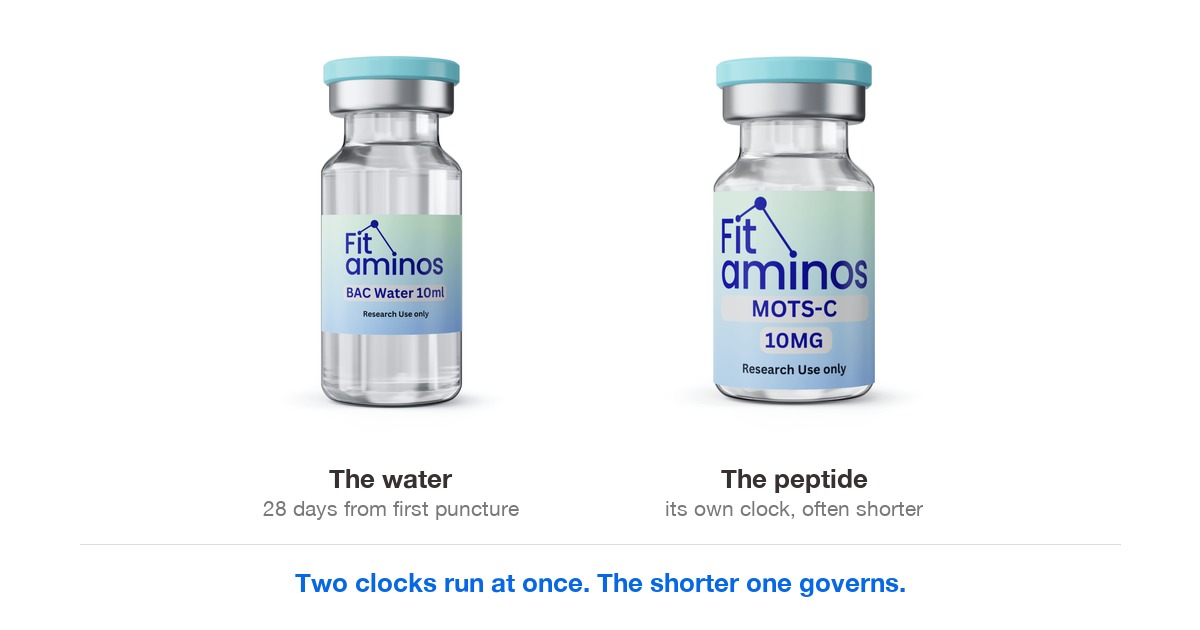
Two clocks run at the same time, and they are unrelated.
The first clock is the water’s. It starts when you pierce the stopper, it is about microbial contamination, and 28 days is the convention. Benzyl alcohol is what makes that window possible.
The second clock is the peptide’s. It starts when the powder goes into solution, it is about chemical degradation, and it has nothing to do with benzyl alcohol at all. A preservative stops things growing in your vial. It does not stop a peptide chain breaking down.
Those two processes are governed by different variables. Microbial growth responds to the preservative. Chemical stability responds to temperature, light, pH and the specific molecule. That is precisely why the reconstituted vial goes in the fridge while the water bottle does not.
The consequence is simple arithmetic. The shorter clock is the one that governs. For many peptides in solution that is the peptide, not the water, and a bottle of bac water sitting well inside its 28 days tells you nothing reassuring about a vial you mixed three weeks ago.
This is also why “bacteriostatic water gives you a 28-day shelf life” is a claim worth being careful with. The water gives the container a 28-day ceiling. What it gives the contents is antimicrobial protection and nothing else.
In practice that means tracking two dates rather than one. The date you opened the water, and the date you mixed each vial. They are rarely the same day and they rarely expire together.
It also means a fresh bottle of water does not reset anything about a peptide you mixed a fortnight ago. The vial in the fridge is on its own schedule and topping up the diluent has no bearing on it.
For compound-specific storage behaviour, the individual protocol pages treat it separately. The MOTS-C 10 mg vial protocol is one example.
How Should You Store an Opened Vial?
Room temperature, out of direct light, with the date of first puncture written on the bottle.
That last part is the one people skip and then regret. Nobody remembers accurately whether a bottle was opened two weeks ago or five, and the whole 28-day convention is useless without a start date. A marker pen on the label solves it.
Keep the stopper clean. The preservative handles ordinary repeated access, not a stopper that has been touched, left uncovered or wiped on something. Swab it before each puncture and the 28 days is doing the job it was designed for.
Store the bottle upright and somewhere stable. Not the door of a fridge, not a windowsill, not a car. Temperature swings are the thing controlled room temperature is defined to avoid, and a car in summer leaves that range comfortably.
If you use more than one bottle at a time, which happens when a large one is open and a small one is in reserve, label both. Two undated bottles on a shelf is the same problem as one, twice over.
When Should You Throw a Vial Away?
Three triggers, and the first one overrides the other two.
Any visible change. Cloudiness, floating particles, discolouration, anything in the liquid that was not there before. Discard immediately regardless of how many days are left on either clock. A clear preserved solution should stay clear.
The 28 days is up. Counted from first puncture, not from purchase and not from the expiry date.
The printed expiry has passed. That one applies whether the bottle was ever opened or not.
When the clock runs out
Fit Aminos stocks bacteriostatic water.
A fresh sealed vial restarts the count. Buy the size you will use.
We are affiliated with Fit Aminos and may earn from purchases made through this link.
Frequently Asked Questions About Bac Water Storage
Does bacteriostatic water need to be refrigerated?
No. The Hospira label specifies storage at 20 to 25°C, which is controlled room temperature, and carries no refrigeration instruction. The reconstituted peptide you mix with it is a separate question and usually does need refrigerating.
How long does bac water last in the fridge?
The fridge does not change the answer. The 28-day post-puncture convention is about microbial safety in a repeatedly accessed container, and it is the benzyl alcohol rather than the temperature doing that work. Cold storage is not harmful and does not extend the window.
How long is bacteriostatic water good for unopened?
Until the expiry date printed on the bottle, which is typically years rather than months. That date assumes the seal is intact and the product has been kept at room temperature. Once you pierce the stopper the printed expiry stops being the operative number and the 28-day clock starts, so an unopened bottle with two years left and an opened bottle from the same batch are in completely different positions.
Can I use bacteriostatic water after 28 days?
The convention says discard. There is no test you can run at home to tell whether a particular bottle is still safe, and the 28 days exists precisely because that judgement cannot be made by looking. If the liquid has changed in appearance at any point before then, discard it regardless of the count.
Why does my peptide need the fridge if the water does not?
Because they are protected against different things. Benzyl alcohol in the water holds back microbial growth, and it does that at room temperature. Your peptide’s problem is chemical degradation of the molecule itself, which is slowed by cold, darkness and stability rather than by any preservative. Two different failure modes, two different storage conditions, two separate clocks.
About the author
This article was written by Dr. Bradley Thomas, MD, orthopedic surgeon and sports medicine specialist, for Peptides Unleashed. Dr. Thomas is double board-certified by the American Board of Orthopaedic Surgery in both Orthopaedic Surgery and Orthopaedic Sports Medicine, and specializes in sports medicine, joint preservation and regenerative therapies.
He earned his medical degree at the Keck School of Medicine at the University of Southern California, completed his residency at Montefiore Medical Center and Albert Einstein College of Medicine, and a fellowship at the Southern California Center for Sports Medicine. He has over 24 years of surgical experience and more than 14,000 procedures performed. He is a Master Instructor with the Arthroscopy Association of North America, a Fellow of the American Academy of Orthopaedic Surgeons, the California Orthopaedic Association and the American Orthopaedic Society for Sports Medicine, and a co-founder of Beach Cities Orthopedics.
Peptides Unleashed is not a medical practice and does not prescribe, diagnose or recommend treatment. The label statements on this page were read directly from the manufacturer’s labelling on DailyMed on 26 August 2026.
More about Dr. Bradley Thomas and how we source and check our information
