
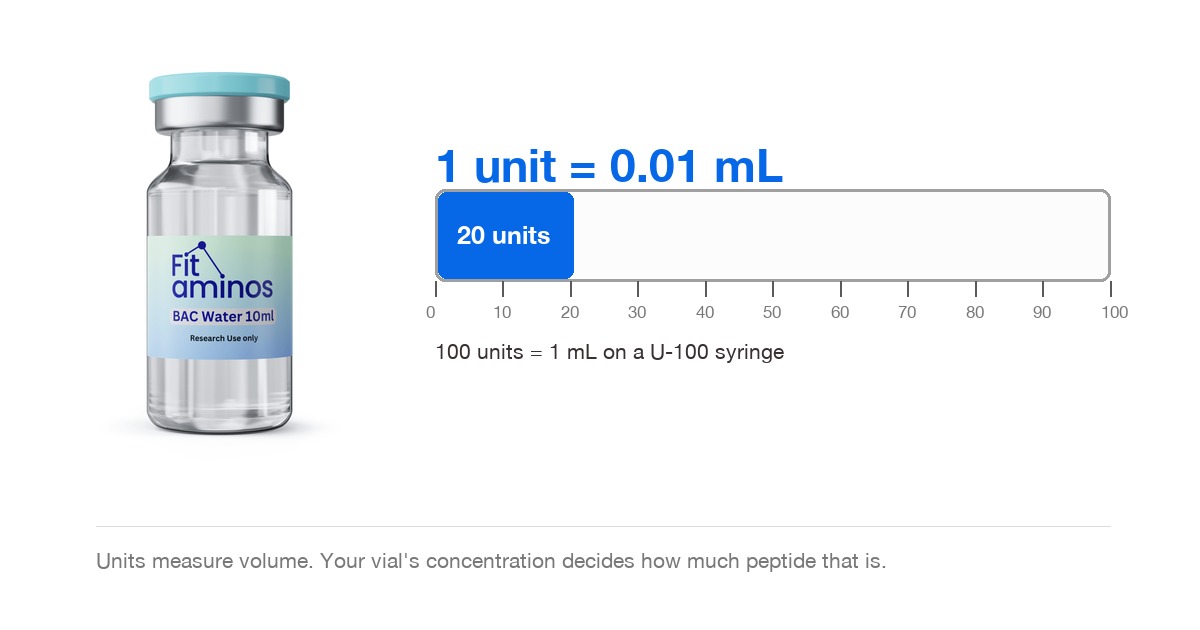
On a U-100 insulin syringe, one unit is 0.01 mL. Ten units is 0.1 mL. Fifty units is half a millilitre. That is the whole conversion, and it does not change with the size of the syringe.
What does change, and what causes most of the trouble when you are reading units on an insulin syringe for a peptide draw, is that a unit measures liquid rather than the amount of peptide in it. This page covers what the marks mean, how to read the barrel, how to turn a milligram or microgram figure into units, and the two mistakes that ruin a draw.
What Do the Units on an Insulin Syringe Mean?
A unit on an insulin syringe is a measure of volume, not a measure of drug. On the U-100 scale, 100 units equals 1 mL, so each unit is one hundredth of a millilitre.
The scale was designed for insulin, which comes at a standard strength. That is why a diabetic can treat units and dose as the same thing. A reconstituted peptide has no standard strength, because the concentration depends entirely on how much water was added to the vial.
The same 10 units can therefore be two completely different amounts of peptide in two different vials.
- Read the number of units as a volume in millilitres
- Find the concentration of your vial in mg per mL
- Multiply the two to get the actual amount you are drawing
- Confirm the result on a peptide dosage calculator
Why Is a Unit Not the Same as a Peptide Dose?
This is the single most useful thing to understand on this page, and it is the thing every guide written for insulin users leaves out.
Insulin sold in the United States is standardised at 100 units per mL. The concentration is fixed, so the syringe scale can double as a dose scale. When a prescription says twenty units, drawing to the 20 mark gives the right amount of insulin every time, from every vial.
A reconstituted peptide has no fixed concentration. You created it when you chose how much bacteriostatic water to add. Put 1 mL into a 10 mg vial and you have 10 mg/mL. Put 5 mL into the same vial and you have 2 mg/mL. The vial holds the same 10 mg either way.
So the 20 mark on the syringe is 0.2 mL in both cases, and 0.2 mL is 2 mg in the first vial and 0.4 mg in the second. Five times the difference, same syringe, same mark, same peptide.
We put this section second rather than at the end because it is the error that makes every other number on the page wrong. Forum posts and vendor pages routinely say things like “draw 10 units” with no mention of concentration. That instruction is incomplete. Without the mg per mL figure it does not describe an amount of anything.
It also explains why two people can follow the same written protocol and draw different amounts. They did not make a mistake reading the syringe. They reconstituted at different concentrations, so the same instruction produced different results. The instruction was the thing at fault.
When someone quotes a unit figure, the useful question back is always the same one: how much water went into how big a vial.
The practical version is short. Units tell you how much liquid. Concentration tells you how much peptide is in that liquid. You need both.
How Do You Read the Barrel Line by Line?
On a 1 mL U-100 syringe the barrel runs from 0 to 100 units. The long marks are usually every 10 units, the short marks every 2 units, so a single short line is 0.02 mL.
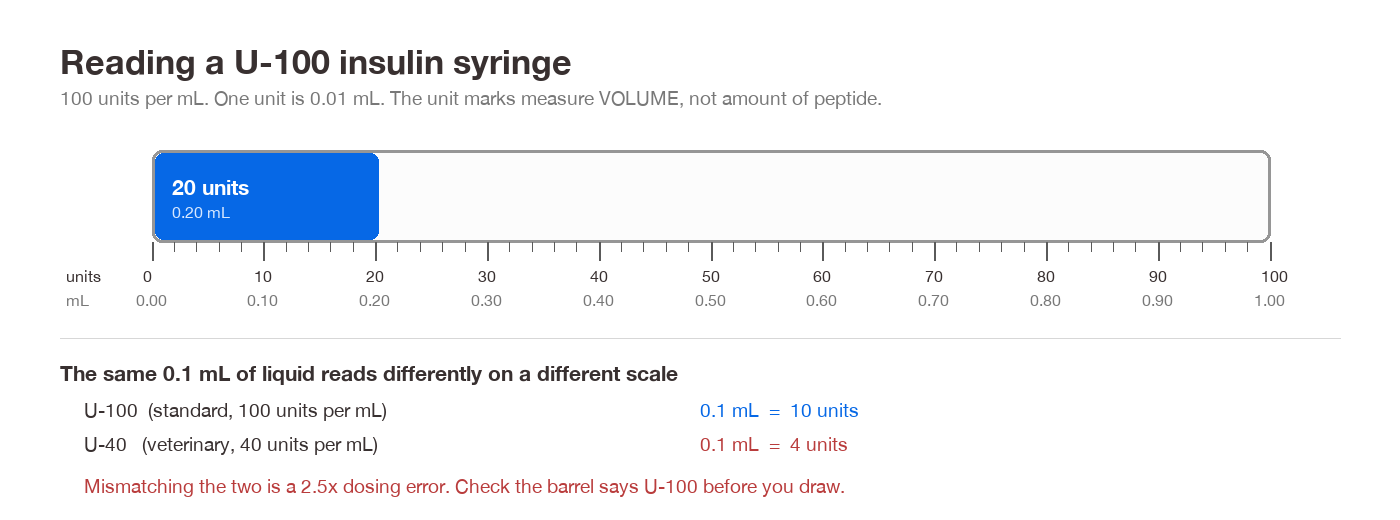
Read to the line, not to the middle of a gap. If your figure lands between two short marks, the volume was chosen badly rather than the syringe being at fault, and it is worth going back and reconstituting at a different concentration so the draw sits on a mark.
Read from the leading edge of the rubber stopper, the flat face nearest the needle, not from the tip of the cone behind it or from the top of the plunger rod. On a small draw the difference between those two reference points can be a unit or more, which is a detail most guides skip entirely.
The scale is printed on the barrel. Check it says U-100 before you draw anything.
How Many Units Is 1 mL on an Insulin Syringe?
One millilitre is 100 units on a U-100 insulin syringe.
That single relationship generates every other conversion, and it is worth memorising rather than looking up each time.
- 1 unit = 0.01 mL
- 10 units = 0.1 mL
- 25 units = 0.25 mL
- 50 units = 0.5 mL
- 100 units = 1 mL
The conversion runs both ways. To go from units to millilitres, divide by 100. To go from millilitres to units, multiply by 100. Nothing else on this page changes that relationship, and no vial, concentration or peptide affects it.
Converting mg and mcg Into Syringe Units
Peptide amounts are quoted in milligrams or micrograms. Syringes are marked in units. Bridging the two is a three-number chain, and it is the same chain every time.
Concentration, then amount, then units. Work it in that order and it does not go wrong.
- Concentration. Total mg in the vial divided by the mL of water you added. A 10 mg vial with 2 mL of water is 5 mg/mL.
- Convert to micrograms if your figure is in micrograms. 1 mg is 1,000 mcg, so 5 mg/mL is 5,000 mcg/mL.
- Volume. The amount you want divided by the concentration. 250 mcg divided by 5,000 mcg/mL is 0.05 mL.
- Units. Multiply millilitres by 100. 0.05 mL is 5 units.
The 250 mcg figure below is an arbitrary number used to show the arithmetic. It is not a recommendation, and this page does not tell you what to draw.
| Vial and water | Concentration | 250 mcg is | On the syringe |
|---|---|---|---|
| 10 mg in 1 mL | 10 mg/mL | 0.025 mL | 2.5 units |
| 10 mg in 2 mL | 5 mg/mL | 0.05 mL | 5 units |
| 10 mg in 3 mL | 3.33 mg/mL | 0.075 mL | 7.5 units |
| 10 mg in 5 mL | 2 mg/mL | 0.125 mL | 12.5 units |
| 5 mg in 2 mL | 2.5 mg/mL | 0.1 mL | 10 units |
Notice the last row. A 5 mg vial in 2 mL gives exactly the same reading as a 10 mg vial in 4 mL would. The syringe cannot tell you which vial it is drawing from, which is why the concentration has to come from you.
If the arithmetic is the part you would rather not do by hand, the peptide dosage calculator runs the same chain, and our mg to units conversion chart has the figures already worked out for the common vial and water combinations.
Does Syringe Size Change What a Unit Means?
No. A unit is 0.01 mL on a 0.3 mL syringe, a 0.5 mL syringe and a 1 mL syringe alike. What changes is how many units fit on the barrel and how far apart the marks are printed.
| Barrel size | Holds | Marks are | Suits |
|---|---|---|---|
| 0.3 mL | 30 units | widest spacing | small draws, easiest to read accurately |
| 0.5 mL | 50 units | medium spacing | most reconstituted peptide draws |
| 1 mL | 100 units | tightest spacing | larger volumes, hardest to read at the low end |
A smaller barrel is easier to read for a small draw because the same 10 units occupies more physical space. If your draws are consistently under 20 units, a 0.3 mL barrel will be easier to read than a 1 mL one.
The trade is capacity. A 0.3 mL barrel cannot draw more than 30 units in one go, so if your volume ever exceeds that you are either drawing twice or switching barrels. Pick the smallest barrel that still holds your largest routine draw.
What Goes Wrong Most Often When Drawing a Dose
Two errors account for most of it, and both are readable rather than technical.
Treating units as an amount. Copying “10 units” from a forum post without knowing the concentration it was written for. The number is meaningless without the mg per mL of the vial it came from.
Using the wrong scale. U-40 syringes exist, mainly for veterinary insulin, and they carry 40 marks per mL instead of 100. The same 0.1 mL of liquid reads as 10 units on a U-100 barrel and 4 units on a U-40. Mixing them up is a 2.5 times error in either direction. The barrel is printed with which one it is.
Before you draw
Fit Aminos stocks bacteriostatic water.
Reconstituting sets the concentration every unit reading depends on.
We are affiliated with Fit Aminos and may earn from purchases made through this link.
Frequently Asked Questions About Syringe Units
Is 0.5 mL the same as 50 units on an insulin syringe?
Yes, on a U-100 syringe. The U-100 scale puts 100 units in 1 mL, so half a millilitre is 50 units. This holds on any U-100 barrel, whether it is a 0.5 mL syringe filled to the top or a 1 mL syringe filled halfway. It would not hold on a U-40 barrel, where 0.5 mL is 20 units.
How much is 20 units on an insulin syringe?
Twenty units is 0.2 mL on a U-100 syringe. How much peptide that contains depends entirely on your vial’s concentration.
How much is 10 units on a 100-unit syringe?
Ten units is 0.1 mL, one tenth of the barrel. On a 1 mL syringe that is the first long mark after zero. If your intended draw comes out below about 10 units, the mark spacing makes it hard to read accurately, and it is usually worth reconstituting at a lower concentration so the same amount occupies more of the barrel.
Is 20 units the same as 2 mL?
No, and this is a common and consequential mix-up. Twenty units is 0.2 mL. Two millilitres is 200 units, which is twice the capacity of a standard 1 mL insulin syringe and could not be drawn in one go.
How many units is 2.5 mg on an insulin syringe?
There is no fixed answer, and any source that gives you one without asking about your vial is guessing. Milligrams measure peptide, units measure liquid, and the bridge between them is the concentration you created when you reconstituted. Worked through: if a 10 mg vial was mixed with 2 mL of water, the concentration is 5 mg/mL, so 2.5 mg occupies 0.5 mL, which is 50 units. If the same 10 mg vial was mixed with 1 mL instead, the concentration is 10 mg/mL, 2.5 mg occupies 0.25 mL, and the answer is 25 units. Same vial, same 2.5 mg, half the reading. Find your concentration first, then convert.
About the author
This article was written by Dr. Bradley Thomas, MD, orthopedic surgeon and sports medicine specialist, for Peptides Unleashed. Dr. Thomas is double board-certified by the American Board of Orthopaedic Surgery in both Orthopaedic Surgery and Orthopaedic Sports Medicine, and specializes in sports medicine, joint preservation and regenerative therapies.
He earned his medical degree at the Keck School of Medicine at the University of Southern California, completed his residency at Montefiore Medical Center and Albert Einstein College of Medicine, and a fellowship at the Southern California Center for Sports Medicine. He has over 24 years of surgical experience and more than 14,000 procedures performed. He is a Master Instructor with the Arthroscopy Association of North America, a Fellow of the American Academy of Orthopaedic Surgeons, the California Orthopaedic Association and the American Orthopaedic Society for Sports Medicine, and a co-founder of Beach Cities Orthopedics.
Peptides Unleashed is not a medical practice and does not prescribe, diagnose or recommend treatment. Dosage charts and protocols on this site are built from peer-reviewed studies, clinical trial registries, pharmacology references and manufacturer Certificates of Analysis. Where a finding is anecdotal, theoretical, or supported only by in-vitro or animal work, we say so in the text rather than presenting it as an established clinical outcome.
More about Dr. Bradley Thomas and how we source and check our information
