
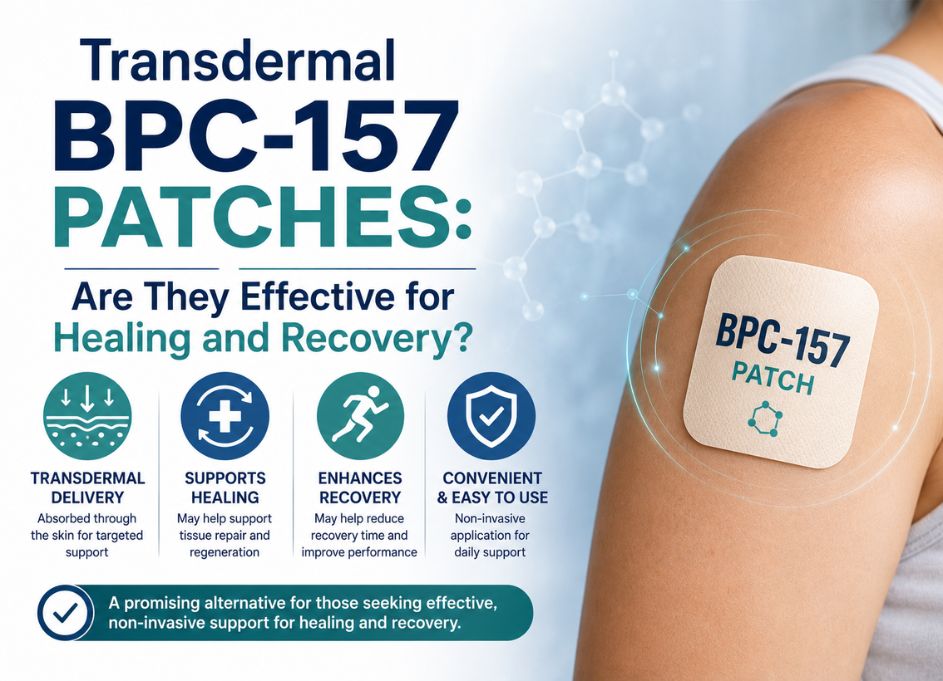
Transdermal BPC-157 patches has become one of the most talked-about peptides in the world of injury recovery, joint health, and regenerative medicine. As interest in the peptide grows, companies have started offering various delivery methods, including injections, oral capsules, nasal sprays, topical creams, and transdermal patches.
Among these options, transdermal BPC-157 patches are often marketed as a convenient, needle-free alternative that may support healing, reduce inflammation, and improve recovery. But an important question remains:
Do BPC-157 patches actually work?
The short answer is that there is currently very little scientific evidence proving that transdermal BPC-157 patches deliver meaningful amounts of the peptide into the bloodstream or injured tissues. While the concept sounds appealing, the available research does not yet provide strong support for the effectiveness of BPC-157 patches in humans.
What Are Transdermal BPC-157 Patches?
Transdermal patches are adhesive patches designed to deliver substances through the skin and into the bloodstream over time.
This drug-delivery method is already used successfully for medications such as:
- Nicotine patches
- Hormone replacement therapy
- Certain pain medications
- Motion sickness treatments
BPC-157 patches attempt to use the same concept by placing the peptide on a patch that remains attached to the skin for several hours or days.
Manufacturers often claim that these patches can:
- Support joint recovery
- Reduce inflammation
- Promote tissue healing
- Improve recovery after injuries
- Eliminate the need for injections
The problem is that peptide delivery through the skin is far more complicated than many advertisements suggest.
The Main Challenge: Skin Absorption
Human skin is designed to keep substances out.
The outermost layer of skin, known as the stratum corneum, acts as a powerful protective barrier. Large molecules generally struggle to penetrate this barrier effectively. Research on transdermal drug delivery consistently shows that molecular size is one of the biggest factors determining whether a compound can successfully pass through the skin.
BPC-157 is a peptide composed of 15 amino acids, making it significantly larger than many compounds commonly delivered through transdermal patches. Because of this size, researchers question whether standard BPC-157 patches can achieve meaningful absorption levels.
This is where many marketing claims begin to run ahead of the evidence.
Is There Research on BPC-157 Patches?
Currently, there are no large human clinical trials demonstrating that commercially available BPC-157 patches effectively deliver therapeutic amounts of the peptide through the skin.
Most BPC-157 research has focused on:
- Injectable administration
- Oral administration
- Laboratory studies
- Animal models
Animal studies have shown that topical BPC-157 may assist wound healing in certain situations. However, these studies do not automatically prove that transdermal patches deliver enough peptide into deeper tissues or the bloodstream to create significant healing effects in humans.
This distinction is important because topical effects on skin wounds are very different from systemic absorption through a patch.
Why Some Users Claim They Work
Despite limited evidence, many people online report positive experiences with BPC-157 patches.
Commonly reported benefits include:
- Reduced joint discomfort
- Faster recovery after exercise
- Improved mobility
- Less muscle soreness
However, anecdotal reports are not the same as clinical evidence. Placebo effects, natural healing processes, concurrent treatments, and confirmation bias can all influence personal experiences. Even enthusiastic online communities acknowledge that user reports should not be treated as proof of effectiveness.
This does not necessarily mean users are imagining benefits. It simply means we currently lack controlled human studies that can determine whether the patches themselves are responsible.
How Do Patches Compare to Other Forms of BPC-157?
Injectable BPC-157
Injectable BPC-157 remains the most commonly used form among researchers and experimental users.
Injection bypasses the skin barrier entirely, allowing direct absorption into body tissues.
Because of this, injections are generally believed to provide the highest bioavailability, although definitive human data remains limited.
Oral BPC-157
Unlike many peptides that are rapidly destroyed in the digestive system, BPC-157 appears unusually stable in gastric environments. This has led researchers to investigate oral administration as a potential delivery method.
However, human evidence remains limited here as well.
Transdermal Patches
Patches offer convenience and avoid needles, but they face the largest absorption challenge.
Current evidence suggests that skin penetration may be insufficient unless advanced delivery technologies are used. Even then, robust human studies are lacking.
Are Companies Overstating the Benefits?
In many cases, yes.
A major problem in the peptide market is that marketing often moves much faster than scientific validation.
Many advertisements imply that BPC-157 patches are proven recovery tools. However, there is currently no strong clinical evidence showing that commercially sold patches produce the dramatic healing effects often advertised.
In fact, several scientific reviews emphasize that human evidence for BPC-157 overall remains limited, regardless of delivery method. Researchers continue to call for larger safety and effectiveness studies before widespread use can be recommended.
Safety Considerations
Another issue is product quality.
BPC-157 is not approved by the U.S. Food and Drug Administration (FDA) for treating injuries, joint problems, or other medical conditions. Regulatory agencies continue to warn that safety and effectiveness have not been adequately established in humans.
Potential concerns include:
- Unknown long-term safety
- Inconsistent product quality
- Incorrect dosing
- Contamination risks
- Lack of manufacturing oversight
Because many peptide products are sold through research or gray-market channels, quality control can vary significantly.
The Bottom Line
Transdermal BPC-157 patches sound attractive because they offer a simple, needle-free way to use the peptide. However, the current evidence does not clearly show that these patches deliver enough BPC-157 through the skin to produce reliable therapeutic effects.
The biggest obstacle is skin absorption. BPC-157 is a relatively large peptide, and there is currently little human research proving that commercial transdermal patches overcome this barrier effectively. While some users report positive results, these experiences remain anecdotal and should not be confused with scientific proof.
For now, claims surrounding BPC-157 patches should be approached cautiously. Until high-quality human studies confirm their effectiveness, they remain an experimental delivery method rather than a proven recovery solution.
References
- McGuire, F. P., et al. (2025). Regeneration or Risk? A Narrative Review of BPC-157 for Musculoskeletal Injuries.
https://pmc.ncbi.nlm.nih.gov/articles/PMC12446177/ - Seiwerth, S., et al. (2021). Stable Gastric Pentadecapeptide BPC 157 and Wound Healing.
https://pmc.ncbi.nlm.nih.gov/articles/PMC8275860/ - He, L., et al. (2022). Pharmacokinetics, Distribution, Metabolism, and Excretion of BPC-157.
https://pmc.ncbi.nlm.nih.gov/articles/PMC9794587/ - Abd, E., et al. (2016). Skin Models for the Testing of Transdermal Drugs.
https://pmc.ncbi.nlm.nih.gov/articles/PMC5076797/ - U.S. Military OPSS. BPC-157: A Prohibited Peptide and an Unapproved Drug.
https://www.opss.org/article/bpc-157-prohibited-peptide-and-unapproved-drug-found-health-and-wellness-products
