
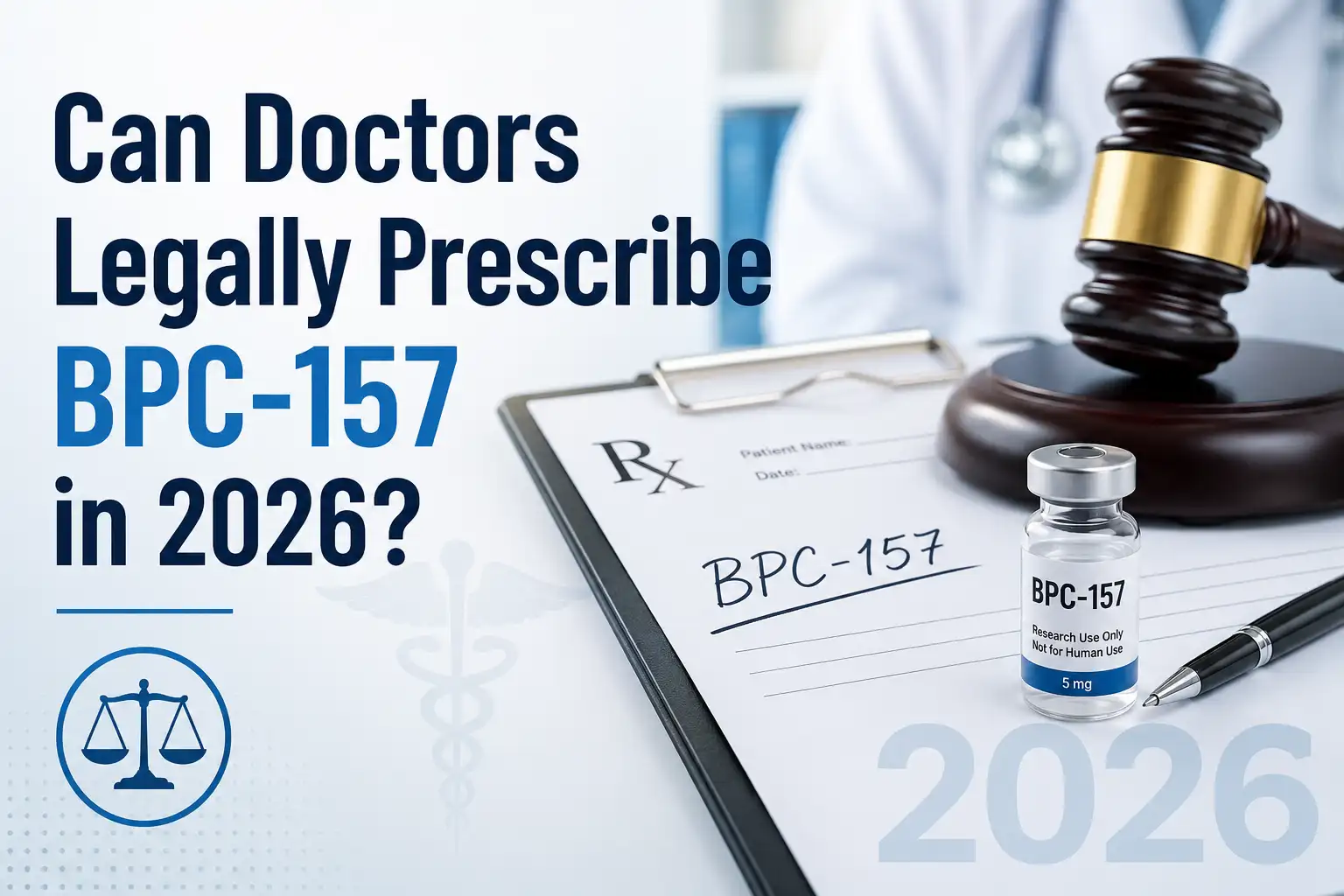
BPC-157 has become one of the most talked-about peptides in the health and fitness industry. Supporters claim it may help with muscle recovery, tendon healing, gut health, and inflammation. However, as its popularity continues growing, one major question keeps appearing: can doctors legally prescribe BPC-157 in 2026?
The answer is not as simple as many influencers make it sound.
Some websites claim BPC-157 is completely legal and widely prescribed. Others say it is fully banned. The truth sits somewhere in the middle. The legal status of BPC-157 remains complicated because regulations continue evolving, especially in the United States.
In this article by Peptides Unleashed, lets understand the difference between FDA approval, compounding rules, research chemicals, and physician oversight is critical before using BPC-157.
What Is BPC-157?
BPC-157 stands for “Body Protection Compound-157.” It is a synthetic peptide derived from a naturally occurring protein found in human gastric juice.
Researchers have studied BPC-157 for its potential role in:
- Muscle recovery
- Tendon and ligament healing
- Gut repair
- Joint support
- Inflammation reduction
- Tissue regeneration
Because of these potential benefits, BPC-157 became extremely popular among athletes, bodybuilders, biohackers, and recovery clinics.
However, popularity does not automatically mean legal approval.
Is BPC-157 FDA Approved?
No. As of 2026, BPC-157 is not approved by the U.S. Food and Drug Administration for standard medical treatment.
That means doctors cannot prescribe it like approved medications such as antibiotics, painkillers, or blood pressure drugs.
For a drug to receive FDA approval, it must go through:
- Large human clinical trials
- Long-term safety evaluations
- Manufacturing quality reviews
- Effectiveness testing
- Risk analysis
BPC-157 has not completed this process.
This is where many websites become misleading. They often present promising animal studies as if they are equal to approved human medical evidence. They are not the same thing.
Can Doctors Prescribe BPC-157 in 2026?
In certain situations, some doctors may still prescribe compounded BPC-157 through specialized compounding pharmacies. However, this exists in a legal and regulatory gray area.
Here is the important distinction many people fail to understand:
- FDA approval and physician prescribing are not always identical
- Compounded medications follow different rules
- Some substances can be compounded even without full FDA approval under specific circumstances
This is why the answer becomes complicated.
Some doctors working in:
- Sports medicine
- Hormone optimization clinics
- Functional medicine
- Longevity medicine
may still discuss or prescribe BPC-157 under medical supervision.
However, availability depends heavily on:
- State regulations
- Pharmacy policies
- FDA guidance
- Legal interpretation
- Physician willingness
So when social media influencers say “BPC-157 is fully legal now,” they are oversimplifying the situation.

Why Did BPC-157 Become Restricted?
The FDA raised concerns about BPC-157 because of limited human safety data and regulatory concerns surrounding peptide compounding.
Several issues contributed to tighter scrutiny:
- Lack of large human clinical trials
- Unclear long-term safety data
- Manufacturing quality concerns
- Potential contamination risks
- Unregulated online peptide sales
As a result, many compounding pharmacies became cautious about offering BPC-157.
That did not stop demand. Instead, the online “research peptide” market exploded.
What Are Research Peptides?
Many companies sell BPC-157 online labeled as:
- “For research purposes only”
- “Not for human consumption”
This labeling exists partly to avoid stricter pharmaceutical regulations.
The problem is that many consumers still buy these products for self-use despite the warning labels.
This creates serious risks because online peptide products may suffer from:
- Incorrect dosing
- Poor sterility
- Fake ingredients
- Contamination
- Low manufacturing standards
People often assume that if a product is easy to buy online, it must be safe or legal. That assumption is dangerous.
The peptide industry still contains many low-quality sellers pretending to operate like pharmaceutical companies.
What Changed in 2026?
In 2026, peptide regulation became even more confusing.
Some regulatory discussions suggested the FDA was reconsidering restrictions on certain compounded peptides, including BPC-157. This created headlines claiming peptides were “coming back” or becoming fully legal again.
However, regulatory reviews do not automatically equal full approval.
A lot of online content exaggerated early discussions as if the legal issues were completely solved. That is not accurate.
The legal environment surrounding BPC-157 is still evolving, and many healthcare professionals remain cautious.
Can Compounding Pharmacies Still Provide BPC-157?
Some may, depending on their legal interpretation and local regulations.
Certain licensed compounding pharmacies continue offering peptide therapies under physician supervision. Others refuse entirely because of legal uncertainty and liability concerns.
This is why access varies so much from clinic to clinic.
One doctor may say:
“Yes, we can prescribe it.”
Another may say:
“No, we do not touch it.”
Both responses can exist legally depending on the situation.
Is BPC-157 Legal in Professional Sports?
Athletes need to pay attention here because this area gets ignored constantly online.
BPC-157 is prohibited by the World Anti-Doping Agency (WADA). That means professional athletes subject to anti-doping testing may face suspensions or penalties if they use it.
A surprising number of fitness influencers conveniently avoid mentioning this when promoting peptides.
If someone competes in tested sports, using BPC-157 without understanding anti-doping rules is reckless.
Why Many Doctors Avoid BPC-157
Some people assume doctors who refuse BPC-157 are simply uninformed. That is usually not true.
Many physicians avoid prescribing it because:
- Human research is still limited
- FDA approval is absent
- Long-term safety remains unclear
- Medical liability risks exist
- Regulatory rules continue changing
That hesitation is often professional caution, not ignorance.
Doctors have legal and ethical responsibilities that influencers on social media do not.
Should You Trust Online BPC-157 Sellers?
Most people should be far more skeptical than they currently are.
The peptide industry contains legitimate providers, but it also contains a large number of questionable sellers using aggressive marketing and exaggerated claims.
Some websites advertise BPC-157 like it is a miracle drug capable of healing nearly everything. That is not supported by strong human evidence.
If a company promises:
- Instant healing
- Zero side effects
- Guaranteed recovery
- “FDA approved” peptide claims
that should immediately raise suspicion.
Final Thoughts
So, can doctors legally prescribe BPC-157 in 2026?
The honest answer is yes in some situations, but the legal and medical landscape remains complicated.
BPC-157 is:
- Not FDA-approved
- Still under regulatory scrutiny
- Sometimes available through compounding pathways
- Commonly sold as a research peptide online
- Surrounded by ongoing legal debate
Some doctors and clinics continue using BPC-157 under medical supervision, while others avoid it entirely because of safety, liability, and regulatory concerns.
The biggest mistake people make is assuming popularity equals legitimacy. Right now, BPC-157 exists in a space where scientific interest, legal uncertainty, medical caution, and aggressive marketing all collide.
Anyone considering BPC-157 should focus on verified medical guidance, realistic expectations, and product quality instead of blindly trusting influencer hype.
References
U.S. Food and Drug Administration. (2024). Certain bulk drug substances for use in compounding that may present significant safety risks.
FDA Guidance on Peptides
Sikiric, P., Seiwerth, S., Rucman, R., Kolenc, D., Vuletic, L. B., Drmic, D., & Brcic, L. (2018). Stable gastric pentadecapeptide BPC 157 and wound healing. Current Pharmaceutical Design, 24(18), 1990–2001.
Read PubMed Study
Gwyer, D., Gyori, B. M., & Prakash, R. (2019). BPC-157 and TB-500: Peptide therapies for musculoskeletal injuries? Current Sports Medicine Reports, 18(12), 483–484.
View Research Article
World Anti-Doping Agency. (2026). Prohibited list: Peptide hormones, growth factors, related substances, and mimetics.
WADA Prohibited Substances List
