
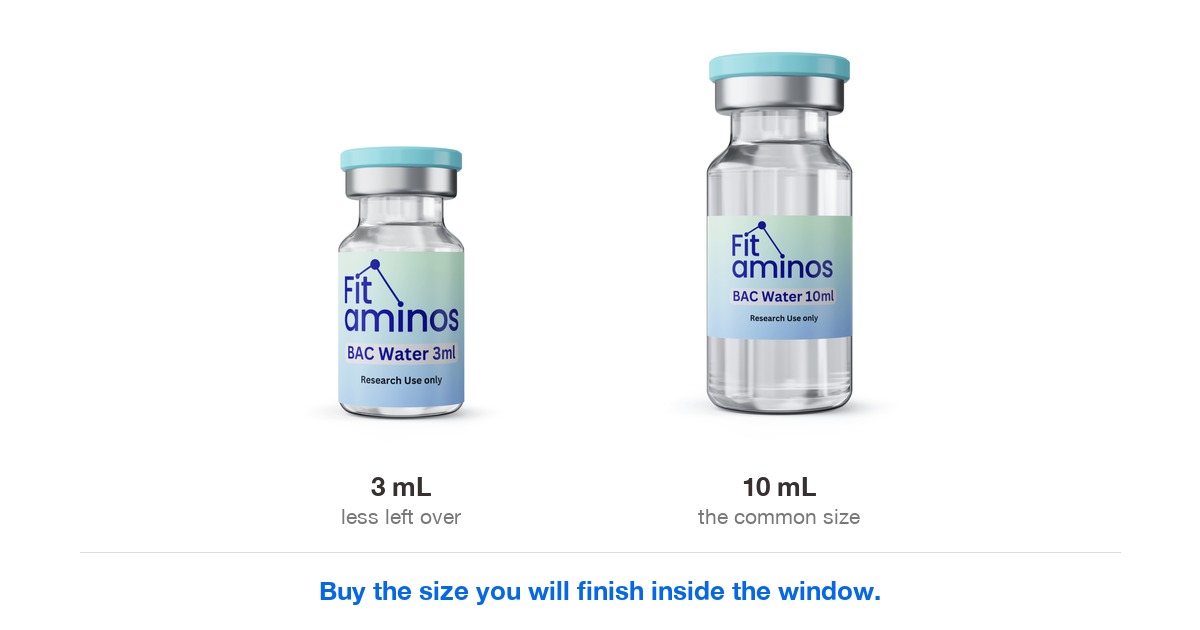
We are affiliated with Fit Aminos, who sell bacteriostatic water. We are telling you that at the top rather than the bottom, because this is a page about where to buy something and you should know that before you read our advice. The criteria below apply to any seller, including ours.
Bacteriostatic water is sold by pharmacies, online marketplaces and research suppliers. Which of those works for you depends on whether you can get a prescription, how quickly you need it, and how much you are willing to pay per millilitre.
It is also harder to find than it used to be, and that is not your imagination. There is a documented supply problem, which is the first thing worth understanding before you start comparing sellers.
Where Can You Buy Bacteriostatic Water Right Now?
Bacteriostatic water comes from three channels: retail and compounding pharmacies, online marketplaces such as Amazon, and research or laboratory suppliers.
Pharmacies stock the pharmaceutical product but the United States label carries “Rx only”, so a prescription may be required even where a branch has it. Marketplaces are fast and inconsistent. Research suppliers are the channel most peptide buyers end up using, and they are also the channel where quality varies most.
- Retail or compounding pharmacy. Genuine product, may need a prescription, availability is patchy
- Online marketplace. Fast delivery, third-party sellers, verify the listing carefully
- Research supplier. No prescription, wide price range, check the label details below
Why Is Bacteriostatic Water So Hard to Find?
Because it is on the FDA’s drug shortage list, and it has been for years.
The FDA Drug Shortages database lists Bacteriostatic Water for Injection from Hospira, a Pfizer company, with a status of Current. The entry was first posted on 3 December 2021 and was last revised on 7 August 2026. The reason FDA records against it is simply “Other”.
One detail worth being precise about, because most of the internet is not. The presentation named in that FDA record is the 1 mL plastic container, NDC 0409-3977-03. It is not the 30 mL glass multi-dose vial that most people reconstituting peptides actually buy. So the listing is not a blanket statement that every bacteriostatic water product is unavailable. What it does tell you is that the sole major manufacturer has had a supply problem with this product line open on the federal register for nearly five years.
That single fact explains most of what you will find when you search for this. Pharmacy staff who say they cannot order it. Backorder notices on supplier sites. Forum threads and local groups full of people asking where to find it. Prices that move around far more than a bottle of preserved water should.
It also explains why so many results for this query are shops rather than guides. When something is scarce, the pages that get written about it are written by the people selling it.
The practical consequence for you is straightforward. Availability, not price, is usually the binding constraint, and a seller who has stock today may not next month. That is worth knowing before you build a routine around one supplier.
It is also a reason to buy slightly ahead of running out rather than reordering on the day you finish a bottle, and a reason not to treat any single seller as a permanent arrangement.
Can You Buy Bacteriostatic Water at CVS?
Sometimes, and it varies branch by branch. It is not a shelf item you can pick up next to the plasters.
Bacteriostatic Water for Injection is labelled “Rx only” in the United States, so a pharmacy may ask for a prescription before dispensing it even when it is in stock. Some branches keep it behind the counter, some can order it in, and some will tell you they cannot get it at all, which is usually the shortage described above rather than a policy decision.
Compounding pharmacies are often a better bet than a retail chain, because bacteriostatic water is a working consumable for them rather than an occasional request.
If you are going to try a pharmacy, phone first and ask two things: whether they stock it, and whether they will dispense it without a prescription. The second answer varies more than people expect, and asking on the phone costs nothing compared with a wasted trip.
What About Amazon and Online Marketplaces?
Marketplaces carry it, and they are the fastest route, but the listing is doing a lot of work that a pharmacy label would normally do for you.
Check what is actually being sold before you buy. Marketplace listings for this product are frequently third-party sellers rather than the manufacturer, the photograph may not match the presentation, and the benzyl alcohol strength is often missing from the description entirely.
If the listing does not state the strength, the vial size and the manufacturer, you are buying on trust rather than on information.
Research Suppliers and What to Check Before Buying
This is where most people reconstituting peptides end up, and it is the channel with the widest quality spread. There is no prescription gate, which is convenient, and it also means nothing external is checking the seller for you.
Four things are worth confirming before you buy from anyone, including us. None of them require expertise, and all of them are visible before you pay.
- The benzyl alcohol strength is stated. The Hospira labelling covers both 0.9% (9 mg/mL) and 1.1% (11 mg/mL), and either does the same job. What matters is that the seller tells you which one you are getting. A product page that does not name the preservative concentration has left out the one thing that makes it bacteriostatic rather than plain sterile water
- It is sold as a multi-dose vial. A stopper designed for repeated puncture is the entire reason to buy bacteriostatic water instead of Sterile Water for Injection. If the presentation is a single-use ampoule, it is the wrong product for a vial you plan to draw from more than once
- Lot number and expiry are legible. These are separate from the beyond-use date that starts when you first puncture the stopper. An unopened bottle has its own shelf life, and a seller who cannot show you the lot and expiry is asking you to assume it
- The vial size matches your actual use. 10 mL and 30 mL are the common presentations. Bigger is not automatically better value, because the water starts its own clock the moment you pierce the stopper
Everything else is preference. Those four are the ones that decide whether the product does the job.
If you want the reasoning behind the vial size question, our guide to bac water for peptides works through how much you actually need per vial and how long an opened bottle stays usable.
Do You Need a Prescription for Bacteriostatic Water?
In the United States the label says “Rx only”, which is why pharmacies may ask for one. Research and laboratory suppliers sell it without a prescription, which is why most people reconstituting peptides use that channel.
We are not able to advise on your jurisdiction, and the position differs by country. The United Kingdom, Australia and Canada all handle it differently from the United States, and all three send a meaningful share of the readers of this site.
What is consistent everywhere is the product itself. Bacteriostatic Water for Injection, USP, in a sealed multi-dose vial, with the preservative strength printed on it. The regulatory route to obtaining it varies. The specification you should be looking for does not.
If you do hold a prescription, it changes which doors are open rather than what you should be checking. A pharmacy-dispensed bottle still needs the same four things confirmed, and the shortage affects the pharmacy channel as much as any other.
How to Compare Price Between Sellers
Compare on price per millilitre, not on the price of the bottle. A 30 mL bottle at twice the price of a 10 mL one is not more expensive, it is the same price per mL for three times the volume.
Then apply the correction most people skip. If the water expires on its own clock before you get through it, the extra volume was not a saving. Work out roughly how much you use in a month, and buy the size that matches, rather than the size with the best headline rate.
Shipping is worth folding into the comparison as well, because on a low-value consumable it is frequently a larger share of the total than the product.
One of the sellers
Fit Aminos stocks bacteriostatic water.
We are affiliated with them. Apply the four checks above to us as well.
We are affiliated with Fit Aminos and may earn from purchases made through this link.
Frequently Asked Questions About Buying Bac Water
Can I buy bacteriostatic water over the counter?
It depends on the channel. The United States label carries “Rx only”, so a pharmacy may require a prescription. Research and laboratory suppliers sell it without one, and that is the route most people reconstituting peptides use. Rules differ by country and we cannot advise on your jurisdiction.
Why is bacteriostatic water out of stock everywhere?
There is a genuine supply problem behind it. FDA lists Bacteriostatic Water for Injection from Hospira as a current shortage, first posted in December 2021 and revised in August 2026.
Is bacteriostatic water from Amazon safe to use?
The question is not really the marketplace, it is the listing. Confirm the manufacturer, the vial size and the benzyl alcohol strength before buying, because third-party listings for this product routinely omit all three. If those details are absent, you cannot tell what you are buying, and that is true on any platform.
How much bacteriostatic water should I buy?
Match the bottle to your actual monthly use rather than to the best price per millilitre. An opened multi-dose vial runs its own clock from first puncture, so volume you do not get through in that window is not a saving. For most people that points at 10 mL rather than 30 mL.
What is the difference between bacteriostatic water and sterile water?
Bacteriostatic water contains benzyl alcohol as a preservative, which is what allows the same vial to be punctured repeatedly. Sterile Water for Injection has no preservative and is intended for single use. If you plan to draw from a vial more than once, the preserved product is the one designed for that, and swapping in sterile water removes the protection you were relying on. There is a third product that causes confusion here, which is plain sterile water sold for irrigation or laboratory use. That one is not intended for injection at all, despite a similar name on the bottle, and it is worth reading the label rather than the shelf position. The distinction matters most in exactly the situation this page is about: when the product you wanted is out of stock and something similar-looking is available instead.
About the author
This article was written by Dr. Bradley Thomas, MD, orthopedic surgeon and sports medicine specialist, for Peptides Unleashed. Dr. Thomas is double board-certified by the American Board of Orthopaedic Surgery in both Orthopaedic Surgery and Orthopaedic Sports Medicine, and specializes in sports medicine, joint preservation and regenerative therapies.
He earned his medical degree at the Keck School of Medicine at the University of Southern California, completed his residency at Montefiore Medical Center and Albert Einstein College of Medicine, and a fellowship at the Southern California Center for Sports Medicine. He has over 24 years of surgical experience and more than 14,000 procedures performed. He is a Master Instructor with the Arthroscopy Association of North America, a Fellow of the American Academy of Orthopaedic Surgeons, the California Orthopaedic Association and the American Orthopaedic Society for Sports Medicine, and a co-founder of Beach Cities Orthopedics.
Peptides Unleashed is not a medical practice and does not prescribe, diagnose or recommend treatment. Supply and regulatory information on this page was read directly from the FDA Drug Shortages database on 26 August 2026.
More about Dr. Bradley Thomas and how we source and check our information
