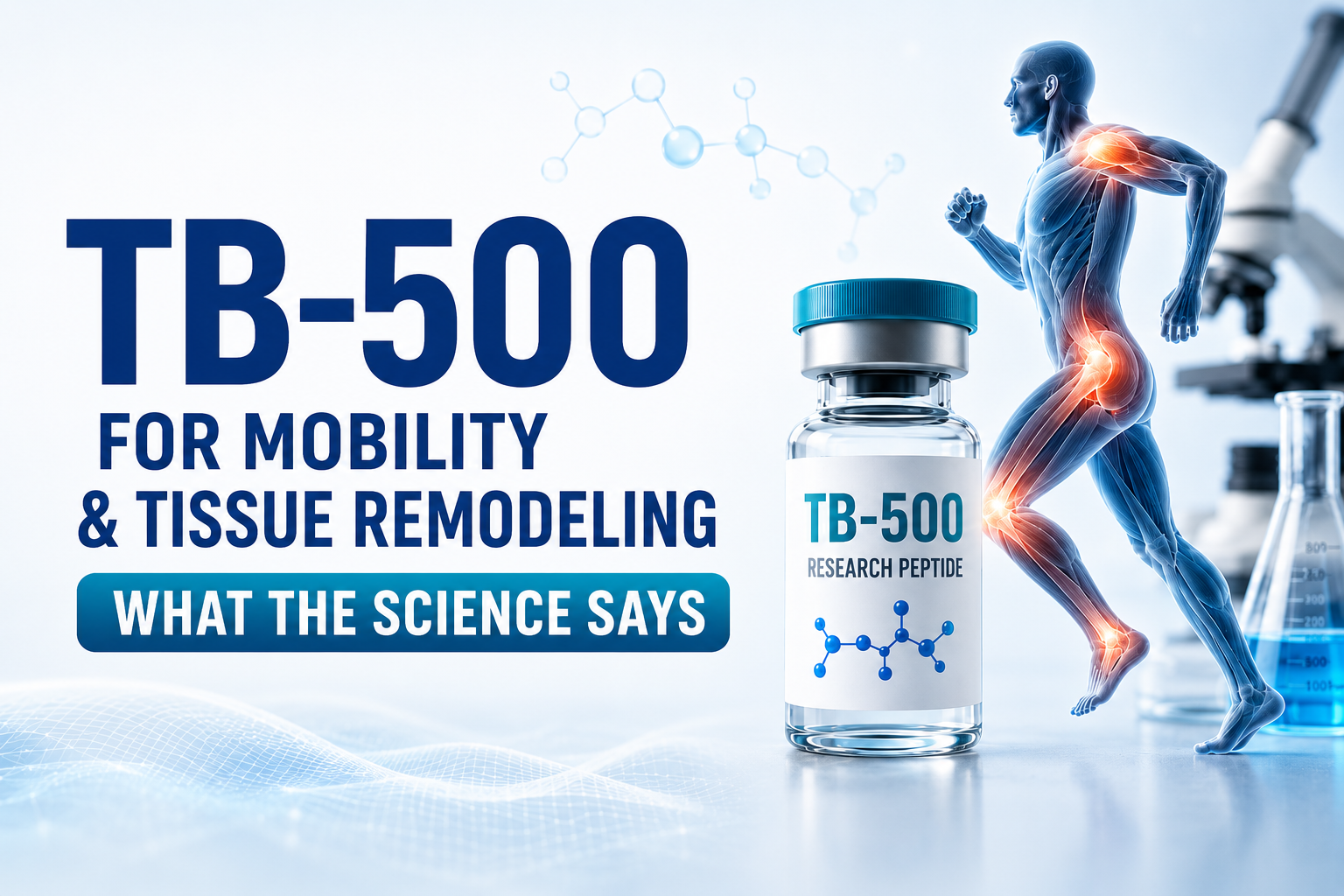
Interest in TB-500 for recovery has increased significantly among researchers studying tissue repair, mobility, and healing after injury. Although TB-500 is widely discussed online, it is important to understand that it remains an investigational research peptide. It has not been approved for medical treatment by the U.S. Food and Drug Administration (FDA) or many other regulatory authorities.
Current studies focus on how TB-500 may influence cell migration, blood vessel formation, inflammation, and tissue remodeling. Much of the available evidence comes from laboratory and animal research rather than large human clinical trials.
This article explains the science behind TB-500, what researchers currently know, its potential role in tissue remodeling, possible risks, and why more research is still needed.
What Is TB-500?
TB-500 is a synthetic peptide derived from Thymosin Beta-4 (Tβ4), a naturally occurring protein found in nearly all human cells. Thymosin Beta-4 plays an important role in:
- Cell migration
- Tissue repair
- Blood vessel formation (angiogenesis)
- Inflammation regulation
- Cytoskeleton organization
- Wound healing
TB-500 was developed to mimic certain biological activities of Thymosin Beta-4 while being easier to study in research settings.
Unlike growth factors that stimulate cell division directly, TB-500 appears to influence how cells move and organize during tissue repair.
Understanding Tissue Remodeling
Tissue remodeling is the body’s natural process of replacing damaged tissue with new, functional tissue.
This process occurs after:
- Muscle injuries
- Tendon strains
- Ligament tears
- Surgical procedures
- Skin wounds
- Connective tissue damage
Tissue remodeling generally occurs in three phases:
| Phase | What Happens |
|---|---|
| Inflammatory Phase | Immune cells remove damaged tissue |
| Repair Phase | New cells, collagen, and blood vessels develop |
| Remodeling Phase | Tissue strengthens and reorganizes over weeks or months |
Researchers are studying whether TB-500 for recovery may influence several of these stages.
How TB-500 May Work
Scientists believe TB-500 primarily works by affecting actin, one of the most important proteins involved in cell movement.
Actin allows cells to:
- Move toward injured tissue
- Change shape
- Form new tissue
- Support wound closure
By interacting with actin, TB-500 may improve communication between repairing cells.
Researchers are currently investigating whether this mechanism contributes to faster tissue remodeling.
TB-500 and Cell Migration
One of the most studied effects of Thymosin Beta-4 is its ability to promote cell migration.
Cell migration is essential because healing cannot occur unless repair cells reach the injured area.
Laboratory studies suggest TB-500 may encourage:
- Fibroblast migration
- Keratinocyte movement
- Endothelial cell migration
- Stem cell recruitment
These processes are considered fundamental components of tissue regeneration.
Potential Effects on Mobility
Mobility often decreases after injury due to:
- Pain
- Inflammation
- Tissue stiffness
- Scar formation
- Reduced flexibility
Researchers are studying whether TB-500 may improve mobility indirectly by supporting healthier tissue remodeling rather than acting as a pain medication.
Possible research observations include:
- Better range of motion
- Reduced tissue stiffness
- Improved flexibility
- Faster return of movement
- Healthier connective tissue organization
However, these findings have not yet been confirmed in large human studies.
TB-500 for Muscle Recovery
Muscle injuries involve damage to muscle fibers followed by regeneration.
Animal studies suggest Thymosin Beta-4 may help support:
- Muscle fiber repair
- Reduced inflammatory damage
- Satellite cell activation
- Improved regeneration
Researchers continue studying whether TB-500 for recovery may influence these biological pathways.
Evidence in humans remains very limited.
Research on Tendons and Ligaments
Tendons and ligaments heal much more slowly than muscles because they receive less blood supply.
Experimental studies suggest TB-500 may influence:
- Collagen organization
- Fibroblast activity
- Tissue remodeling
- Blood vessel formation
Researchers hope these effects could improve recovery after connective tissue injuries.
However, current evidence comes primarily from preclinical research.
Blood Vessel Formation
Healing tissues require oxygen and nutrients.
One area of TB-500 research involves angiogenesis, the development of new blood vessels.
Studies of Thymosin Beta-4 suggest it may:
- Support endothelial cell migration
- Promote capillary formation
- Improve blood supply to healing tissue
Improved circulation may enhance overall tissue repair.
Researchers continue investigating this mechanism.
Inflammation and Recovery
Inflammation is necessary after injury, but excessive inflammation may slow healing.
Some experimental studies indicate Thymosin Beta-4 may help regulate inflammatory signaling rather than completely suppress it.
Researchers have observed possible effects on:
- Immune cell recruitment
- Cytokine activity
- Oxidative stress
- Tissue protection
Balanced inflammation may support healthier remodeling.
More human research is required before drawing conclusions.
Scar Tissue Formation
Scar tissue is often less flexible than healthy tissue.
Scientists are investigating whether TB-500 influences:
- Collagen alignment
- Extracellular matrix organization
- Tissue flexibility
- Scar quality
Improved collagen organization may contribute to better long-term mobility.
These findings remain under investigation.
Animal Research Findings
Several animal studies involving Thymosin Beta-4 have reported:
- Faster wound closure
- Improved muscle regeneration
- Better tendon healing
- Enhanced corneal repair
- Increased blood vessel growth
- Reduced fibrosis in certain tissues
Although encouraging, animal findings do not necessarily predict human outcomes.
Large clinical trials are still lacking.
Human Research Status
Human evidence remains limited.
Most available information consists of:
- Small clinical studies
- Experimental investigations
- Early-stage research
- Safety observations
There are currently no large randomized clinical trials proving TB-500 improves recovery or mobility in humans.
Therefore, claims that TB-500 guarantees faster healing are not supported by current scientific evidence.
Potential Risks and Unknowns
Because TB-500 is still investigational, many safety questions remain unanswered.
Possible concerns include:
- Unknown long-term effects
- Product quality variation
- Contamination risks
- Lack of standardized dosing
- Limited human safety data
- Unknown interactions with medications
Many products sold online are labeled “for research use only,” and their purity may vary significantly.
Regulatory Status
TB-500 is not approved as a prescription medication for treating injuries or improving recovery.
Several sports organizations also prohibit its use because of its potential performance-enhancing effects and lack of approved medical use.
Researchers continue studying its biological effects in controlled laboratory settings.
Limitations of Current Research
When evaluating TB-500 for recovery, it is important to recognize several limitations:
- Most evidence comes from laboratory research.
- Animal studies cannot fully predict human responses.
- Human trials remain scarce.
- Long-term safety is unknown.
- Optimal dosing has not been established.
- Individual responses may vary.
These limitations mean that strong conclusions cannot yet be made.
Areas Scientists Continue to Study
Researchers are investigating whether TB-500 may have future applications in:
- Sports injury recovery
- Tendon remodeling
- Ligament healing
- Muscle regeneration
- Wound repair
- Connective tissue disorders
- Eye injury research
- Cardiac tissue repair
These remain active areas of investigation rather than established medical treatments.
TB-500 vs. Natural Healing
The body naturally repairs injured tissue through complex biological processes involving inflammation, collagen production, and cellular remodeling.
TB-500 research aims to understand whether enhancing some of these natural mechanisms could improve recovery. At present, there is insufficient evidence to conclude that TB-500 consistently outperforms normal healing in humans.
Key Takeaways
Current research suggests that TB-500 for recovery may influence several biological processes involved in tissue remodeling, including cell migration, angiogenesis, collagen organization, and inflammation regulation. These mechanisms make it an interesting subject for scientific investigation.
However, nearly all promising findings come from laboratory and animal research. High-quality human clinical evidence remains limited, and TB-500 has not been approved as a treatment for injuries, mobility problems, or tissue repair.
As research continues, scientists hope to better understand both its potential benefits and its long-term safety profile.
Frequently Asked Questions
Is TB-500 approved for treating injuries?
No. TB-500 is an investigational peptide and has not been approved by the FDA for treating injuries or improving recovery.
Does TB-500 improve mobility?
Researchers are studying whether TB-500 may support tissue remodeling that could influence mobility, but convincing human evidence is currently lacking.
Is TB-500 the same as Thymosin Beta-4?
No. TB-500 is a synthetic peptide derived from a portion of the naturally occurring protein Thymosin Beta-4.
Is there strong evidence for TB-500 for recovery?
Not yet. Most evidence comes from laboratory and animal studies rather than large human clinical trials.
Why is TB-500 popular in research?
Scientists are interested in its potential effects on cell migration, wound healing, tissue remodeling, angiogenesis, and inflammation regulation.
References
- Goldstein, A. L., & Kleinman, H. K. (2015). Thymosin beta 4: A multi-functional regenerative peptide. Basic Properties and Clinical Applications. https://doi.org/10.1016/j.exer.2014.08.010
- Malinda, K. M., et al. (1999). Thymosin beta 4 accelerates wound healing. The FASEB Journal, 13(3), 474–480. https://faseb.onlinelibrary.wiley.com/doi/10.1096/fasebj.13.3.474
- Smart, N., & Riley, P. R. (2008). The role of Thymosin Beta-4 in tissue repair and regeneration. Trends in Cardiovascular Medicine, 18(2), 54–59. https://doi.org/10.1016/j.tcm.2007.12.002
- U.S. Food and Drug Administration (FDA). Human Drug Compounding Information: https://www.fda.gov/drugs/human-drug-compounding
- World Anti-Doping Agency (WADA). Prohibited List: https://www.wada-ama.org/en/prohibited-list
