
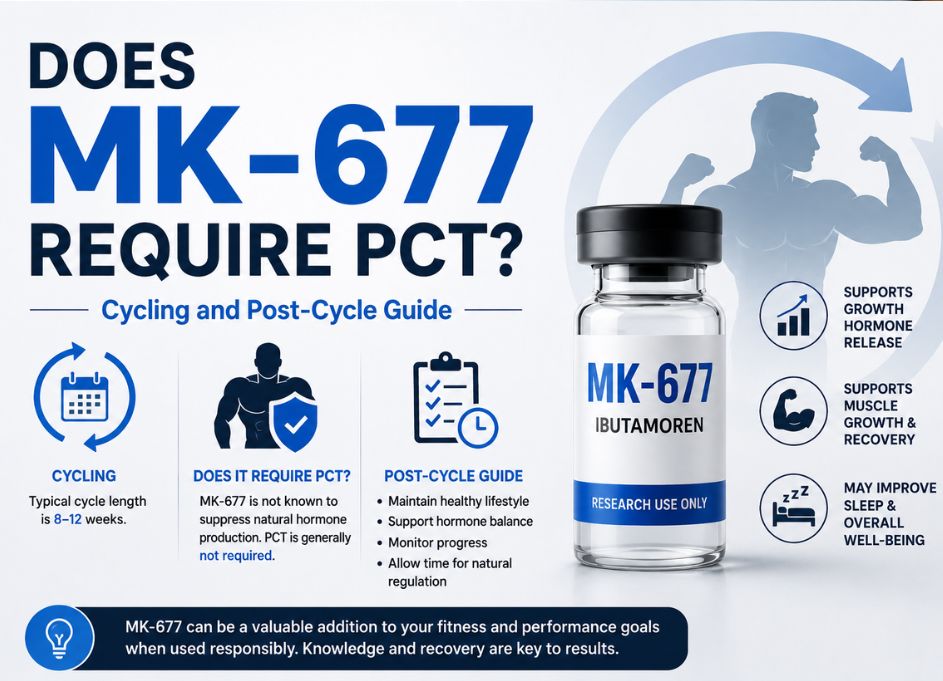
Does MK-677 Require PCT? MK-677, commonly known as Ibutamoren, has gained significant attention among fitness enthusiasts, bodybuilders, and longevity researchers due to its ability to increase growth hormone (GH) and insulin-like growth factor-1 (IGF-1) levels. Unlike anabolic steroids and many selective androgen receptor modulators (SARMs), MK-677 works through a different mechanism, leading many users to wonder whether post-cycle therapy (PCT) is necessary after completing a cycle.
PCT is commonly used after steroid cycles to help restore natural testosterone production and minimize hormonal imbalances. Since MK-677 does not directly interact with androgen receptors, the question of whether it requires PCT remains one of the most frequently discussed topics in the performance enhancement community.
This article by Peptides Unleashed explores how MK-677 works, whether it suppresses testosterone, potential benefits and side effects, and what current research says about the need for post-cycle therapy.
What Is MK-677?
MK-677 (Ibutamoren) is an orally active growth hormone secretagogue. It works by mimicking ghrelin, a hormone responsible for stimulating hunger and growth hormone release.
By binding to ghrelin receptors, MK-677 signals the body to increase the production of:
- Growth Hormone (GH)
- Insulin-Like Growth Factor-1 (IGF-1)
Unlike anabolic steroids, MK-677 does not supply external hormones to the body. Instead, it encourages the natural release of hormones already produced by the pituitary gland.
Because of its oral administration and long half-life, MK-677 has become a popular research compound for investigating muscle growth, recovery, aging, and metabolic health.

How Does MK-677 Work?
MK-677 activates the ghrelin receptor, also known as the growth hormone secretagogue receptor (GHSR). This activation stimulates the pituitary gland to release more growth hormone.
Increased growth hormone levels subsequently elevate IGF-1 production in the liver. IGF-1 plays a critical role in:
- Muscle growth
- Tissue repair
- Bone health
- Recovery processes
- Protein synthesis
Researchers have found that MK-677 can significantly increase circulating GH and IGF-1 levels without directly affecting testosterone production.
This distinction is important when discussing post-cycle therapy requirements.
Does MK-677 Suppress Testosterone?
The primary reason people use PCT after steroids is testosterone suppression.
Anabolic steroids often reduce the body’s natural production of:
- Testosterone
- Luteinizing Hormone (LH)
- Follicle-Stimulating Hormone (FSH)
When this suppression occurs, users frequently require medications such as Clomid or Nolvadex to help restore hormonal balance.
Current research suggests that MK-677 does not significantly suppress the hypothalamic-pituitary-gonadal (HPG) axis responsible for testosterone production.
Studies examining MK-677 have generally reported:
- Increased GH levels
- Increased IGF-1 levels
- Minimal changes in testosterone
- No significant shutdown of natural hormone production
As a result, MK-677 is often viewed differently from anabolic steroids and suppressive SARMs.
Does MK-677 Require PCT?
For most individuals using MK-677 as a standalone compound, traditional post-cycle therapy is generally not considered necessary.
Since MK-677 does not appear to significantly suppress testosterone production, there is typically no need to restart natural testosterone production after discontinuation.
However, context matters.
When PCT Is Usually Not Needed
If MK-677 is used alone:
- Testosterone production generally remains intact.
- LH and FSH levels are typically unaffected.
- Traditional PCT medications are usually unnecessary.
When PCT May Be Needed
If MK-677 is combined with:
- Anabolic steroids
- Suppressive SARMs
- Testosterone cycles
Then post-cycle therapy may be required due to the accompanying compounds rather than MK-677 itself.
Many online discussions mistakenly attribute hormonal suppression to MK-677 when the suppression is actually caused by other substances used alongside it.
MK-677 and PCT: Quick Comparison
| Factor | MK-677 |
|---|---|
| Testosterone Suppression | Minimal to none |
| HPG Axis Shutdown | Not typically observed |
| Growth Hormone Increase | Yes |
| IGF-1 Increase | Yes |
| Traditional PCT Needed | Usually No |
| Oral Administration | Yes |
| Common Cycle Duration | 8–24 Weeks |
Potential Benefits of MK-677
Researchers continue to investigate MK-677 for a variety of applications.
Increased Growth Hormone Production
One of MK-677’s primary effects is its ability to elevate growth hormone levels for extended periods.
Enhanced Recovery
Higher GH and IGF-1 levels may support tissue repair and recovery following intense exercise.
Improved Sleep Quality
Many users report deeper and more restorative sleep while using MK-677.
Increased Muscle Growth Potential
Through increased IGF-1 production, MK-677 may support lean muscle development when combined with proper nutrition and training.
Bone Health Support
Some studies suggest MK-677 may positively influence bone mineral density and skeletal health.
Increased Appetite
Because it activates ghrelin receptors, MK-677 often causes a noticeable increase in hunger.
Potential Side Effects of MK-677
Although MK-677 does not typically require PCT, it is not free of side effects.
Water Retention
Many users experience temporary fluid retention during a cycle.
Increased Hunger
The appetite-stimulating effect can be beneficial for bulking but problematic for some individuals.
Elevated Blood Sugar
Research suggests MK-677 may influence insulin sensitivity and glucose metabolism.
Fatigue
Some individuals report lethargy, particularly during the early stages of use.
Tingling Sensations
Higher growth hormone levels may contribute to numbness or tingling sensations in the hands and feet.
Potential Insulin Resistance
Long-term use may warrant monitoring of blood glucose and insulin markers.
What Does Research Say About MK-677 and PCT?
Current scientific evidence supports the idea that MK-677 increases growth hormone and IGF-1 without causing significant testosterone suppression.
Several human studies have demonstrated:
- Sustained increases in GH
- Elevated IGF-1 levels
- Improved nitrogen retention
- Minimal effects on reproductive hormones
Because the compound does not appear to shut down testosterone production, researchers generally do not classify MK-677 as requiring traditional post-cycle therapy.
However, long-term human data remains limited, and additional research is needed to fully understand its safety profile.
Frequently Asked Questions (FAQs)
Does MK-677 require Clomid or Nolvadex after a cycle?
For standalone MK-677 use, Clomid and Nolvadex are generally not necessary because testosterone suppression is typically minimal or absent.
Can MK-677 lower testosterone?
Current research suggests MK-677 does not significantly reduce testosterone levels in healthy individuals.
How long should an MK-677 cycle last?
Many users run cycles lasting between 8 and 24 weeks, although there is no universally established protocol.
Is MK-677 a steroid?
No. MK-677 is a growth hormone secretagogue that stimulates GH and IGF-1 production without acting as an anabolic steroid.
Is MK-677 a SARM?
No. Although often grouped with SARMs, MK-677 works through the ghrelin receptor and is not a selective androgen receptor modulator.
What happens when you stop MK-677?
Growth hormone and IGF-1 levels gradually return to baseline. Most users do not experience severe hormonal crashes associated with steroid discontinuation.
Should blood work be done after an MK-677 cycle?
Monitoring blood glucose, insulin sensitivity, IGF-1 levels, and overall health markers can be beneficial, particularly during longer cycles.
Conclusion
MK-677 has become a popular research compound because of its ability to increase growth hormone and IGF-1 levels without directly suppressing testosterone production. Unlike anabolic steroids and many SARMs, MK-677 does not appear to significantly affect the hormonal pathways responsible for natural testosterone production.
As a result, traditional post-cycle therapy is generally unnecessary when MK-677 is used as a standalone compound. The main exceptions occur when it is stacked with suppressive substances that independently require PCT.
While MK-677 may offer potential benefits related to recovery, sleep, muscle growth, and hormone support, users should remain aware of possible side effects such as increased appetite, water retention, and changes in glucose metabolism. As with all investigational compounds, more long-term human research is needed to fully evaluate its safety and effectiveness.
References
- Murphy, M. G., et al. (1998). Effects of MK-677, a novel growth hormone secretagogue, on growth hormone secretion in healthy adults. https://pubmed.ncbi.nlm.nih.gov/9467542/
- Chapman, I. M., et al. (1997). Stimulation of the growth hormone-insulin-like growth factor I axis by MK-677 in elderly subjects. https://pubmed.ncbi.nlm.nih.gov/9349662/
- Nass, R., et al. (2008). Effects of an oral ghrelin mimetic on body composition and clinical outcomes in healthy older adults. https://pubmed.ncbi.nlm.nih.gov/18981485/
- Smith, R. G., et al. (2005). Growth hormone secretagogues and their therapeutic potential. https://pubmed.ncbi.nlm.nih.gov/15829156/
- Camacho-Hübner, C., et al. (1997). The effects of MK-677 on growth hormone and IGF-1 secretion. https://pubmed.ncbi.nlm.nih.gov/9215689/
