
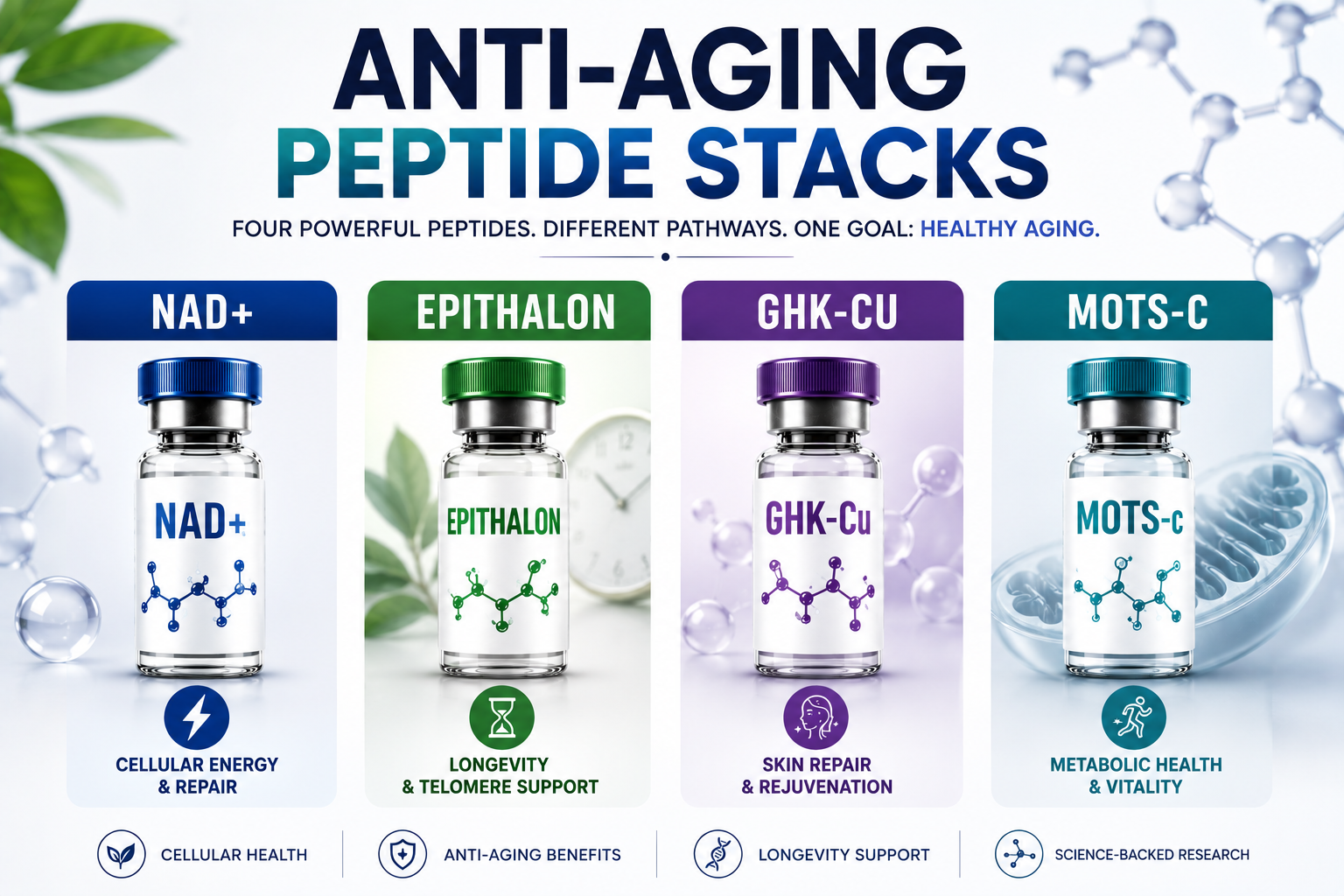
Interest in longevity research has expanded rapidly, especially around compounds that may influence cellular energy, tissue repair, mitochondrial function, skin regeneration, and biological aging. An anti-aging peptide stack typically refers to combining two or more experimental compounds with different proposed mechanisms rather than relying on a single molecule.
Among the compounds frequently discussed in longevity research are NAD+, Epithalon (Epitalon), GHK-Cu, and MOTS-c. However, they are not interchangeable. They target different biological pathways, and the strength of evidence behind each one varies considerably.
It is also important to clarify that NAD+ is not a peptide. NAD+ is a naturally occurring coenzyme involved in cellular energy metabolism and redox reactions. Epithalon, GHK-Cu, and MOTS-c are peptide-related compounds, although their research backgrounds and proposed mechanisms differ.
This guide compares these compounds from a research perspective and explains what scientists currently know about their potential role in healthy aging.
What Is an Anti-Aging Peptide Stack?
An anti-aging peptide stack is a combination of compounds investigated for different aspects of aging biology. The theoretical idea is that targeting several pathways may provide broader effects than focusing on one pathway.
A proposed stack might target:
- Cellular energy and NAD+ metabolism
- Mitochondrial function
- Skin and extracellular matrix remodeling
- Oxidative stress and inflammation
- Telomere and cellular-aging pathways
However, the existence of a theoretical mechanism does not prove that combining these compounds improves longevity in humans.
This distinction matters because much of the research surrounding experimental longevity peptides comes from laboratory studies, animal models, or small human studies. A 2026 review of therapeutic peptides in gerontology concluded that several non-approved peptides show promising preclinical findings but lack the long-term safety data and systematic clinical validation needed for routine use.
NAD+: Cellular Energy and Aging Research
Nicotinamide adenine dinucleotide, or NAD+, is a coenzyme found in essentially every cell. It participates in energy production, redox reactions, DNA repair processes, and signaling pathways involving proteins such as sirtuins.
NAD+ levels and NAD-related metabolism can change with age, which has led researchers to investigate whether restoring NAD+ availability could influence aspects of age-related decline.
Importantly, research generally focuses on NAD+ precursors such as nicotinamide riboside (NR) and nicotinamide mononucleotide (NMN) rather than assuming that administering NAD+ itself will produce anti-aging benefits.
A 2026 systematic review analyzed 113 eligible intervention studies, including 33 human studies. The researchers found that oral NR and NMN reliably increased NAD-related biomarkers in humans. However, effects on metabolic, vascular, physical-performance, and other healthspan outcomes were mixed. The review also found no eligible clinical outcomes trials establishing intravenous or intramuscular NAD+ itself as an anti-aging treatment.
Therefore, NAD+ is biologically interesting, but increased NAD-related biomarkers should not automatically be interpreted as increased lifespan or proven anti-aging effects.
Epithalon: Telomeres and Longevity Research
Epithalon, also called Epitalon, is a synthetic tetrapeptide consisting of four amino acids: Ala-Glu-Asp-Gly.
It has attracted attention because research has explored its possible relationship with telomerase activity, telomere biology, pineal-gland function, and aging-related processes.
The proposed rationale is particularly interesting because telomeres are protective structures at the ends of chromosomes, and telomere shortening is associated with cellular aging. Some laboratory and animal research has reported effects on telomerase and telomere-related pathways.
However, the human evidence is much weaker than the marketing surrounding Epithalon sometimes suggests.
A 2026 review of therapeutic peptides in gerontology described Epitalon as an investigational compound with animal research and small clinical studies, while emphasizing the absence of strong Western randomized controlled trials and long-term safety data.
That means Epithalon should currently be viewed as a research compound rather than a proven longevity treatment.
GHK-Cu: Skin Aging and Tissue Remodeling
GHK-Cu is a copper-binding peptide complex involving glycyl-L-histidyl-L-lysine and copper.
Among the compounds in this comparison, GHK-Cu has a particularly interesting connection with skin aging and tissue remodeling. Research has investigated its effects on collagen production, extracellular matrix remodeling, inflammation, wound healing, and skin appearance.
A review published in Aging Pathobiology and Therapeutics described GHK-Cu as having anti-inflammatory, antioxidant, tissue-remodeling, and regenerative properties in laboratory and animal research.
There is also some human cosmetic research. Earlier clinical studies reported improvements in parameters such as skin density, thickness, laxity, fine lines, and wrinkles following topical GHK-Cu use.
However, the evidence should not be exaggerated. A more recent review noted that despite considerable interest in GHK-Cu and related cosmetic peptides, there is still a surprising lack of modern, high-quality clinical research addressing their effectiveness and skin penetration.
Therefore, GHK-Cu has a more credible skin-focused research rationale than a proven whole-body longevity effect.
MOTS-c: Mitochondrial and Metabolic Aging Research
MOTS-c is a 16-amino-acid mitochondrial-derived peptide encoded by a region of mitochondrial DNA.
Researchers have become interested in MOTS-c because of its potential relationship with metabolic regulation, mitochondrial function, glucose metabolism, stress responses, and age-associated metabolic changes.
Experimental research suggests that MOTS-c may influence metabolic pathways and cellular responses to stress. Reviews have also reported associations between MOTS-c biology and conditions involving metabolic dysfunction and aging.
One interesting connection is its relationship with NAD+ metabolism. Preclinical research suggests that MOTS-c can influence intracellular NAD+ and signaling pathways such as SIRT1. However, these mechanistic findings do not establish that administering MOTS-c to humans will increase lifespan or prevent age-related disease.
Human evidence remains particularly limited. Current research is still working toward determining whether the promising laboratory findings translate into meaningful clinical outcomes.
NAD+ vs. Epithalon vs. GHK-Cu vs. MOTS-c
| Compound | Main research focus | Evidence strength | Potential area of interest |
|---|---|---|---|
| NAD+ | Cellular energy and redox metabolism | Human biomarker evidence; clinical outcomes mixed | Cellular metabolism and healthspan |
| Epithalon | Telomere and aging-related pathways | Mostly preclinical with limited human research | Cellular aging and longevity |
| GHK-Cu | Skin remodeling and tissue repair | Some human topical research plus preclinical evidence | Skin aging and collagen |
| MOTS-c | Mitochondrial and metabolic regulation | Primarily preclinical/early clinical research | Metabolic and mitochondrial health |
This comparison shows why simply putting these compounds into one “anti-aging stack” can be misleading. They are investigating different biological targets, and the evidence supporting each target is not equivalent.
Could These Compounds Work Better Together?
The theoretical argument for stacking is straightforward: aging is not caused by one pathway.
For example, NAD+ research focuses heavily on cellular metabolism, MOTS-c on mitochondrial and metabolic signaling, GHK-Cu on tissue remodeling and skin biology, and Epithalon on telomere-related mechanisms.
In theory, these pathways could overlap.
In practice, however, there is a major evidence gap: there is little clinical evidence demonstrating that combining these four compounds produces additive or synergistic anti-aging effects in humans.
This is one of the most important points readers should understand.
A biological mechanism that looks complementary on paper does not automatically translate into a safe or effective combination. Combining experimental compounds can also make it more difficult to identify which compound is responsible for benefits or adverse effects.
Potential Risks and Evidence Gaps
The biggest problem with many anti-aging peptide stacks is not necessarily that every compound is ineffective. The bigger issue is that long-term human safety and effectiveness have not been established for many of these approaches.
Potential concerns include:
- Limited long-term human safety data
- Differences in product purity and formulation
- Uncertainty about dosing and administration
- Possible interactions between compounds
- Lack of large randomized controlled trials
- Difficulty separating placebo effects from biological effects
- Unknown effects from long-term combination use
The 2026 gerontology review specifically emphasized that investigational peptides such as Epitalon and other non-approved compounds lack the long-term safety surveillance necessary to establish routine clinical use.
This is especially important when compounds are marketed online with claims about reversing aging, extending lifespan, or regenerating organs. Research findings are not the same thing as clinical proof.
What Does the Research Actually Support?
Based on the current evidence, these compounds should not be ranked simply from “best” to “worst.”
Instead, their research interests are different.
NAD+ has the strongest human evidence for changing NAD-related biomarkers, particularly through precursors such as NR and NMN. Yet whether these changes translate into meaningful anti-aging benefits remains uncertain.
GHK-Cu has the most practical research connection to skin appearance and tissue remodeling, including some human topical studies. However, evidence for systemic longevity remains insufficient.
MOTS-c is scientifically interesting because of its mitochondrial and metabolic biology, but much of the evidence remains preclinical.
Epithalon has attracted longevity interest because of telomere and pineal-related research, but its clinical evidence base is limited and long-term safety remains uncertain.
A Better Way to Think About Anti-Aging Peptide Stacks
Instead of asking, “What is the best anti-aging peptide stack?” a more scientifically useful question is:
Which biological aging pathway is being investigated, and how strong is the evidence that targeting it improves meaningful human outcomes?
That approach prevents marketing claims from becoming confused with established science.
For example, someone interested in skin aging may encounter GHK-Cu research, while someone studying mitochondrial metabolism may focus on MOTS-c. NAD+ research is more directly connected with cellular metabolism, whereas Epithalon is associated with telomere and aging-related pathways.
These differences matter.
Conclusion
The concept of an anti-aging peptide stack is appealing because aging involves multiple interconnected biological processes. NAD+, Epithalon, GHK-Cu, and MOTS-c each represent a different research direction, from cellular energy and mitochondrial signaling to skin remodeling and telomere biology.
But the evidence is not strong enough to conclude that combining these compounds will slow human aging or extend lifespan.
Current research supports continued investigation rather than confident anti-aging claims. NAD+ augmentation has demonstrated biological activity in human studies, GHK-Cu has some evidence for topical skin benefits, while Epithalon and MOTS-c remain much more experimental.
For readers researching longevity, the most important distinction is between biological plausibility, laboratory evidence, and proven clinical outcomes. An effective anti-aging strategy should ultimately be judged by high-quality human evidence, long-term safety, and meaningful health outcomes—not simply by how many pathways a peptide stack appears to target.
Frequently Asked Questions
Is NAD+ a peptide?
No. NAD+ is a coenzyme involved in cellular metabolism and redox reactions. It is often discussed alongside longevity peptides but is chemically different from peptides such as Epithalon, GHK-Cu, and MOTS-c.
Which compound is most associated with skin aging?
GHK-Cu has the strongest connection to skin research among these four compounds. Studies have investigated collagen production, skin density, wrinkles, and tissue remodeling, particularly with topical formulations.
Is Epithalon proven to extend human lifespan?
No. Epithalon remains an investigational compound. Although laboratory and animal research has generated interest in telomere and longevity pathways, strong human evidence demonstrating lifespan extension is lacking.
Is MOTS-c proven to reverse aging?
No. MOTS-c has promising mitochondrial and metabolic research behind it, but most evidence remains preclinical, and human efficacy data are still limited.
Is an anti-aging peptide stack safe?
There is not enough long-term clinical evidence to declare combinations of experimental peptides safe for anti-aging purposes. Product quality, formulation, dose, interactions, and individual health factors can all affect risk.
References
Gallagher, C., & Emmanuel, O. O. (2026). NAD⁺ supplementation for anti-aging and wellness: A PRISMA-guided systematic review of preclinical and clinical evidence. Ageing Research Reviews, 116, 103057. https://doi.org/10.1016/j.arr.2026.103057 (ScienceDirect)
Mavrych, V., Shypilova, I., & Bolgova, O. (2026). Therapeutic peptides in gerontology: Mechanisms and applications for healthy aging. Frontiers in Aging, 7. https://doi.org/10.3389/fragi.2026.1790247 (Frontiers)
Pickart, L., & colleagues. Research reviews on GHK/GHK-Cu and aging, tissue remodeling, and skin regeneration. PubMed
MOTS-c research review. MOTS-c, the Most Recent Mitochondrial Derived Peptide in Human Aging and Age-Related Diseases. PubMed
Topically applied GHK as an anti-wrinkle peptide: Advantages, problems and prospective. PMC (PubMed Central (PMC))
