
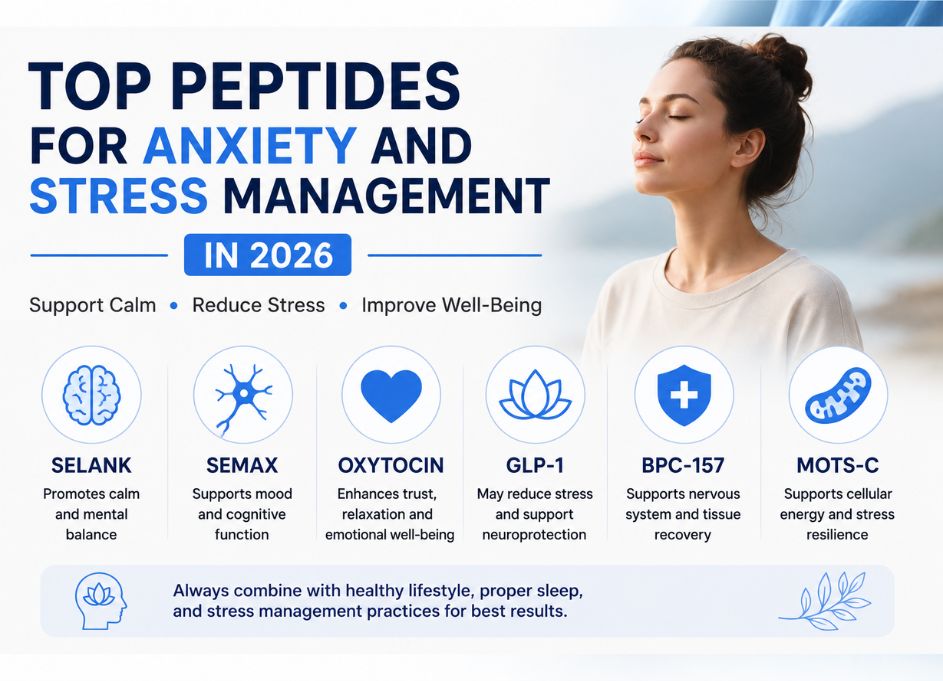
Anxiety and chronic stress affect millions of people worldwide, impacting mental well-being, sleep quality, focus, and overall health. While traditional approaches such as therapy, lifestyle modifications, and medications remain the primary treatment options, researchers have become increasingly interested in peptides and their potential influence on stress-related pathways.
Peptides are short chains of amino acids that act as signaling molecules throughout the body. Certain peptides are being studied for their potential effects on mood regulation, stress response, cognitive function, and emotional resilience. Although research remains ongoing, several peptides have shown promising results in preclinical and early human studies.
This article by Peptides Unleashed explores the top peptides for anxiety and stress management in 2026, the science behind their potential benefits, and what current research suggests about their future role in mental wellness.
Understanding Anxiety and Stress
Anxiety is a natural response to perceived threats or challenges. However, when anxiety becomes excessive or persistent, it can interfere with daily life and overall health.
Common symptoms of anxiety include:
- Excessive worrying
- Restlessness
- Difficulty concentrating
- Irritability
- Muscle tension
- Sleep disturbances
- Increased heart rate
Chronic stress can contribute to anxiety by continuously activating the body’s stress-response system, leading to elevated cortisol levels and potential disruptions in brain function.
Researchers are exploring peptides because many naturally influence hormones, neurotransmitters, and biological systems involved in emotional regulation.
How Peptides May Influence Anxiety and Stress
Peptides may affect anxiety-related pathways through several mechanisms:
| Potential Mechanism | Possible Impact |
|---|---|
| Cortisol Regulation | Supports healthy stress response |
| Neurotransmitter Modulation | May influence serotonin and dopamine activity |
| Sleep Improvement | Better sleep can reduce anxiety symptoms |
| Neuroprotection | Supports healthy brain function |
| Anti-Inflammatory Effects | May reduce inflammation associated with chronic stress |
| Cognitive Support | Helps maintain focus and mental clarity |
While these mechanisms are promising, peptides should not be considered replacements for professional mental health treatment.
Selank: The Most Studied Anti-Anxiety Peptide
What Is Selank?
Selank is a synthetic peptide developed from a naturally occurring immune peptide called tuftsin. It has gained attention for its potential anxiolytic (anxiety-reducing) properties without the sedative effects commonly associated with some traditional anxiety medications.
Research Findings
Studies suggest Selank may:
- Reduce feelings of anxiety
- Support emotional stability
- Enhance cognitive performance under stress
- Improve concentration and focus
- Promote balanced neurotransmitter activity
Researchers believe Selank may influence serotonin pathways, which play a significant role in mood regulation and emotional well-being.
Potential Benefits
Stress Resilience
Selank may help individuals better adapt to stressful situations without excessive emotional reactions.
Cognitive Enhancement
Unlike some anti-anxiety medications that may cause mental fog, Selank has demonstrated potential cognitive-supportive effects in research settings.
Sleep Support
By promoting emotional calmness, Selank may indirectly improve sleep quality in individuals experiencing stress-related sleep disturbances.
Semax: Cognitive and Stress Support
What Is Semax?
Semax is another peptide originally developed for neurological applications. Although it is often discussed for cognitive enhancement, researchers have also examined its potential influence on stress adaptation and emotional regulation.
Research Findings
Studies indicate Semax may:
- Support healthy brain-derived neurotrophic factor (BDNF) activity
- Enhance mental performance during stressful situations
- Improve focus and memory
- Help regulate stress responses
Potential Benefits for Anxiety
Improved Mental Resilience
Semax may help the brain better cope with psychological stressors.
Cognitive Preservation During Stress
Stress often impairs memory and concentration. Semax may support cognitive function during challenging periods.
Research Status
Most evidence remains preliminary, and additional clinical studies are needed to establish its role in anxiety management.

Oxytocin: The Social Bonding Peptide
What Is Oxytocin?
Often referred to as the “bonding hormone,” oxytocin is naturally produced by the body and plays a critical role in social interaction, trust, and emotional connection.
Research Findings
Research suggests oxytocin may:
- Reduce social anxiety
- Promote feelings of trust
- Enhance emotional recognition
- Improve social engagement
Potential Benefits
Social Anxiety Support
Several studies have explored oxytocin’s potential to reduce anxiety during social interactions.
Emotional Regulation
Oxytocin may help moderate emotional responses to stressful situations.
Limitations
Results vary among individuals, and researchers continue investigating the complex relationship between oxytocin and anxiety.
MOTS-c: Emerging Research on Stress Adaptation
What Is MOTS-c?
MOTS-c is a mitochondrial-derived peptide involved in energy metabolism and cellular stress responses.
Research Findings
Researchers have observed that MOTS-c may:
- Improve cellular resilience
- Support metabolic health
- Enhance adaptation to physiological stress
- Promote healthy aging processes
Anxiety and Stress Implications
Although direct anxiety research remains limited, better metabolic and mitochondrial function may contribute to improved stress resilience and overall well-being.
Future Potential
MOTS-c remains an exciting area of investigation as researchers continue exploring connections between metabolism and mental health.
BPC-157: Stress and Gut-Brain Health
What Is BPC-157?
BPC-157 is a synthetic peptide derived from a protective protein found in the stomach.
Research Findings
Animal studies suggest BPC-157 may:
- Support nervous system function
- Promote tissue healing
- Influence neurotransmitter systems
- Support gut health
The Gut-Brain Connection
Researchers increasingly recognize the relationship between gut health and mental wellness.
Potential benefits include:
- Improved digestive function
- Reduced inflammation
- Support for the gut-brain axis
- Enhanced overall resilience to stress
Research Limitations
Most anxiety-related findings come from animal research, and more human studies are necessary.
Kisspeptin: A New Area of Anxiety Research
What Is Kisspeptin?
Kisspeptin is primarily known for regulating reproductive hormones, but recent research has explored its potential influence on emotional processing and mood.
Research Findings
Early studies suggest kisspeptin may:
- Reduce negative emotional responses
- Influence mood-related brain regions
- Enhance positive emotional processing
Future Outlook
Kisspeptin research remains in its early stages, but findings have generated significant interest within neuroscience communities.
Comparing Popular Peptides for Anxiety and Stress
| Peptide | Primary Focus | Research Stage |
|---|---|---|
| Selank | Anxiety reduction and emotional balance | Moderate |
| Semax | Cognitive support and stress adaptation | Moderate |
| Oxytocin | Social anxiety and emotional connection | Moderate |
| MOTS-c | Cellular stress resilience | Emerging |
| BPC-157 | Gut-brain support and recovery | Emerging |
| Kisspeptin | Emotional regulation | Early-stage |
Safety Considerations
Peptide research continues to evolve, and many compounds remain investigational.
Important considerations include:
- Long-term safety data may be limited
- Product quality varies significantly between suppliers
- Research findings may not always translate into clinical outcomes
- Professional medical guidance is essential before considering any peptide-based intervention
Individuals with anxiety disorders should continue working with qualified healthcare professionals and evidence-based treatment plans.
Lifestyle Strategies That Complement Anxiety Management
Peptides are only one area of research. Proven lifestyle approaches remain foundational for stress management.
Helpful strategies include:
- Regular physical activity
- Consistent sleep schedules
- Mindfulness practices
- Balanced nutrition
- Stress reduction techniques
- Social support networks
- Cognitive behavioral therapy when appropriate
Combining healthy lifestyle habits with emerging scientific developments may provide the best long-term outcomes for emotional wellness. People dealing with ongoing pressure may also benefit from exploring practical resilience and recovery resources that support healthier coping habits and emotional well-being.
Frequently Asked Questions
What is the best peptide for anxiety?
Selank is currently one of the most researched peptides specifically for anxiety-related applications and emotional regulation.
Can peptides replace anxiety medications?
No. Peptides should not be viewed as replacements for prescribed treatments unless directed by a qualified healthcare professional.
Are peptides approved for anxiety treatment?
Many peptides discussed in anxiety research remain investigational and may not be approved specifically for anxiety treatment in many countries.
Can peptides improve stress resilience?
Some peptides, including Selank, Semax, and MOTS-c, are being studied for their potential role in helping the body adapt to stress.
Is there a connection between gut health and anxiety?
Yes. Research increasingly supports a strong gut-brain connection, which is one reason peptides such as BPC-157 have attracted scientific interest.
Conclusion
The growing field of peptide research is opening new possibilities for understanding anxiety and stress management. Among current candidates, Selank remains one of the most promising peptides for anxiety-related applications, while Semax, Oxytocin, MOTS-c, BPC-157, and Kisspeptin continue to attract scientific attention.
Although early findings are encouraging, most peptide-based approaches require further clinical investigation before definitive conclusions can be drawn. As research progresses through 2026 and beyond, peptides may offer valuable insights into new strategies for supporting emotional resilience, cognitive performance, and overall mental wellness.
