
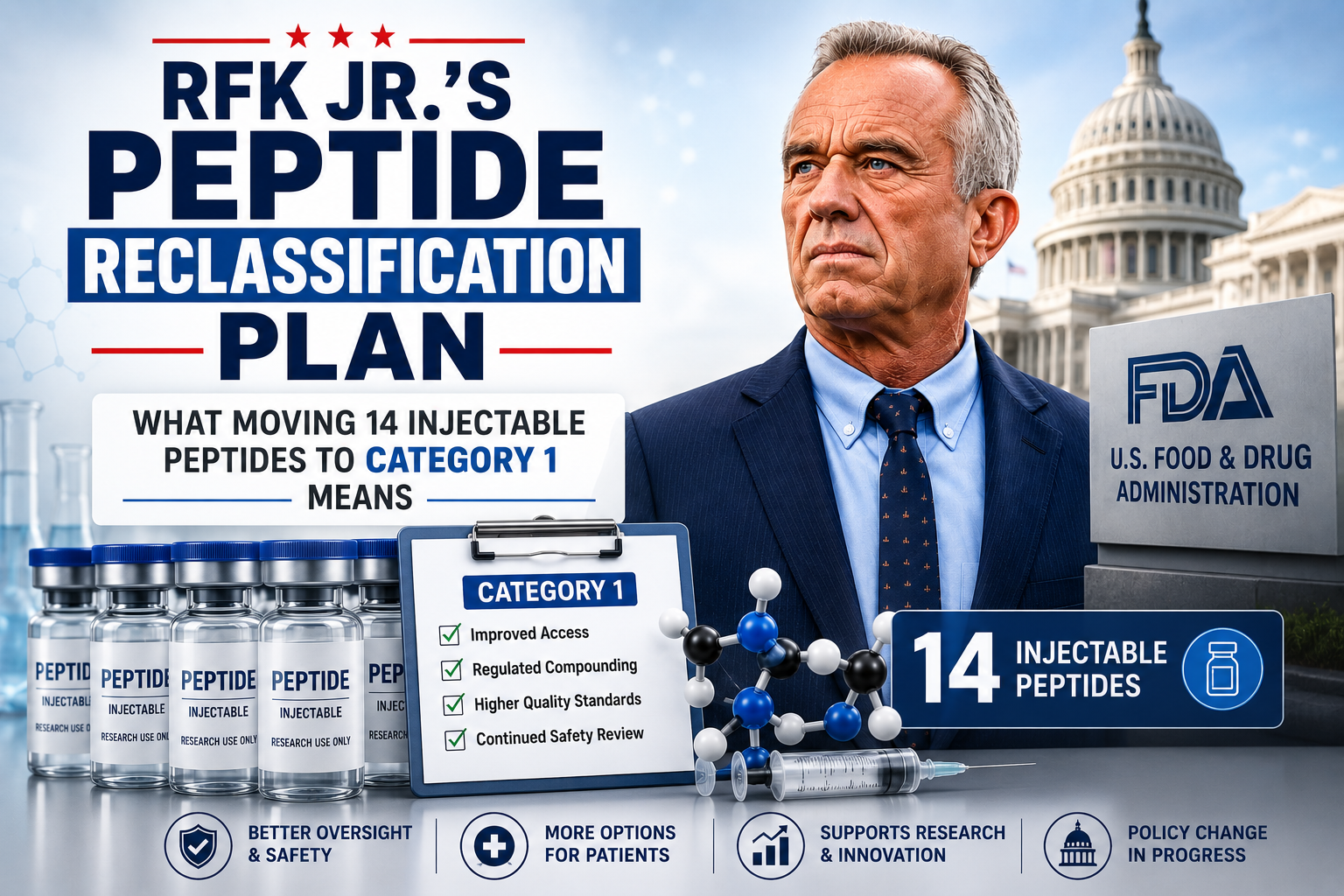
Robert F. Kennedy (Jr. RFK Jr.’s Peptide Reclassification Plan), the U.S. Secretary of Health and Human Services (HHS), has proposed moving 14 injectable peptides from the FDA’s Category 2 list back to Category 1. If approved, this change could make several popular peptides available again through licensed compounding pharmacies.
As a result, researchers, healthcare providers, and peptide enthusiasts are paying close attention.
Supporters believe the move could improve access to promising therapies. Critics, however, argue that more clinical research is needed before restrictions are eased.
So, what does this proposal actually mean? More importantly, how could it affect the peptide market?
Let’s take a closer look.
What Is RFK Jr.’s Peptide Reclassification Plan ?
The proposal aims to restore compounding access to several injectable peptides that were restricted by the FDA in recent years.
In 2023, the FDA moved a number of peptides into Category 2 due to concerns about safety, quality control, and limited clinical evidence. As a result, many compounding pharmacies stopped offering these products.
RFK Jr. has suggested that approximately 14 of these peptides should be moved back to Category 1, allowing licensed pharmacies to compound them while regulatory reviews continue.
Why Is This Important?
For many clinics and patients, peptide access became much more difficult after the restrictions.
If the proposal moves forward, healthcare providers may once again have access to a wider range of peptide therapies through regulated channels.
Understanding Category 1 and Category 2
One of the biggest misconceptions is that reclassification means FDA approval.
That is not true.
What Is Category 1?
Category 1 includes substances that may be compounded by licensed pharmacies while the FDA continues evaluating them.
These substances are generally considered eligible for compounding under current guidelines.
What Is Category 2?
Category 2 includes substances that have raised concerns during FDA review.
These concerns may involve:
- Safety risks
- Limited research
- Manufacturing issues
- Questions about effectiveness
Because of these concerns, pharmacies face greater restrictions when compounding Category 2 substances.
What Reclassification Does NOT Mean
Moving a peptide back to Category 1 does not mean:
- It is FDA approved
- It has proven medical benefits
- It is completely risk-free
- Insurance will cover it
- Long-term safety is fully understood
Instead, the change mainly affects pharmacy compounding rules.
Which Peptides Could Return to Category 1?
While regulators have not finalized the complete list, several peptides are frequently mentioned in industry discussions.
Potential Peptides Under Review
| Peptide | Common Area of Research |
|---|---|
| BPC-157 | Tissue repair and recovery |
| TB-500 | Wound healing |
| GHK-Cu | Skin and tissue regeneration |
| CJC-1295 | Growth hormone support |
| Ipamorelin | Growth hormone release |
| AOD-9604 | Metabolic research |
| Selank | Anxiety and neurological research |
| Semax | Cognitive performance |
| MOTS-C | Metabolic health |
| KPV | Inflammation support |
| Thymosin Alpha-1 | Immune system regulation |
The final list may change as the FDA review process continues.
Why Were These Peptides Restricted?
The FDA’s decision in 2023 was based on several concerns.
Limited Human Research
Many peptides have shown promising results in animal studies.
However, large-scale human clinical trials are often lacking.
Without stronger evidence, regulators may hesitate to allow widespread use.
Safety Concerns
Another concern involves long-term safety.
Questions remain regarding:
- Hormonal effects
- Cancer-related risks
- Immune system responses
- Cardiovascular health
Because many peptides are relatively new, researchers are still studying their long-term impact.
Quality Control Issues
Some regulators have also raised concerns about manufacturing standards.
Inconsistent product quality can create risks for patients, especially with injectable compounds.
How Could This Affect the Peptide Market?
If the proposal becomes reality, the market could experience significant growth.
Increased Access Through Compounding Pharmacies
One of the biggest changes would be improved availability through licensed pharmacies.
This could lead to:
- Better product quality
- Improved patient safety
- Greater physician oversight
- More reliable sourcing
For many patients, this may be preferable to purchasing products from unregulated online vendors.
Growth in Regenerative Medicine
Regenerative medicine clinics often use peptides as part of broader treatment programs.
If more peptides become available, these clinics may expand their services.
This could increase interest in:
Recovery Programs
Clinics focused on injury recovery may benefit from expanded peptide access.
Longevity Medicine
Many anti-aging practitioners view peptides as a promising area of research.
Functional Medicine
Some functional medicine providers may incorporate peptides into personalized wellness programs.
Reduced Dependence on Gray-Market Suppliers
Following the FDA restrictions, many consumers turned to research peptide websites.
Unfortunately, quality standards vary widely among these suppliers.
If licensed pharmacies regain access, patients may have safer alternatives.
Potential Benefits of Reclassification
Supporters of the proposal point to several possible advantages.
More Treatment Options
Doctors and clinics could gain access to additional tools for patient care.
Better Regulatory Oversight
Compounded products are generally subject to stricter quality controls than many research-only products.
Increased Research Interest
Greater access may encourage researchers to conduct additional clinical studies.
This could improve our understanding of peptide safety and effectiveness.
Industry Growth
The peptide sector has expanded rapidly in recent years.
Reclassification could attract:
- New investors
- Healthcare providers
- Research institutions
- Pharmaceutical companies
Challenges Still Remain
Despite the excitement, several obstacles remain.
FDA Reviews Are Ongoing
The proposal does not automatically change regulations overnight.
Federal review processes still need to be completed.
Scientific Questions Remain
Many peptides continue to face important research gaps.
Scientists still need more data on:
- Long-term safety
- Optimal dosing
- Drug interactions
- Clinical effectiveness
State Regulations May Differ
Even if federal rules change, some states may maintain their own restrictions.
As a result, access could vary across different locations.
What Does This Mean for Patients?
Patients should view the proposal with both optimism and caution.
While access may improve, medical supervision remains essential.
Before using any peptide therapy, individuals should:
- Consult a qualified healthcare provider
- Discuss potential risks and benefits
- Use reputable sources
- Follow appropriate monitoring protocols
Peptides may offer exciting possibilities, but they are not miracle treatments.
Frequently Asked Questions
Is RFK Jr. approving these peptides?
No. The proposal involves reclassification for compounding purposes, not FDA approval.
Will peptides become easier to obtain?
Potentially yes. If the proposal is approved, licensed compounding pharmacies may regain access to several peptides.
Are these peptides proven to work?
Some peptides show promise in research. However, many still lack large-scale human clinical trials.
Are peptide therapies safe?
Safety varies by compound. More research is needed for many peptides, particularly regarding long-term use.
When could the changes take effect?
There is currently no confirmed timeline. Regulatory reviews are still ongoing.
Conclusion
RFK Jr.’s Peptide Reclassification Plan proposal to move 14 injectable peptides back to Category 1 could significantly reshape the peptide industry.
If approved, the change may improve access through licensed compounding pharmacies, encourage additional research, and support growth in regenerative medicine and longevity care.
However, it is important to remember that reclassification is not the same as FDA approval. Many peptides still require further study to establish their safety and effectiveness.
For now, researchers, healthcare providers, and patients will continue watching closely as regulators decide the future of peptide access in the United States.
References
New York Post. (2026).RFK Jr.’s Peptide Reclassification Plan may make it easier to get peptides but what do doctors think?
SELF Magazine. (2026). RFK Jr. Wants to Unban 14 Peptides. What Doctors Want You to Know.
Barron’s. (2026). How RFK Jr. Sent Hims & Hers Stock Higher.
U.S. Department of Health and Human Services. Robert F. Kennedy Jr., Secretary of HHS.
