
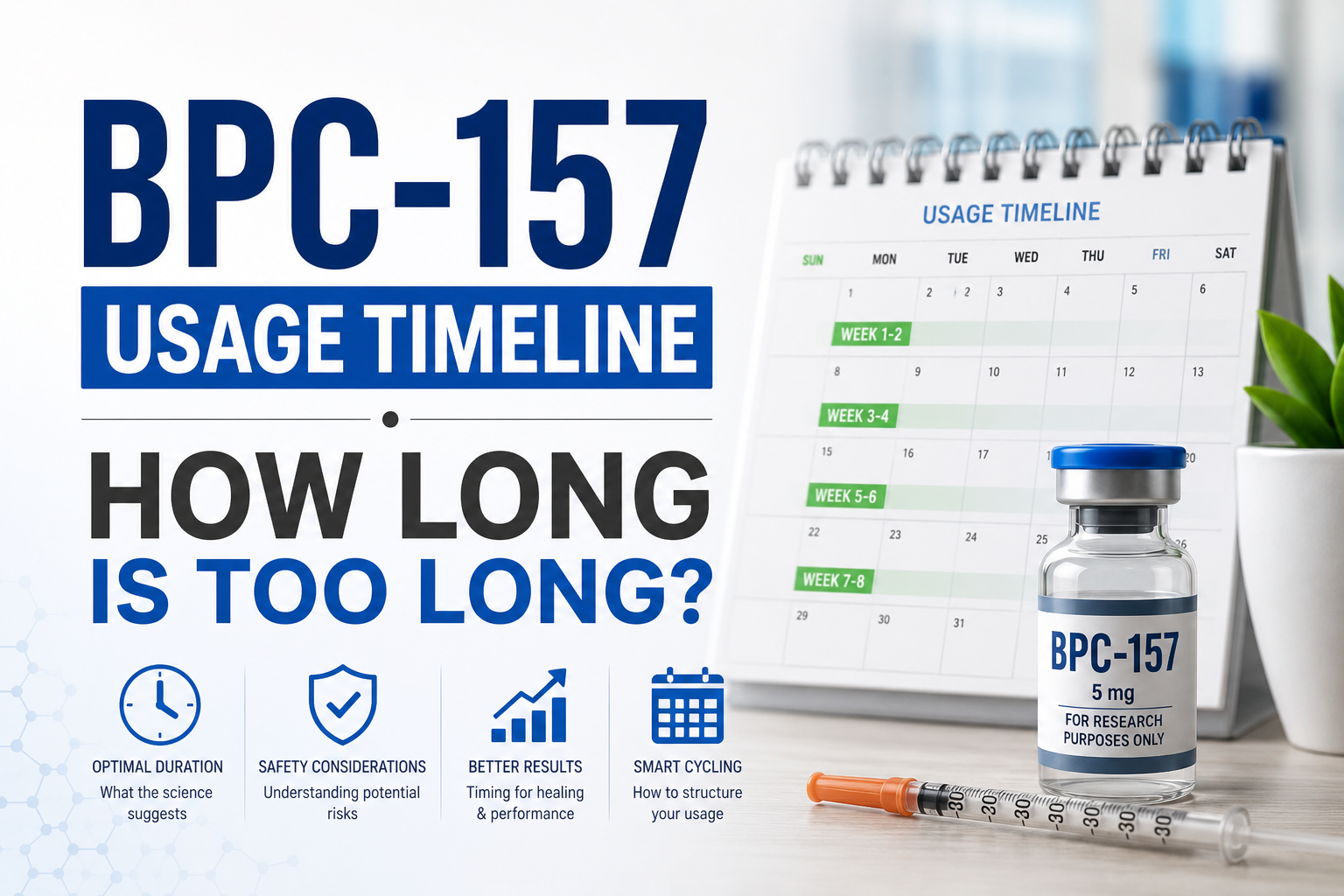
BPC-157 Usage has become one of the most discussed research peptides in recent years. Researchers and peptide enthusiasts often explore its potential role in injury recovery, tissue repair, and inflammation management. As interest continues to grow, one question comes up repeatedly:
How long should a BPC-157 cycle last?
The answer is not as straightforward as many people hope. While animal studies have produced encouraging results, there are currently no large-scale human clinical trials that establish official guidelines for BPC-157 use.
Most people who use BPC-157 in research settings do so for a specific purpose, such as supporting recovery from an injury or addressing chronic inflammation. In these situations, the peptide is typically used for a limited period rather than indefinitely.
This guide explores common BPC-157 usage timelines, what current research suggests, potential concerns about long-term use, and how to determine when a cycle may have gone on long enough.
Quick Answer: Most BPC-157 cycles last between 4 and 8 weeks. While some individuals experiment with longer cycles, research on long-term use remains limited, making extended use difficult to evaluate from a safety perspective.
What Is BPC-157?
BPC-157 stands for Body Protection Compound-157, a synthetic peptide derived from a protective protein naturally found in gastric juice.
Researchers have investigated BPC-157 for its potential effects on:
- Tendon healing
- Ligament repair
- Muscle recovery
- Gut health
- Inflammation control
- Blood vessel formation
Although these findings are promising, most evidence comes from animal studies rather than human clinical research.
As a result, many questions about ideal dosing, cycle length, and long-term safety remain unanswered.
Why Are People Interested in BPC-157?
One reason BPC-157 has attracted attention is its potential ability to support multiple healing pathways at the same time.
Research suggests it may help promote:
- Collagen production
- Tissue regeneration
- Blood flow to injured areas
- Reduced inflammatory responses
- Faster healing after injury
Because of these potential benefits, BPC-157 is commonly discussed among athletes, fitness enthusiasts, and researchers interested in recovery support.Common BPC-157 Cycle Lengths
There is no universally accepted cycle duration for BPC-157. However, several usage patterns appear frequently in research discussions and anecdotal reports.
Short Cycles: 2–4 Weeks
A shorter cycle is often used when dealing with:
- Minor muscle strains
- Mild inflammation
- Small soft-tissue injuries
- Recovery support after intense training
Some users report noticing changes within the first two weeks. However, healing rates vary significantly depending on the type and severity of the injury.
Standard Cycles: 4–8 Weeks
A cycle lasting four to eight weeks is the most commonly discussed timeframe.
This duration is often associated with:
- Tendon recovery
- Ligament injuries
- Joint discomfort
- Post-surgical recovery support
- Chronic inflammation
For many individuals, this timeframe aligns with the natural healing process of connective tissues.
Extended Cycles: 8–12 Weeks
Longer cycles are sometimes considered for more serious conditions.
Examples include:
- Chronic tendon damage
- Long-term joint issues
- Severe soft-tissue injuries
- Complex recovery situations
However, evidence supporting extended use remains limited.
Table 1: Typical BPC-157 Cycle Lengths
| Cycle Length | Common Purpose | Research Support |
|---|---|---|
| 2–4 Weeks | Minor injuries and inflammation | Moderate |
| 4–8 Weeks | Tendon, ligament, and muscle recovery | Strongest practical support |
| 8–12 Weeks | Chronic or severe injuries | Limited |
| Over 12 Weeks | Long-term experimentation | Very limited |
Why Cycle Length Matters
Many people assume that if a peptide helps recovery, using it longer will automatically produce better results.
Unfortunately, biology does not always work that way.
Once healing reaches a certain point, additional peptide exposure may offer fewer benefits. In some cases, continued use may simply maintain the same effect rather than improve outcomes further.
Because long-term human studies are lacking, researchers often recommend using BPC-157 for a specific recovery goal instead of treating it as a permanent supplement.
Does Longer Use Mean Better Results?
Current evidence does not suggest that indefinite BPC-157 use provides additional healing benefits.
Most animal studies evaluate outcomes over weeks rather than months or years.
As tissue healing progresses, the body typically moves through several stages:
- Inflammation
- Tissue repair
- Remodeling
- Recovery
Once these processes are largely complete, the need for ongoing support may decrease.
As a result, many researchers question whether extending a cycle far beyond the recovery period offers meaningful advantages.
When Does BPC-157 Become Too Long?
There is no official cutoff point. However, several factors may indicate that a cycle has reached its practical limit.
Healing Has Stopped Improving
If recovery progress plateaus for several weeks, continuing the cycle may not produce additional benefits.
The Injury Has Fully Recovered
Once the original issue has resolved, ongoing use may no longer serve a clear purpose.
No Defined Recovery Goal Exists
BPC-157 is generally discussed as a recovery-focused peptide rather than a long-term wellness supplement.
Usage Extends Beyond Several Months
The further use extends beyond typical cycle lengths, the less research is available to support safety or effectiveness.
What Does Research Say About Long-Term Safety?
One of the biggest challenges with BPC-157 is the lack of long-term human data.
Available research suggests:
- Low toxicity in animal studies
- Favorable tolerability profiles
- No major organ toxicity reported in preclinical models
However, researchers still do not know enough about:
- Multi-year exposure
- Long-term cardiovascular effects
- Hormonal interactions
- Potential cancer-related concerns
This uncertainty is one reason many experts recommend conservative cycle lengths.
Potential Risks of Extended BPC-157 Use
While serious side effects have not been consistently reported in research settings, prolonged use raises several theoretical concerns.
Limited Human Research
The biggest concern is not a known risk but an unknown one.
Without long-term studies, researchers cannot confidently predict outcomes years into the future.
Changes in Angiogenesis
BPC-157 may influence angiogenesis, the process of forming new blood vessels.
While this can support healing, researchers continue to study how long-term angiogenic effects may impact overall health.
Unnecessary Exposure
Using any compound longer than needed may increase exposure without providing additional benefits.
Should You Take Breaks Between Cycles?
Many individuals choose to take breaks between BPC-157 cycles.
A common approach looks like this:
| Phase | Duration |
|---|---|
| Active Cycle | 4–8 Weeks |
| Recovery Break | 2–4 Weeks |
| Reassessment | Evaluate healing progress |
This allows time to determine whether recovery continues without additional peptide use.
Factors That Influence Cycle Duration
No two injuries heal at the same speed.
Several factors may affect how long a BPC-157 cycle is used.
Injury Severity
A mild strain may improve quickly, while a severe tendon injury may require a longer recovery period.
Age
Older individuals generally experience slower tissue repair than younger individuals.
Lifestyle Habits
Sleep, nutrition, hydration, and rehabilitation all influence healing outcomes.
Recovery Goals
Someone recovering from surgery may have different needs than someone managing chronic inflammation.
Common Mistakes People Make
Many people focus only on the peptide while ignoring other important recovery factors.
Some of the most common mistakes include:
Using BPC-157 Without a Clear Purpose
Every cycle should have a defined goal.
Ignoring Physical Therapy
For tendon and ligament injuries, rehabilitation remains essential.
Assuming More Is Better
Longer use does not automatically produce better results.
Relying Solely on Anecdotal Reports
Online testimonials can be useful, but they should never replace scientific evidence.
The Future of BPC-157 Research
Interest in BPC-157 continues to grow worldwide.
Future human studies may help answer important questions such as:
- What is the optimal cycle length?
- What dosing strategies are most effective?
- Is long-term use safe?
- Which conditions respond best to treatment?
Until those studies are completed, many questions will remain unanswered.
Frequently Asked Questions
How long should a typical BPC-157 cycle last?
Most commonly discussed protocols range from 4 to 8 weeks.
Can BPC-157 be used for more than 12 weeks?
Some individuals experiment with longer cycles, but research supporting extended use is limited.
Is BPC-157 safe for long-term use?
Current human safety data is insufficient to determine long-term safety.
Does BPC-157 stop working over time?
There is no strong evidence that BPC-157 causes receptor desensitization, but benefits may plateau once healing is complete.
Should I take a break between cycles?
Many researchers and practitioners recommend taking a break and reassessing recovery before starting another cycle.
Can BPC-157 be used for chronic injuries?
Some individuals explore longer cycles for chronic conditions, although research remains limited.
Conclusion
BPC-157 remains one of the most promising peptides in regenerative medicine research. Current evidence and practical experience suggest that 4 to 8 weeks is the most common and reasonable cycle length for most recovery goals.
While longer cycles are sometimes used for severe injuries, the lack of long-term human safety data makes extended use difficult to evaluate. Instead of focusing on how long BPC-157 can be used, it may be more useful to focus on whether the original healing goal has been achieved.
Until larger human studies become available, a cautious and goal-oriented approach remains the most sensible strategy.
References
Sikiric, P., Seiwerth, S., Rucman, R., Kolenc, D., Vuletic, L. B., Drmic, D., & Staresinic, M. (2020). Stable gastric pentadecapeptide BPC-157 and wound healing. Current Pharmaceutical Design, 26(24), 2992–3000.
Vukojevic, J., Siroglavic, M., Kasnik, K., Kralj, T., Stancic, D., Kokot, A., & Sikiric, P. (2022). BPC-157 in musculoskeletal healing research. Biomedicines, 10(5), 1023.
Hsieh, M. J., Liu, H. T., Wang, C. N., Huang, H. Y., Lin, Y. T., Ko, Y. S., & Wang, J. S. (2017). Experimental evidence of BPC-157 effects on angiogenesis and tissue repair. Journal of Physiology and Pharmacology, 68(3), 401–412.
