
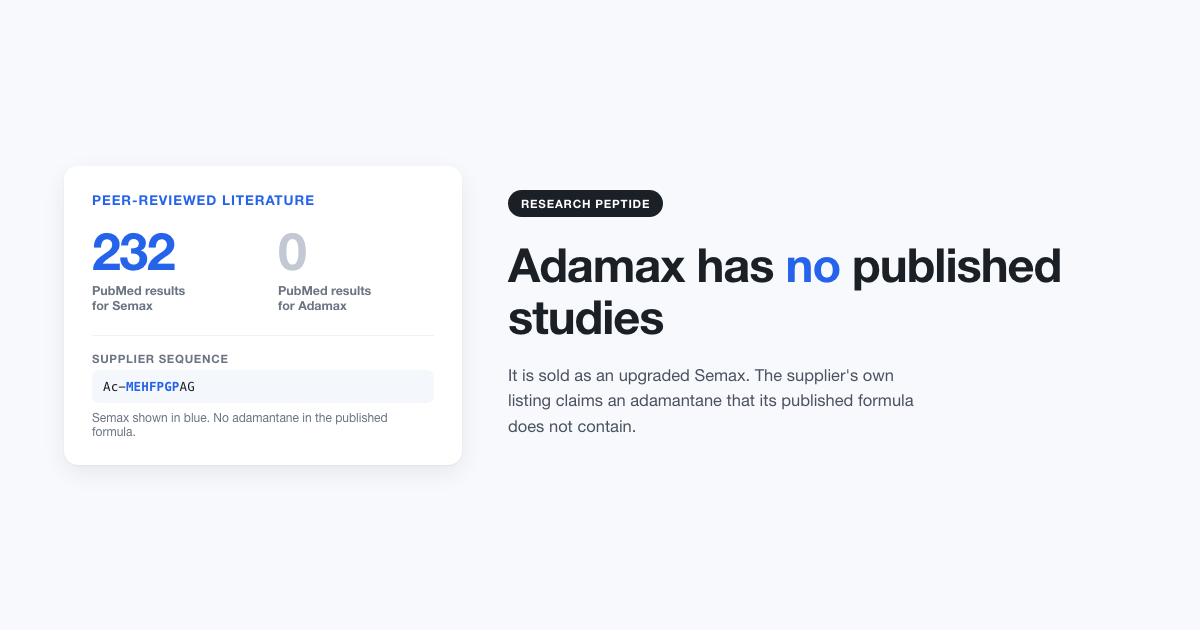
Adamax is sold as a next-generation Semax. If you are trying to find out what the research says about it, here is the finding that matters most: a PubMed search for Adamax returns no studies of the peptide at all. The single result is a machine learning paper that uses an optimisation algorithm of the same name. Semax, by contrast, returns 232 results.
That gap is the most useful thing anyone can tell you about this compound, so this page starts there and then sets out what the supplier data does and does not establish.
The literature, counted
| Compound | PubMed results | What that means |
|---|---|---|
| Semax | 232 | A real body of work, much of it Russian, spanning animal and human studies |
| Adamax | 0 | No published study of the peptide. Nothing to summarise. |
Zero is not a small number that might grow with a better search. It means no group has published a paper on this molecule under this name. Every performance statement you will read about Adamax traces back to supplier copy, not to a journal.
What Semax is, for comparison
Semax is well characterised and its entry is public.
- Identity: ACTH(4-7) with a Pro-Gly-Pro tail
- Sequence: Met-Glu-His-Phe-Pro-Gly-Pro
- CAS number: 80714-61-0
- Formula: C37H51N9O10S, 813.9 g/mol
- PubChem CID: 9811102
It is a fragment of adrenocorticotropic hormone with a short tail added to slow its breakdown. It has been studied in Russia since the 1980s and carries regulatory approval there for indications that have never been reviewed by the FDA or the EMA.
What the supplier data says Adamax is
BOC Sciences, a chemical supplier, lists Adamax under catalogue number BAT-016517 with the following specification.
- Sequence: Ac-Met-Glu-His-Phe-Pro-Gly-Pro-Ala-Gly-OH, written as Ac-MEHFPGPAG
- Formula: C44H61N11O13S, 984.10 g/mol
Read that sequence against Semax and the relationship is obvious. The first seven residues are Semax exactly. Adamax adds an acetyl group to the front and alanine and glycine to the back. Both are conventional ways to slow enzymatic degradation of a short peptide. As chemistry, calling it a Semax analogue is fair.
The contradiction in the supplier listing
The same catalogue page describes Adamax as having “a adamantane portion similar to P21.” Adamantane is a rigid three-ring hydrocarbon cage, and P21 is a real compound derived from ciliary neurotrophic factor that genuinely carries an adamantyl group. Attaching one is a recognised way to help a molecule cross the blood-brain barrier.
There is no adamantane in the structure the same page publishes. The sequence Ac-MEHFPGPAG is nine standard amino acids and nothing else. The molecular formula C44H61N11O13S is consistent with that peptide and cannot accommodate an adamantyl cage, which would add C10H15 and shift the mass substantially. The full IUPAC name printed alongside it describes no such group either.
So one of two things is true. Either the prose describes an intended design that the supplied material does not match, or the published structure is wrong. Either way the name Adamax implies a feature that the accompanying data does not show, and nobody has published a paper that would settle it.
The claims that have no source
Supplier and clinic pages for Adamax commonly assert that it raises brain-derived neurotrophic factor, increases hippocampal TrkB receptor sensitivity, and outperforms other Semax analogues by a factor of two to three in athletic endurance.
Those are specific, quantitative, testable statements. None of them carries a citation, and there is no published study of this peptide that any of them could be citing. A number as precise as “two to three times” implies a measurement, and no such measurement exists in the literature.
This is worth separating clearly. The underlying biology is not absurd. Semax has been studied in connection with neurotrophic signalling, and an acetylated, extended analogue plausibly resists degradation for longer. Plausible is not the same as demonstrated, and a marketing page is not a result.
What would change the picture
- A published characterisation. Any peer-reviewed paper naming the compound and its structure would settle the adamantane question in a paragraph.
- A comparison against Semax. The whole premise is that it improves on Semax. No study has run both.
- Consistent supplier documentation. Different vendors should agree on the structure. Right now the most detailed public listing disagrees with itself.
If you are evaluating a supplier
With no literature to check a product against, the documentation is all there is. A batch-specific certificate of analysis with a stated purity and the method used to measure it is the minimum, and a generic certificate reused across batches is not that. Our guide to reading a peptide certificate of analysis covers what a genuine one contains and the checks that catch a fabricated one. For how manufacturing standards differ between suppliers, see our review of GMP-compliant peptide companies.
Ask specifically which sequence the vendor is supplying. Given that the most detailed public specification contains an internal contradiction, two suppliers selling “Adamax” may not be selling the same molecule.
The short version
Adamax is an acetylated, extended Semax analogue on the supplier data, with no adamantane in the published structure despite the name and the catalogue description. There are no peer-reviewed studies of it. The confident figures circulating about it have no source. Semax, the compound it is derived from, has 232 papers behind it and is the more reasonable starting point for anyone reading the research.
References
- PubChem. Semax, Compound CID 9811102. National Center for Biotechnology Information. pubchem.ncbi.nlm.nih.gov/compound/9811102
- PubMed search, “Semax”, 232 results, retrieved 25 September 2026. pubmed.ncbi.nlm.nih.gov/?term=Semax
- PubMed search, “Adamax”, no results for the peptide, retrieved 25 September 2026. pubmed.ncbi.nlm.nih.gov/?term=Adamax
- BOC Sciences. Adamax, catalogue number BAT-016517, product specification. aapep.bocsci.com/product/adamax-450686.html
