
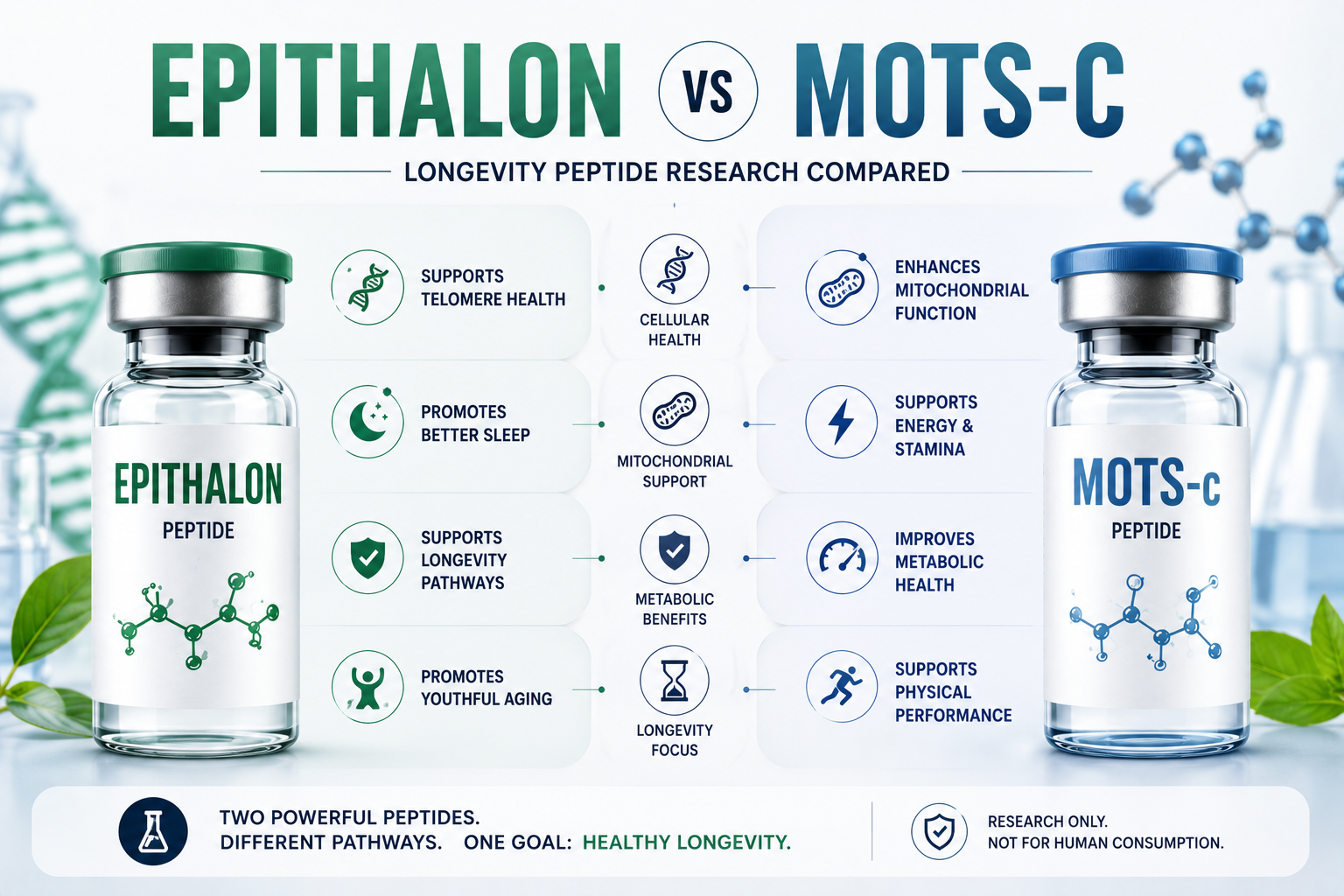
Epitalon vs MOTS-c compared for longevity research. Learn how these peptides differ in telomere biology, mitochondrial function, metabolism, aging, benefits, risks, and research evidence.
Aging research is exploring several peptides that may influence the biological processes linked to longevity and healthy aging. Two compounds that often attract attention are Epitalon and MOTS-c.
However, Epitalon and MOTS-c are not the same type of peptide. They are being studied for different biological effects.
Epitalon is mainly associated with telomeres, telomerase activity, and cellular aging. MOTS-c is a mitochondrial-derived peptide studied mainly for metabolism, mitochondrial signaling, stress responses, and physical function.
This makes the Epitalon vs MOTS-c comparison especially interesting for longevity research. Still, neither peptide has been proven to extend human lifespan.

What Is Epitalon?
Epitalon, also called Epithalon, is a short synthetic peptide made from four amino acids. It has been investigated in aging research for several decades.
Researchers have studied Epitalon in connection with telomeres, telomerase, oxidative stress, gene regulation, and other processes associated with aging.
One reason Epitalon continues to attract attention is its potential effect on telomere biology. Telomeres help protect the ends of chromosomes and generally become shorter as cells divide.
A 2025 laboratory study found that Epitalon increased telomere length in several human cell lines. The researchers linked the effect in normal cells with increased hTERT expression and telomerase activity.
However, this was a cell-based study, not a clinical trial. Therefore, the results cannot be used as proof that Epitalon extends human lifespan.
What Is MOTS-c?
MOTS-c is different from Epitalon because it is a mitochondrial-derived peptide. It contains 16 amino acids and is encoded by a short open reading frame within mitochondrial DNA.
Mitochondria are important for cellular energy production and metabolic signaling. As a result, researchers are interested in whether MOTS-c can influence metabolic health and age-related changes.
Studies suggest that MOTS-c may interact with pathways involved in energy metabolism, insulin sensitivity, stress adaptation, inflammation, and physical performance. One important pathway discussed in the research is the AMPK pathway.
Unlike Epitalon, MOTS-c research is therefore strongly connected to metabolic health and mitochondrial function.
Epitalon vs MOTS-c: Key Differences
The easiest way to understand Epitalon vs MOTS-c is to compare their main research areas.
| Feature | Epitalon | MOTS-c |
|---|---|---|
| Peptide type | Synthetic tetrapeptide | Mitochondrial-derived peptide |
| Main research area | Telomeres and cellular aging | Mitochondrial and metabolic health |
| Telomere research | Stronger focus | Not the primary focus |
| Metabolic research | Limited | Major research area |
| Stress response | Under investigation | Important research area |
| Exercise research | Limited | Growing area of interest |
| Human clinical evidence | Limited | Emerging |
| Proven lifespan extension | No | No |
This comparison shows that these peptides should not simply be ranked as “better” or “worse.”
Instead, they represent different approaches to longevity research.
Epitalon and Telomere Research
Telomeres are often discussed in aging research because they can shorten over time. This has led researchers to investigate whether maintaining telomere length could support healthy cellular aging.
Epitalon is particularly interesting in this area.
The 2025 study mentioned above reported telomere extension in normal human cell lines after Epitalon exposure. The researchers also observed increased telomerase activity.
These findings are scientifically interesting, but there is an important limitation.
Longer telomeres do not automatically mean longer human life.
Telomere biology is complex. In addition, telomerase is also involved in the biology of many cancer cells. Therefore, increasing telomerase activity should not automatically be interpreted as an anti-aging benefit.
More human research is needed before Epitalon can be considered a proven longevity intervention.
MOTS-c and Mitochondrial Health
MOTS-c takes a different route.
Research suggests that MOTS-c participates in communication between mitochondria and the nucleus. Under certain forms of cellular stress, MOTS-c can influence genes involved in stress adaptation.
Researchers have also studied MOTS-c in relation to:
- Energy metabolism
- Insulin sensitivity
- Mitochondrial function
- Exercise adaptation
- Muscle health
- Inflammation
- Age-related metabolic changes
This makes MOTS-c particularly interesting in the context of healthspan, which refers to the period of life spent in relatively good health.
Importantly, promising mechanisms are not the same as proven clinical benefits.
Is MOTS-c Moving Into Human Research?
Yes. This is one of the more important developments in current MOTS-c research.
A registered Phase 2a clinical trial is currently evaluating MOTS-c in adults with prediabetes and overweight or obesity. The study is designed to compare MOTS-c with placebo and assess insulin sensitivity, metabolic markers, and safety.
The trial plans to include 120 participants and uses a randomized, double-blind, placebo-controlled design. The treatment period is 12 weeks, followed by safety monitoring.
This does not prove that MOTS-c is an anti-aging treatment.
However, controlled human research is an important step because animal and laboratory findings cannot establish how effective or safe a peptide will be in people.
Which Is Better for Longevity?
There is currently no scientific evidence that proves one is better than the other for extending human lifespan.
Epitalon may be more interesting for researchers studying:
- Telomere biology
- Telomerase activity
- Cellular aging
- Gene regulation
- Aging-related cellular changes
MOTS-c may be more interesting for research involving:
- Mitochondrial signaling
- Energy metabolism
- Insulin sensitivity
- Muscle function
- Exercise adaptation
- Metabolic aging
Therefore, the answer depends on what aspect of longevity research you are interested in.
Epitalon vs MOTS-c for Healthspan
The concept of healthspan is becoming increasingly important in longevity research.
Living longer is not necessarily the same as living healthier for longer. Researchers are therefore interested in interventions that might help maintain metabolic health, physical function, and cellular resilience.
MOTS-c has a particularly interesting research profile in this area because studies have connected it with metabolism, exercise, and mitochondrial signaling.
Epitalon, meanwhile, remains more closely associated with cellular aging and telomere research.
Still, neither peptide has enough clinical evidence to claim that it improves human healthspan.
Safety and Research Limitations
Safety is one of the biggest issues when discussing experimental longevity peptides.
Online claims can make peptides such as Epitalon and MOTS-c sound more established than they actually are. That is misleading.
For both compounds, important questions remain about long-term safety, appropriate clinical use, dosing, product quality, and real-world effectiveness.
MOTS-c is currently being investigated in a controlled clinical trial, but that does not mean its effectiveness or safety has already been established.
Likewise, laboratory findings involving Epitalon do not establish that it is safe or effective as a human anti-aging treatment.
For this reason, research findings should be separated from marketing claims.
Can Epitalon and MOTS-c Be Used Together?
Because Epitalon and MOTS-c appear to affect different biological pathways, some longevity discussions consider combining them.
However, there is not enough clinical evidence to establish that combining the two provides additional longevity benefits.
Different mechanisms do not automatically mean that combining compounds is better. Without controlled human research, the benefits and risks of such combinations remain uncertain.
For research purposes, it is better to evaluate each compound based on the quality of its individual evidence.
Epitalon vs MOTS-c: The Bottom Line
The Epitalon vs MOTS-c comparison is really a comparison between two different areas of longevity research.
Epitalon is mainly studied for telomere biology, telomerase activity, and cellular aging. Recent laboratory research has added new interest to this area, but human evidence remains limited.
MOTS-c is mainly studied for mitochondrial signaling, metabolism, insulin sensitivity, stress adaptation, and physical function. Its research is now progressing into controlled human clinical testing.
So, which peptide is the winner?
There is no proven winner.
If future clinical studies confirm meaningful benefits, the role of these peptides may become clearer. For now, however, both should be viewed as investigational compounds rather than proven longevity treatments.
Frequently Asked Questions
Is Epitalon better than MOTS-c?
Not based on current evidence. The two peptides are being investigated for different biological pathways, and neither has been proven to extend human lifespan.
Does Epitalon increase telomere length?
A 2025 laboratory study found increased telomere length in human cell lines treated with Epitalon. However, this does not prove that the same effect produces longer or healthier lives in humans.
What is MOTS-c mainly studied for?
MOTS-c is mainly studied for mitochondrial signaling, metabolism, insulin sensitivity, stress adaptation, exercise, and age-related metabolic changes.
Is MOTS-c being studied in humans?
Yes. A Phase 2a randomized, double-blind, placebo-controlled trial is currently evaluating MOTS-c for insulin sensitivity in adults with prediabetes and overweight or obesity.
Can Epitalon or MOTS-c extend human lifespan?
There is currently no strong clinical evidence proving that either peptide extends human lifespan.
Research References
- PubMed: Epitalon and telomere length research
- PubMed: MOTS-c and aging research
- PubMed: MOTS-c, metabolism, stress, and aging
- ClinicalTrials.gov: Phase 2a MOTS-c clinical trial
