
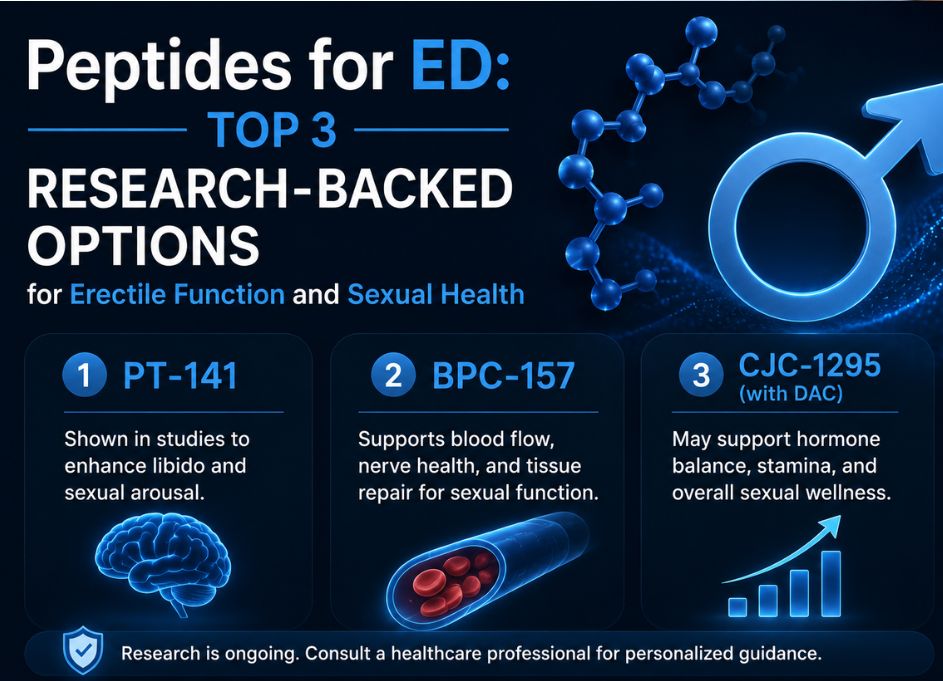
Erectile dysfunction (ED) is one of the most common sexual health concerns among men worldwide. It is estimated that hundreds of millions of men experience some degree of erectile dysfunction, with prevalence increasing with age. While medications such as Viagra (sildenafil) and Cialis (tadalafil) remain the standard treatment options, researchers are increasingly exploring peptide therapies as potential alternatives or complementary approaches.
Peptides are short chains of amino acids that act as signaling molecules within the body. Some peptides influence hormone production, blood flow, tissue repair, and neurological pathways involved in sexual arousal. As a result, several peptide therapies have gained attention for their potential role in improving erectile function and sexual health.
However, not all peptides promoted online for ED are supported by scientific evidence. Some have undergone clinical testing, while others are backed mainly by animal studies or anecdotal reports. This article examines the top three research-backed peptides currently associated with erectile dysfunction and sexual performance.
Comparison Table: Top Peptides for Erectile Dysfunction
| Peptide | Primary Mechanism | Research Support | Potential Benefits | Main Limitation |
|---|---|---|---|---|
| PT-141 (Bremelanotide) | Activates melanocortin receptors in the brain | Strong human clinical evidence | Increased libido, improved erections, enhanced arousal | Nausea and flushing may occur |
| Melanotan II | Stimulates melanocortin receptors | Moderate evidence | Enhanced sexual desire and erectile response | Skin darkening and more side effects |
| CJC-1295 | Increases growth hormone release | Limited direct ED evidence | Better vitality, recovery, and hormone support | Not a direct ED treatment |
PT-141 (Bremelanotide)
PT-141, also known as Bremelanotide, is widely regarded as the most promising peptide for erectile dysfunction based on current scientific evidence.
Unlike traditional ED medications that primarily improve blood flow, PT-141 works through the central nervous system. It activates melanocortin receptors in the brain that regulate sexual desire and arousal. This unique mechanism allows it to influence sexual function independently of vascular pathways.
Potential Benefits of PT-141
Research has shown that PT-141 may help:
- Improve erectile quality
- Increase sexual desire
- Enhance sexual arousal
- Support men who do not respond well to PDE5 inhibitors
- Improve overall sexual satisfaction
Several clinical trials have reported significant improvements in erectile responses compared with placebo treatments. Some studies have also found positive outcomes when PT-141 is used alongside traditional ED medications.
Possible Side Effects
Reported side effects include:
- Nausea
- Facial flushing
- Headache
- Fatigue
- Dizziness
Despite promising results, PT-141 remains an investigational treatment for erectile dysfunction in men and is not currently FDA-approved for this indication.
Melanotan II
Melanotan II was originally developed for its potential tanning effects. During research studies, investigators noticed that participants frequently reported increased sexual arousal and spontaneous erections.
These observations eventually led scientists to develop PT-141, which was designed to provide sexual benefits while minimizing unwanted pigmentation effects.
Potential Benefits of Melanotan II
Research suggests Melanotan II may:
- Increase libido
- Enhance sexual desire
- Improve erectile response
- Stimulate arousal through neurological pathways
Like PT-141, Melanotan II primarily works by influencing melanocortin receptors within the brain.
Limitations and Risks
While Melanotan II demonstrates potential sexual health benefits, it is associated with a greater likelihood of side effects, including:
- Skin darkening
- Facial flushing
- Nausea
- Changes in mole pigmentation
- Potential cardiovascular concerns
Because of these issues, many researchers view PT-141 as the safer and more targeted option.
CJC-1295
CJC-1295 differs significantly from PT-141 and Melanotan II. Rather than directly affecting sexual arousal pathways, it stimulates the release of growth hormone and increases insulin-like growth factor-1 (IGF-1) levels.
Growth hormone plays an important role in recovery, metabolism, muscle maintenance, and overall vitality. These factors can indirectly influence sexual health and performance.
Potential Benefits of CJC-1295
Potential benefits include:
- Increased energy levels
- Improved recovery
- Enhanced body composition
- Better sleep quality
- Hormonal optimization support
Does CJC-1295 Treat ED Directly?
Current evidence does not support CJC-1295 as a direct treatment for erectile dysfunction.
While improved hormone balance and overall health may positively affect sexual function, there is limited clinical evidence showing significant improvements in erectile performance specifically due to CJC-1295.
For this reason, it is generally considered a supportive peptide rather than a primary ED therapy.

What About BPC-157?
BPC-157 is frequently discussed in peptide communities as a potential solution for numerous health concerns, including erectile dysfunction.
However, current human research does not support strong claims regarding BPC-157 as an ED treatment. Most studies involving BPC-157 focus on tissue repair, injury recovery, wound healing, and inflammation reduction.
Although future research may reveal additional applications, there is currently insufficient evidence to recommend BPC-157 specifically for erectile dysfunction.
How Do Peptides Compare to Traditional ED Medications?
Traditional medications such as sildenafil and tadalafil have decades of clinical research supporting their effectiveness.
Peptides offer a different approach:
- Viagra and Cialis improve blood flow.
- PT-141 targets sexual arousal in the brain.
- CJC-1295 focuses on hormone-related wellness.
- Melanotan II influences both arousal and pigmentation pathways.
For men whose ED involves reduced libido or psychological arousal rather than blood-flow limitations, peptides such as PT-141 may eventually provide valuable alternatives.
However, traditional ED medications currently have substantially stronger evidence and wider regulatory approval.
Which Peptide Has the Strongest Evidence?
Based on available research, the ranking is relatively clear:
PT-141 (Bremelanotide)
- Strongest human clinical evidence
- Direct erectile dysfunction research
- Significant libido-enhancing effects
Melanotan II
- Demonstrated sexual effects
- Moderate research support
- Greater side-effect concerns
CJC-1295
- Indirect benefits through hormone support
- Limited direct ED evidence
Frequently Asked Questions (FAQs)
What is the best peptide for erectile dysfunction?
PT-141 (Bremelanotide) currently has the strongest scientific evidence for improving erectile function and sexual desire.
Is PT-141 better than Viagra?
They work differently. Viagra increases blood flow to the penis, while PT-141 targets arousal centers in the brain. Depending on the cause of ED, one may be more effective than the other.
Can peptides increase libido?
Yes. PT-141 and Melanotan II have demonstrated the ability to increase sexual desire and arousal in research studies.
Is PT-141 FDA-approved?
PT-141 is approved in certain contexts for female sexual dysfunction, but it is not currently FDA-approved for treating erectile dysfunction in men.
Are peptides safe for erectile dysfunction?
Safety data remains limited compared with traditional ED medications. Long-term studies are still needed for most peptide therapies.
Can BPC-157 help with ED?
There is currently insufficient human clinical evidence to support BPC-157 as an effective erectile dysfunction treatment.
How quickly does PT-141 work?
Research suggests that effects may begin within a few hours after administration, although response times vary among individuals.
Conclusion
Peptide therapies are generating considerable interest in the field of men’s sexual health. Among currently available options, PT-141 stands out as the most research-backed peptide for erectile dysfunction and libido enhancement. Its unique ability to target neurological pathways involved in sexual arousal makes it different from traditional ED medications.
Melanotan II also demonstrates sexual health benefits but carries a higher risk of side effects. Meanwhile, CJC-1295 may contribute to improved vitality and hormone balance, though it lacks strong evidence as a direct erectile dysfunction treatment.
As research continues, peptide-based therapies may play an increasingly important role in sexual medicine. For now, however, traditional ED medications remain the most thoroughly studied and widely accepted treatment options.
References
- https://pubmed.ncbi.nlm.nih.gov/12851303/
- https://pmc.ncbi.nlm.nih.gov/articles/PMC7752520/
- https://pmc.ncbi.nlm.nih.gov/articles/PMC2694735/
- https://auanews.net/issues/articles/2026/april-2026/peptides-for-sexual-dysfunction-what-clinicians-should-know
- https://www.boltpharmacy.co.uk/guide/is-there-a-peptide-for-erectile-dysfunction
