
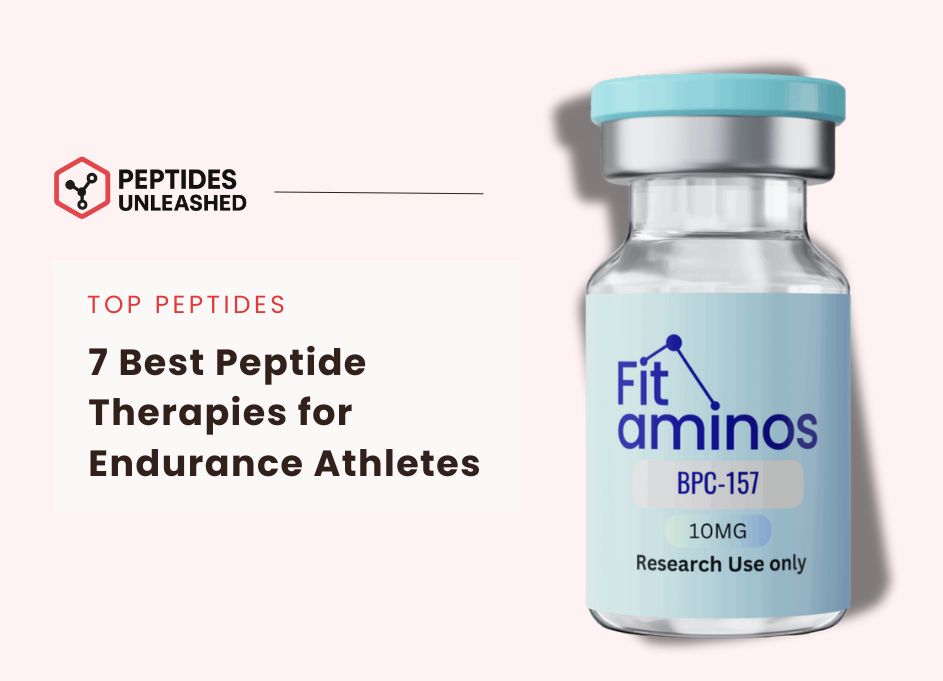
Peptide Therapies for Endurance Athletes—runners, cyclists, swimmers, and triathletes often push their physiology to the edge. Improving mitochondrial efficiency, increasing VO₂ max, accelerating recovery, and reducing inflammation are all key performance levers. When used legally and under proper medical supervision, peptide therapies can directly target these mechanisms to help endurance athletes perform harder, recover faster, and stay healthier.
Top 7 Peptide Therapies for Endurance Athletes
This guide by Peptides Unleashed, cuts through hype and focuses on seven peptides with the strongest physiological rationale and emerging research behind endurance enhancement.
BPC-157 – Accelerated Recovery & Soft Tissue Repair
BPC-157 isn’t a “performance enhancer” in the traditional sense. Its value comes from unusually fast healing of muscles, tendons, and ligaments; critical for athletes who train daily.
Physiological Effects
- Enhances angiogenesis (new blood vessel formation)
- Speeds repair of muscle microtears
- Reduces inflammation after intense sessions
Why It Matters for Endurance Athletes
High-volume training increases injury risk. Faster recovery = more consistent training cycles.
TB-500 (Thymosin Beta-4) – Mobility & Tissue Regeneration
TB-500 is another peptide centered on healing, not direct endurance enhancement. It improves cell migration and repair, especially around connective tissue.
Performance Relevance
- Helps prevent training interruptions
- Enhances joint and muscle fluidity
- Useful during high-mileage blocks
Paired with BPC-157, athletes often report reduced downtime and fewer overuse setbacks.

AOD-9604 – Fat Metabolism Support
While marketed for fat loss, AOD-9604’s value for endurance athletes lies in enhanced lipid oxidation.
Physiological Effects
- Supports fat mobilization
- May improve metabolic efficiency during long training sessions
Endurance athletes benefit from improved fat utilization because it spares glycogen, extending sustainable power output.
MOTS-c – Mitochondrial Performance & VO₂ Optimization
MOTS-c directly influences mitochondrial biogenesis and stress adaptation—exactly what endurance athletes need. Endurance-focused researchers typically run lower-frequency, longer-cycle protocols — see our MOTS-c peptide dosing reference for weight-based weekly totals.
Performance Benefits
- Increased exercise tolerance
- Improved glucose and fatty acid utilization
- Enhanced mitochondrial function
In emerging studies, MOTS-c increased endurance capacity in rodents and improved metabolic flexibility in humans.
SS-31 (Elamipretide) – Mitochondrial Protection During High Output
SS-31 is one of the few peptides designed specifically for mitochondrial protection. It helps maintain ATP output under stress and reduces oxidative damage.
Implications for Athletes
- Better sustained power
- Less mitochondrial fatigue
- Faster recovery of energy systems
Athletes who train in high heat or long-distance events may benefit most.
CJC-1295 + Ipamorelin – Growth Hormone Optimization for Recovery
This peptide combo enhances growth hormone (GH) release without spikes or suppression. Its impact is indirect but meaningful.
Benefits
- Improved muscle recovery
- Higher collagen synthesis
- Better sleep quality (major performance factor)
- Reduced soft-tissue breakdown
GH pathways also influence red blood cell production and endurance indirectly.
ARA-290 (Cibinetide) – Oxygen Delivery & Anti-Inflammatory Regulation
ARA-290 acts on the innate repair receptor, reducing inflammation while improving microvascular blood flow.
Performance Impact
- Enhanced oxygen transport
- Reduced post-training cytokine load
- Better tolerance for multi-day events
It may also help reduce neuropathic symptoms in cyclists who ride long hours.

Comparative Table: Key Benefits of Each Peptide
| Peptide | Primary Benefit | Main Performance Advantage | Best For |
|---|---|---|---|
| BPC-157 | Tissue repair, anti-inflammation | Faster injury recovery | Runners, cyclists, athletes with repeat overuse issues |
| TB-500 | Muscle & joint recovery | Reduced downtime | High-volume endurance athletes |
| AOD-9604 | Fat metabolism | Better fat oxidation | Long-distance athletes |
| MOTS-c | Mitochondrial efficiency | Increased endurance capacity | Elite endurance athletes |
| SS-31 | Mitochondrial protection | Sustained energy output | High-intensity training |
| CJC-1295 + Ipamorelin | GH optimization | Recovery + sleep | All endurance disciplines |
| ARA-290 | Oxygen delivery + anti-inflammation | Improved stamina | Cyclists, triathletes |
Safety Notes for Endurance Athletes
You want honesty, so here it is:
- Some peptides are still under research; not all are approved for clinical use.
- Illegal doping is a real risk—athletes in tested organizations must avoid WADA-prohibited substances.
- Misuse can screw up hormones, soft tissue, and metabolism.
- Always use medically supervised protocols.
If you’re chasing endurance gains without understanding your biomarkers, you’re playing with fire.
Final Thoughts (Peptide Therapies for Endurance Athletes)
Peptides aren’t shortcuts. They’re performance multipliers—but only when layered on top of disciplined training, smart fueling, and adequate sleep. Used correctly, they can support mitochondrial output, recovery speed, and training density.
Used carelessly, they’re a waste of money at best and a physiological disaster at worst.
References
A note: peptide research is evolving. These references focus on mitochondrial science, tissue repair, and GH physiology—core mechanisms relevant to the peptides discussed.
- Baar, K. (2014). Using molecular biology to maximize training adaptations. International Journal of Sports Nutrition and Exercise Metabolism. https://doi.org/10.1123/ijsnem.2014-0110
- Le Bourg, E. (2022). Mitochondrial peptides and aging: A review. Biogerontology. https://link.springer.com/article/10.1007/s10522-022-09947-w
- Rodgers, J. T., & Puigserver, P. (2007). Fasting-dependent regulation of mitochondrial oxidative phosphorylation. Cell Metabolism. https://www.cell.com/cell-metabolism/fulltext/S1550-4131(07)00253-5
- Reznick, R. M., & Shulman, G. I. (2006). The role of mitochondrial dysfunction in insulin resistance. Journal of Clinical Investigation. https://www.jci.org/articles/view/29124
- Wright, G. L. et al. (2018). Elamipretide improves mitochondrial function and exercise tolerance. Mitochondrion. https://doi.org/10.1016/j.mito.2018.06.001
- Kharitonenkov, A. (2020). Innate repair receptor activation and inflammation control. Frontiers in Immunology. https://www.frontiersin.org/articles/10.3389/fimmu.2020.00335/full
- Liu, C. et al. (2015). A mitochondrial-derived peptide (MOTS-c) promotes metabolic homeostasis. Cell Metabolism. https://www.cell.com/cell-metabolism/fulltext/S1550-4131(15)00363-5
Many endurance protocols pair these peptides with carnitine derivatives for sustained fatty-acid utilization. See our L-Carnitine dosage reference for stack-friendly dosing windows around training sessions.
