
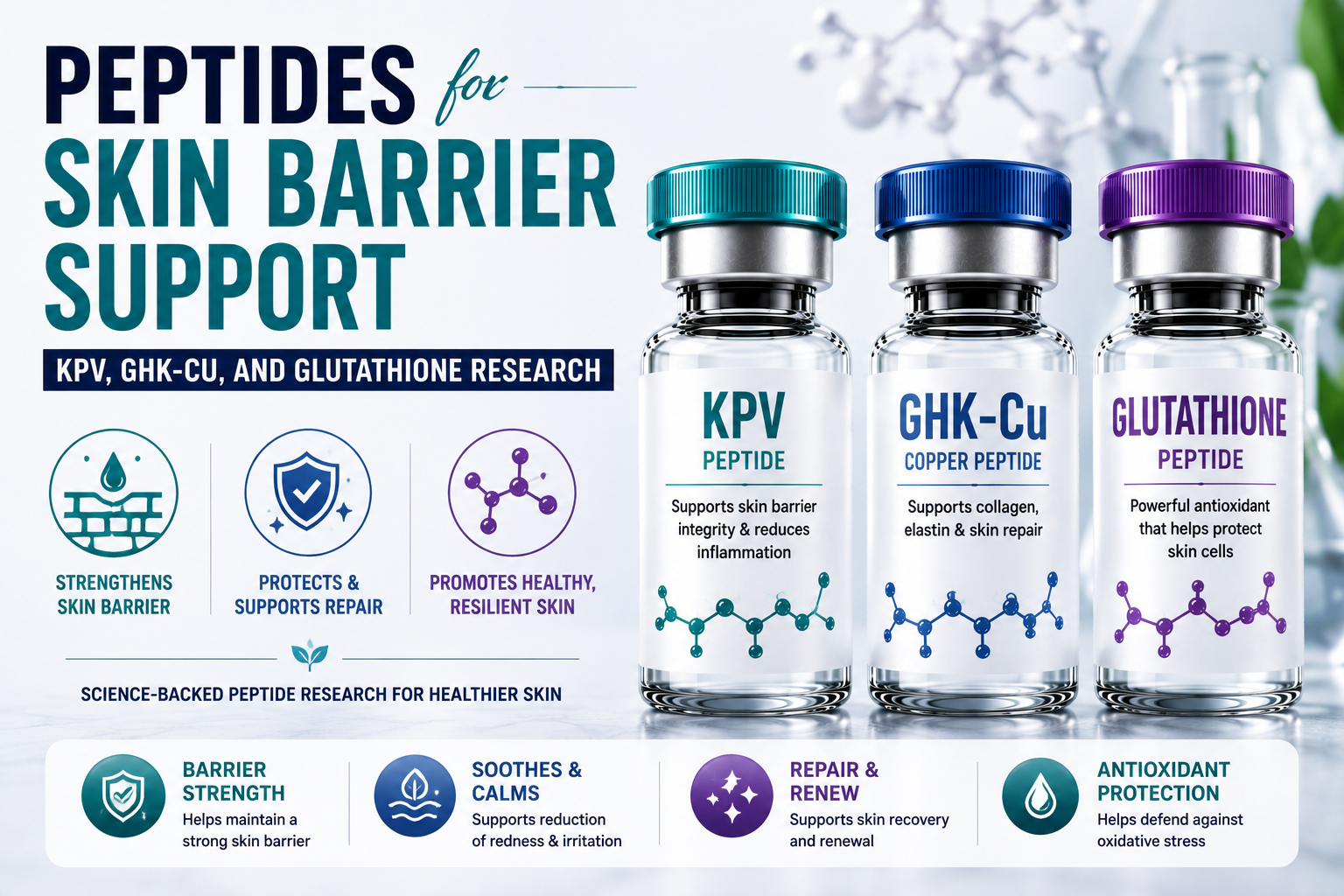
The skin barrier is one of the body’s most important protective systems. It helps keep moisture inside the skin while limiting the entry of irritants, allergens, microorganisms, and environmental pollutants. When the barrier becomes compromised, the skin may become dry, rough, sensitive, red, or more reactive to skincare products.
Interest in peptides for skin barrier support has grown because several peptides and peptide-related compounds are being studied for their potential roles in inflammation, tissue remodeling, collagen production, and oxidative stress. Among the compounds receiving attention are KPV, GHK-Cu, and glutathione.
However, the research needs to be interpreted carefully. These compounds are not interchangeable, and evidence that they directly restore the human skin barrier is still limited. Much of the research involves laboratory models, animal studies, cosmetic formulations, or outcomes related to skin appearance rather than direct measurements of barrier recovery.
Understanding the Skin Barrier
The skin barrier is more than simply the outer layer of the skin. The stratum corneum contains corneocytes surrounded by an organized lipid matrix, including ceramides, cholesterol, and fatty acids. Together, these structures help reduce excessive water loss and protect against external substances.
One important way researchers evaluate barrier function is transepidermal water loss (TEWL). TEWL measures the amount of water moving through the skin and escaping into the environment. Higher TEWL is generally associated with impaired barrier function.
A damaged barrier can be influenced by many factors, including excessive cleansing, harsh exfoliation, environmental exposure, inflammation, certain skin conditions, and inappropriate skincare routines. Pollution has also been associated with increased TEWL in research, potentially through oxidative damage.
Because barrier health depends heavily on lipids, hydration, and proper epidermal function, peptides should be viewed as potential supportive compounds rather than replacements for basic barrier-care strategies.
Why Are Peptides for Skin Barrier Research Interesting?
Peptides are short chains of amino acids that can participate in biological signaling. Depending on their structure, some peptides may influence cellular processes involved in inflammation, tissue repair, extracellular matrix production, or oxidative stress.
This makes peptides interesting in dermatology and cosmetic science. Researchers are investigating whether certain peptides can support processes associated with skin repair and resilience.
Still, there is an important distinction between biological activity and proven clinical effectiveness. A compound can produce an interesting response in cultured cells or animal tissue without demonstrating the same effect in people.
For skin-barrier research, this distinction is particularly important.
KPV and Skin Inflammation Research
KPV is a small tripeptide consisting of lysine, proline, and valine. It is derived from the C-terminal portion of alpha-melanocyte-stimulating hormone (α-MSH) and has attracted research interest because of its potential anti-inflammatory activity.
Inflammation can interfere with normal skin function and may contribute to barrier disruption in inflammatory skin conditions. Therefore, researchers have explored whether compounds with anti-inflammatory properties could indirectly support healthier barrier function.
The theoretical interest in KPV is not that it simply acts as a moisturizer. Instead, researchers are interested in whether reducing inflammatory signaling could create a more favorable environment for normal skin function and recovery.
That distinction matters. Evidence for KPV’s potential biological activity does not automatically demonstrate that topical or systemic KPV repairs a damaged human skin barrier.
GHK-Cu and Skin Repair
GHK-Cu is a copper complex of the naturally occurring tripeptide glycyl-L-histidyl-L-lysine. It is one of the more widely discussed peptide compounds in cosmetic skin research.
Earlier experimental research found that GHK-Cu could increase extracellular matrix accumulation in rat wound models. Researchers observed increases in collagen and other components associated with tissue repair.
More recent laboratory and ex-vivo research has continued to investigate GHK-Cu in relation to collagen. One 2023 study examined GHK-Cu combined with hyaluronic acid and reported increased expression of collagen I, IV, and VII in fibroblast experiments, with additional findings in an ex-vivo skin model
These findings help explain why GHK-Cu is frequently included in discussions about skin repair, firmness, and aging.
However, collagen stimulation is not the same thing as barrier restoration. The skin barrier depends strongly on the organization of the stratum corneum and its lipid components. Ceramides, for example, play an important role in preventing excessive water loss.
Therefore, GHK-Cu may be biologically relevant to skin remodeling while still requiring more research to establish a direct skin-barrier benefit.
Glutathione and Oxidative Stress
Glutathione is different from many compounds discussed in the peptide category because it is a naturally occurring tripeptide made from glutamate, cysteine, and glycine. It functions as an important intracellular antioxidant.
Oxidative stress is relevant to skin health because reactive oxygen species can contribute to cellular damage and may affect normal skin function. This has led researchers to investigate glutathione for several dermatological and cosmetic applications.
Human studies have mainly focused on pigmentation and skin appearance rather than directly proving restoration of the skin barrier. For example, a randomized, placebo-controlled trial investigated topical oxidized glutathione and reported changes in pigmentation and several measures of skin condition.
Another randomized clinical trial investigated oral glutathione and reported potential effects on skin pigmentation, although the evidence base remains limited and does not establish glutathione as a treatment for damaged skin barriers.
For this reason, glutathione is better described as an antioxidant-related compound with skin research interest rather than a proven skin-barrier repair peptide.
KPV vs. GHK-Cu vs. Glutathione
These three compounds have different research profiles.
| Compound | Main research interest | Potential relevance to skin barrier | Evidence limitations |
| KPV | Inflammatory signaling | May be indirectly relevant through inflammation control | Limited human skin-barrier evidence |
| GHK-Cu | Tissue remodeling and collagen | Potential support for skin repair processes | Much evidence is experimental or cosmetic |
| Glutathione | Antioxidant activity and pigmentation | Oxidative-stress pathway may be relevant | Direct barrier-repair evidence is limited |
The biggest mistake would be to treat these compounds as three versions of the same treatment. They work through different biological pathways and have different levels and types of evidence.
Peptides for Skin Barrier Support: What the Research Really Shows
The current research provides a reasonable scientific basis for continued investigation, but it does not justify strong claims that peptides can universally repair or rebuild the skin barrier.
GHK-Cu has evidence involving wound repair, extracellular matrix production, and collagen-related processes. KPV has attracted attention because of its potential relationship with inflammatory pathways. Glutathione has a well-established biological role in antioxidant defense and has been investigated in human skin studies.
But none of these facts alone proves that using these compounds will restore a damaged skin barrier in humans.
A stronger way to evaluate future research would be to look for controlled human studies that measure objective outcomes such as TEWL, stratum corneum hydration, irritation, and changes in barrier-related proteins or lipids.
This is important because visible improvements in smoothness or hydration do not necessarily mean that the underlying barrier has been restored.
What Actually Supports a Healthy Skin Barrier?
Peptides may be interesting additions to skincare research, but basic barrier care remains fundamental.
Moisturizers can support different components of the skin barrier. Occlusives reduce water loss, humectants attract water, and emollients help improve the physical properties of the stratum corneum. Research reviews also indicate that moisturization can improve TEWL and support barrier homeostasis
Ceramides are particularly relevant because they are important components of the lipid matrix between corneocytes. Research has examined ceramide-containing formulations for their ability to improve water retention and barrier function.
A practical barrier-focused routine generally means avoiding unnecessary irritation, using gentle cleansing, maintaining moisturization, and protecting the skin from environmental damage. Peptide products can be considered within that broader routine, but they should not be treated as a substitute for proven barrier-supportive skincare.
Are Peptides for Skin Barrier Support Worth Watching?
Yes, but with realistic expectations.
The concept of peptides for skin barrier support is scientifically interesting because peptides can influence biological processes involved in inflammation, tissue remodeling, collagen production, and cellular signaling. GHK-Cu currently has particularly interesting research around tissue repair and extracellular matrix activity, while KPV and glutathione offer different potential mechanisms.
The problem is that marketing often moves faster than clinical evidence.
A promising laboratory result is not equivalent to a proven dermatological treatment. Likewise, an ingredient that improves hydration, pigmentation, or skin appearance is not automatically repairing the barrier.
Future clinical studies should determine whether these compounds can consistently improve objective barrier measurements such as TEWL, hydration, lipid organization, and recovery following controlled barrier disruption.
Final Thoughts
Research into peptides for skin barrier support is developing, but the evidence should be separated from marketing claims. KPV, GHK-Cu, and glutathione each have different biological properties and research backgrounds.
GHK-Cu is associated with tissue remodeling and collagen-related research, KPV is being investigated for inflammatory pathways, and glutathione is primarily recognized for its antioxidant role. These mechanisms may be relevant to overall skin health, but direct evidence for skin-barrier restoration remains incomplete.
For now, the strongest approach is to view these compounds as research subjects rather than guaranteed solutions. A healthy skin barrier still depends on the fundamentals: adequate hydration, appropriate moisturization, intact epidermal lipids, reduced irritation, and protection from environmental stressors.
Medical Disclaimer
This article is for educational and research purposes only. KPV, GHK-Cu, and glutathione should not be assumed to be proven treatments for skin-barrier disorders. Evidence varies by compound, formulation, route of administration, and study design. Anyone with persistent irritation, dermatitis, wounds, or another skin condition should consult a qualified healthcare professional.
References
- Akdeniz, M., Gabriel, S., Lichterfeld-Kottner, A., Blume-Peytavi, U., & Kottner, J. (2018). Transepidermal water loss in healthy adults: A systematic review and meta-analysis. British Journal of Dermatology, 179(5), 1049–1055. PubMed – Transepidermal Water Loss Research
- Bouwstra, J. A., & Ponec, M. (2006). The skin barrier in healthy and diseased state. Biochimica et Biophysica Acta, 1758(12), 2080–2095. PubMed – Skin Barrier Research
- Pickart, L., & Margolina, A. (2018). Regenerative and protective actions of the GHK-Cu peptide in the light of the new gene data. International Journal of Molecular Sciences, 19(7), 1987. PubMed – GHK-Cu Research
- Jiang, F., Wu, Y., Liu, Z., Hong, M., & Huang, Y. (2023). Synergy of GHK-Cu and hyaluronic acid on collagen IV upregulation via fibroblast and ex-vivo skin tests. Journal of Cosmetic Dermatology, 22(9), 2598–2604. PubMed – GHK-Cu and Collagen Study
- Eberlein, B., et al. Research on KPV and melanocortin-related anti-inflammatory activity. PubMed – KPV Research
- Weschawalit, S., et al. (2017). Glutathione and its anti-aging and skin-brightening effects. Clinical, Cosmetic and Investigational Dermatology, 10, 147–153. PubMed – Glutathione Skin Research
- Choi, H. C., et al. (2010). Glutathione supplementation and skin pigmentation: A randomized, double-blind, placebo-controlled study. Journal of Dermatological Science, 50(2), 135–142. PubMed – Glutathione Clinical Study.
