
When you’re sourcing research-grade peptides, the marketplace is crowded and full of pitfalls. Vendors may claim high purity or GMP compliance without the documentation to back it up. For your experiments to deliver meaningful, reproducible results, you need more than marketing language, you need substance.
That’s where Good Manufacturing Practice (GMP) certification becomes critical. GMP isn’t just a badge; it’s a structured system that ensures products are consistently produced and controlled to meet defined quality standards.
In the context of peptides (especially those used for research or drug-development), GMP compliance signals:
- Controlled manufacturing processes (validated, documented)
- Traceability of each batch (raw materials, equipment, personnel)
- Independent testing and quality assurance of each lot
For example, one provider of peptide manufacturing explains that cGMP standards “help ensure the safety, quality and efficacy of pharmaceutical products” including peptides.
In short: If the vendor claims GMP but won’t clearly show how that standard applies to your product, you’re at risk of ending up with mislabeled, contaminated or non-pure peptides and that can wreck research outcomes or produce misleading data.
Understanding GMP Standards & Quality Control
Let’s unpack what GMP actually requires, and why each component matters for peptides.
What is GMP?
The World Health Organization (WHO) defines GMP as “that part of quality assurance which ensures that medicinal products are consistently produced and controlled to the quality standards appropriate to their intended use.” Meanwhile, the International Society for Pharmaceutical Engineering explains that GMP regulations in the U.S. require manufacturers of drugs, devices and some food items to take proactive steps to ensure their products are safe, pure and effective.
In other words: GMP isn’t optional it’s a regulatory baseline for anything being used in a research, clinical, or therapeutic context.
Key Elements of GMP for Peptides
Here’s what good-manufacturing practice looks like in practice, particularly for peptide products:
- Validated manufacturing processes: Every step (synthesis, purification, lyophilization, filling) must be defined, proven and documented.
- Raw material control: Amino acids, resins, solvents, reagents must be qualified, tested and tracked. Contaminated or incorrect raw materials compromise the final peptide.
- Equipment and facility maintenance: Cleanrooms, equipment calibration, environmental controls especially important for peptides sensitive to degradation or contamination.
- Documentation & traceability: Batch records, master production records, change control, deviation logs all must exist and be auditable.
- Quality control testing: Final peptides must be tested for identity, purity, potency (if applicable), stability and sterility (depending on use).
In effect, when a supplier says “GMP-certified,” you should expect mature systems behind that claim not just a certificate scanned and posted online.
The Role of Third-Party Testing and Certificates of Analysis (COAs)
Let me be blunt GMP certification is necessary, but not sufficient. What really distinguishes a reliable peptide vendor is transparent testing of each batch, and ideally by an independent third party.
Why third-party testing matters
A vendor may claim 99 % purity but if they’re generating the data themselves, with no independent oversight, you’re only getting half the story. Look for suppliers that allow or publish independent lab figures (HPLC, mass spec) and match them to each batch.
What a robust COA should include
For each peptide lot you buy, the Certificate of Analysis (COA) should show:
- Purity percentage (98 % or higher for many research-grade peptides)
- Molecular identity (correct mass, correct sequence)
- Contaminant checks (residual solvents, heavy metals, endotoxin if applicable)
- Batch number correspondence (so you know the COA is specific to your vial)
Top peptide vendors openly publish COAs or provide them upon request you should not have to chase them down after purchase.
Warning Signs of Unreliable Peptide Vendors
Let’s get real: You’ll save time and frustration by identifying major red flags before you purchase.
Avoid vendors who:
- Use vague language like “high purity” without actual percentage data
- Refuse to provide a batch-specific COA, or only supply generic documentation
- Provide dosage advice or claim human use (when product is labelled “For research use only”)
- Price well below market norms with no explanation
- Have weak or no customer support, poorly documented manufacturing, or unverifiable claims
If you skip vendor due diligence, you risk wasting time, money, and research integrity.
The Top 6 GMP-Compliant Research Peptide Companies
Here are six suppliers widely recognised for strong manufacturing protocols, transparency and quality control each with unique strengths.
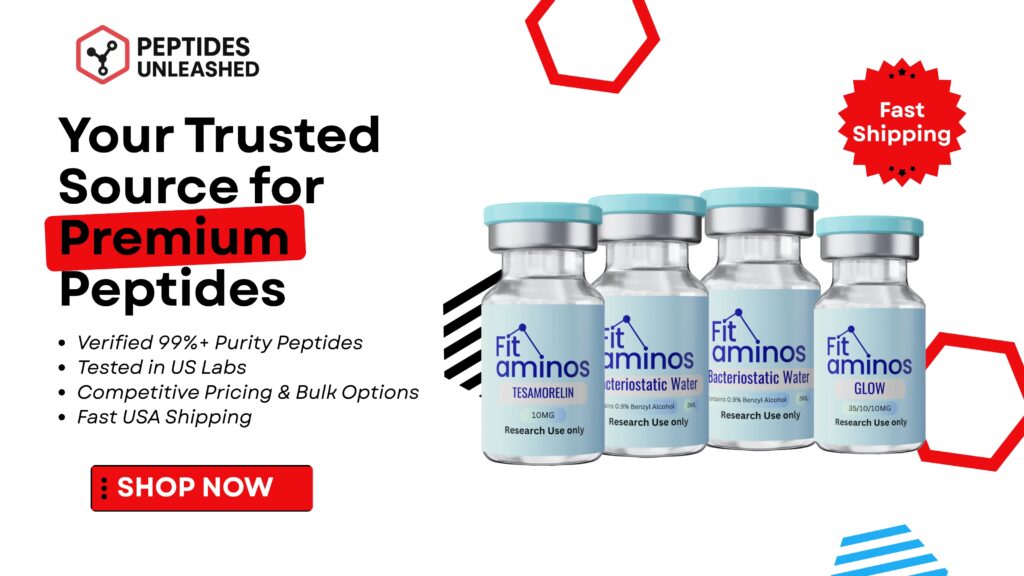
1. FitAminos: Best for premium, U.S.-based research peptides
Why they stand out:
- Purity reported at >99 % for many products
- Batch-specific COAs published online
- Filler-free formulations (maximising peptide content, minimal additives)
Ideal for: Researchers who prioritise traceability, domestic shipping and minimal risk.
2. Bachem Holding AG: Best for large-scale pharma and biotech
Why they stand out:
- Fully GMP/cGMP and ISO certified with global scale
- Portfolio spans R&D peptides to commercial therapeutic APIs
Ideal for: Organisations operating at regulation-intensive levels and needing end-to-end supply chain reliability.
3. GenScript: Best for complex custom synthesis
Why they stand out:
- Their facility meets ICH-Q7 / 21 CFR 210/211 standards for cGMP peptide production.
- Capable of difficult sequences, neoantigens, and custom modifications
Ideal for: Advanced R&D requiring custom synthesis beyond standard catalog peptides.
4. Thermo Fisher Scientific: Best for integrated biopharma supply
Why they stand out:
- FDA-registered facilities, global logistics
- Strong in upstream (peptides) and downstream supply of reagents.
Ideal for: Labs or companies wanting supply consolidation across multiple reagent types.
5. AnaSpec: Best for transitioning toward clinical-grade peptides
Why they stand out:
- cGMP cleanroom manufacturing audited for early-phase clinical peptide production
- Strong in modified peptides and detection reagents
Ideal for: Research groups bridging discovery to clinical or IND-enabling work.
6. Phoenix Pharmaceuticals: Best for academic research labs
Why they stand out
- Decades in academic supply, portfolio focused on research rather than commercialization
- Personalised customer service and custom assay support
Ideal for Academic labs with limited budgets but high standards of documentation and support.
Vendor Comparison at a Glance
| Supplier | GMP/ISO Certified | Third-Party Testing | COA Availability | Typical Purity | Core Market | Global Reach |
|---|---|---|---|---|---|---|
| FitAminos | Yes | Yes | Public | >99% | U.S. research, wellness | Limited international |
| Bachem Holding AG | Yes (audited GMP/cGMP) | Yes | Yes | 98–99%+ | Pharma/biotech | Global |
| GenScript | Yes (cGMP, ICH Q7, 21 CFR) | Yes | Yes | 95–99%+ | Custom synthesis | Global |
| Thermo Fisher Scientific | Yes (FDA, ISO 13485, etc.) | Yes | Yes | 98–99%+ | Biopharma, reagents | Global logistics |
| AnaSpec | Yes (cGMP, PSC) | Yes | Yes | >98% | Clinical-grade research | U.S. & Europe |
| Phoenix Pharmaceuticals | Yes | On request | Yes | >98% | Academic research | U.S., Europe, global |
How to Choose the Right Peptide Supplier
Here’s how you cut through the noise and pick a supplier that actually fits your project not just the vendor’s marketing.
1. Align with Your Research Goals
- Academic/basic research: Budget matters. Purity still matters. Look for suppliers with strong support, good documentation, and lower volume pricing.
- Drug discovery/preclinical: You might want custom sequences, reliable purity, good documentation but you may also accept slightly lower volumes.
- Clinical or commercial: You need full GMP/cGMP compliance, robust audit trails, scalability, regulatory support cost is less critical than risk mitigation.
2. Verify Certifications & Documentation
Don’t take a vendor’s word for it. Ask the following:
- Request a current GMP certificate showing facility and scope.
- Review sample COAs that correspond to actual batch numbers.
- Ask whether testing is truly independent or merely vendor-generated.
- Check whether the supplier’s systems cover your intended use (research vs. clinical).
3. Test Customer Support & Logistics
- Contact them with a technical question (e.g., about purification strategy for a modified peptide) and evaluate their response time and technical depth.
- Ask about shipment to your geography (Pakistan/UAE if that’s your target). Are there logistics issues?
- Read reviews or talk to peers who have ordered from them. The vendor’s responsiveness post-purchase matters as much as pre-sale claims.
4. Consider Long-Term Relationship and Value
- A supplier who treats you like a partner not just a one-time sale is valuable.
- Evaluate whether they offer consulting on peptide design, purification, storage, or custom formats.
- Think about future scale: if your research evolves into clinical or commercial phases, can you stay with the same vendor or will you switch? Switching adds risk.
Final Summary
If you’re serious about peptide work, here’s the bottom line: GMP certification is the starting line not the finish line. What really matters is what the supplier does after the certificate: testing each batch, documenting it, shipping reliably, and supporting you technically.
- For high-purity U.S. research use: consider FitAminos.
- For pharma-grade, large-scale supply: Bachem or Thermo Fisher.
- For advanced custom synthesis: GenScript or AnaSpec.
- For academic-budget research with strong support: Phoenix Pharmaceuticals.
No matter which vendor you choose, demand transparency. Ask for COAs. Confirm batch-specific data. Look for independent testing. And don’t let your choice be driven purely by price. Your research depends on the molecular accuracy of your peptides and that requires vendor integrity at every step.
